
What Are Critical Minerals and Why Are They Important?
Imagine driving an electric vehicle, charging your smartphone, using a laptop, or switching on electricity generated by a solar power plant. These everyday activities have something important in common: they depend on minerals extracted from the Earth.
While most people associate mining with coal, iron ore, gold and other traditional resources, a different group of minerals is becoming increasingly important to the global economy. These are known as critical minerals.
From lithium and cobalt used in batteries to rare earth elements required for advanced electric motors, these resources are essential to the technologies shaping our future. They support electric vehicle manufacturing, renewable energy generation, telecommunications, aerospace, defence equipment, medical technology and advanced electronics.
However, there is an important difference between an ordinary mineral resource and a critical mineral. A mineral becomes critical when it has significant economic or strategic importance and faces a potential risk of supply disruption.
For example, lithium is an important component of many rechargeable batteries. If its supply becomes restricted because of geopolitical tensions, trade restrictions, mining disruptions or limited processing capacity, the effects can spread across battery manufacturers, automobile companies and energy storage businesses.
This is why governments and industries worldwide are paying greater attention to mineral availability.
The growing demand for clean energy technologies has made this issue even more important. Electric vehicles, wind turbines, solar panels and battery storage systems require different minerals, sometimes in substantially larger quantities than traditional technologies.
At the same time, the extraction and processing of several minerals are concentrated in a limited number of countries. This creates challenges related to critical mineral supply chain security, international trade and economic independence.
India is also recognising the importance of these resources. In June 2023, the Ministry of Mines released a list of 30 critical minerals based on the country’s economic priorities, supply risks and future industrial requirements.
The development of domestic mining capabilities, international partnerships, mineral processing facilities and recycling systems is becoming an important part of India’s long-term economic and energy strategy.
But what exactly makes a mineral critical? Why are countries competing to secure these resources? Which industries depend on them? And how can India reduce its dependence on imported minerals?
Let’s explore the subject in detail.
1. What Are Critical Minerals? Understanding Their Meaning and Importance
Critical minerals are natural mineral resources that are essential for a country’s economic development, technological advancement and national security but may face significant supply-related risks.
In simple terms, these are minerals that a country cannot easily replace because important industries depend on them, while their availability may be affected by geographical concentration, geopolitical tensions, limited production capacity or other disruptions.
The word critical does not necessarily mean that a mineral is rare. Some critical minerals are relatively abundant in the Earth’s crust. Their importance comes from their applications, economic value and the difficulty of securing a reliable supply.
For example, copper is widely distributed around the world and has been mined for centuries. However, it remains strategically important because electricity networks, renewable energy systems, electric vehicles, construction and industrial machinery depend heavily on it.
Similarly, graphite is used in several industrial applications, but battery-grade graphite has become particularly important because it is widely used in lithium-ion battery anodes.
Therefore, criticality is not determined by scarcity alone.
The two major factors used to evaluate critical minerals are:
-
Economic Importance: How essential is the mineral to important industries, infrastructure, technology and economic development?
-
Supply Risk: How vulnerable is its availability because of concentrated production, import dependence, geopolitical instability, trade restrictions or processing limitations?
A mineral with high economic importance and high supply risk is generally considered particularly critical.
Why does every country have a different list of critical minerals?
There is no single universal list of critical minerals that applies equally to every country.
Each government evaluates mineral requirements according to its own industrial structure, technological priorities, national security needs and import dependence.
For instance, a country with a large electric vehicle manufacturing industry may place greater importance on lithium, nickel, cobalt and graphite.
Another country with significant semiconductor and electronics industries may pay particular attention to gallium, germanium, silicon and other specialised materials.
Countries with large defence industries may also prioritise minerals used in advanced alloys, radar systems, precision equipment and high-performance magnets.
This explains why critical mineral lists can differ between India, the United States, the European Union, Japan and other economies.
Critical minerals versus ordinary minerals
The distinction is based on strategic importance rather than simply the mineral’s physical characteristics.
|
Factor |
General mineral |
Critical mineral |
|---|---|---|
|
Economic role |
May support specific industries |
Essential to strategically important sectors |
|
Supply risk |
May have multiple supply options |
Can face significant supply vulnerabilities |
|
Substitution |
May be easier to replace |
Alternatives may be limited or expensive |
|
Government attention |
Depends on industry requirements |
Often receives strategic policy attention |
|
Security importance |
Varies |
Can directly affect national and economic security |
An important point is that a mineral can become more critical over time. Changes in technology, industrial demand, international relations and production capacity can change its strategic importance.
For example, the expansion of electric vehicles and grid-scale battery storage has increased the importance of lithium and graphite.
Why critical minerals are becoming increasingly valuable
Several long-term developments are increasing the importance of these resources.
First, the global economy is becoming more dependent on digital technologies. Smartphones, data centres, semiconductor manufacturing, communication networks and advanced computing equipment require specialised materials.
Second, countries are investing in renewable energy and electrification. Solar panels, wind turbines, electric vehicles and energy storage systems rely on different combinations of minerals.
Third, governments are prioritising national security and supply-chain resilience. The experience of international trade disruptions has demonstrated how dependence on a limited number of suppliers can create economic vulnerabilities.
Finally, industrial competition is increasing. Countries that can secure mineral resources and develop processing capabilities may gain advantages in advanced manufacturing.
Critical minerals are therefore not simply commodities traded in international markets. They are strategic resources that influence the future of industrial development.
2. Why Are Critical Minerals Important? Their Role in the Global Economy
The importance of critical minerals becomes easier to understand when we examine the industries that depend on them.
These resources are not limited to one sector. They form the foundation of several interconnected industries, from electricity generation and transportation to defence, telecommunications and advanced manufacturing.
Their economic importance is increasing because modern technologies require specialised materials with specific electrical, magnetic, chemical and physical properties.
Let’s look at the major areas where these minerals play an important role.
A. Energy Transition and Clean Energy Technologies
One of the biggest reasons behind the growing demand for critical minerals is the global energy transition.
Countries are gradually moving towards cleaner sources of energy to reduce greenhouse gas emissions, improve energy efficiency and decrease dependence on fossil fuels.
This transition requires significant investments in solar power, wind energy, electric vehicles, battery storage and electricity transmission infrastructure.
However, clean energy technologies cannot be manufactured without mineral resources.
Consider a solar power plant. Its photovoltaic modules depend on materials such as silicon, while its electrical infrastructure requires copper and aluminium. Certain advanced solar technologies also use specialised materials such as tellurium, gallium and indium.
Wind turbines require copper for electrical systems and, in some designs, rare earth elements for permanent magnets.
Electric vehicles depend on lithium, graphite, nickel, cobalt and other materials, depending on their battery chemistry.
The important point is that the transition towards clean energy does not eliminate the need for natural resources. Instead, it changes the types of resources required by the global economy.

Examples of critical minerals used in clean energy technologies:
|
Technology |
Important minerals |
Main application |
|---|---|---|
|
Solar panels |
Silicon, silver, gallium, indium, tellurium |
Photovoltaic electricity generation |
|
Wind turbines |
Copper, rare earth elements, nickel |
Electrical systems and permanent magnets |
|
Electric vehicles |
Lithium, graphite, nickel, cobalt, copper |
Batteries, motors and wiring |
|
Energy storage |
Lithium, vanadium, graphite, nickel |
Battery storage systems |
|
Hydrogen technologies |
Platinum group metals, nickel, zirconium |
Electrolysers and fuel cells |
|
Electricity networks |
Copper, aluminium, silicon |
Transmission and electrical equipment |
The demand for these materials depends on technology choices, manufacturing efficiency, battery chemistry and the pace of clean energy investment.
For example, not every electric vehicle battery contains cobalt or nickel. Lithium iron phosphate (LFP) batteries use lithium, iron and phosphate-based chemistry instead of nickel and cobalt. This is one reason why understanding battery technology is important when analysing future mineral demand.
B. Lithium-Ion Batteries and Electric Vehicle Manufacturing
Electric vehicles are among the most visible examples of how critical minerals are changing industrial demand.
Unlike conventional petrol and diesel vehicles, electric vehicles use battery systems to store electrical energy and power their motors.
Most modern electric cars use rechargeable lithium-ion batteries, although several alternative battery technologies are also under development.
These batteries require specialised materials to deliver energy density, charging performance, durability and safety.
Let’s understand the major minerals used in lithium-ion batteries.

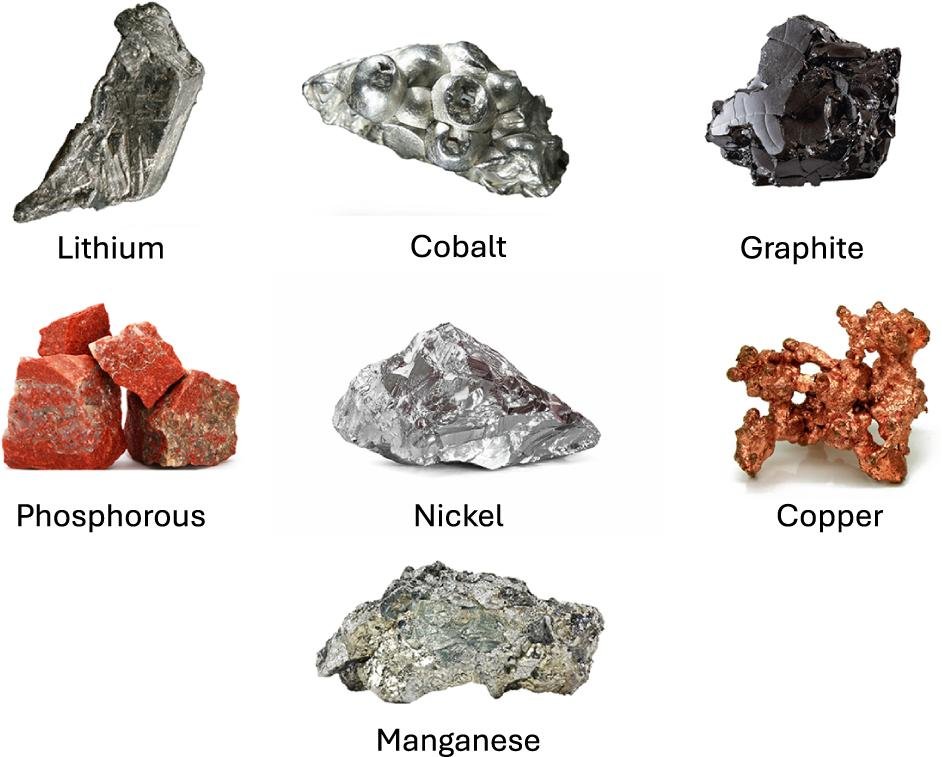
1. Lithium
Lithium is one of the most important materials in rechargeable battery technology.
It enables the movement of lithium ions between the battery’s electrodes during charging and discharging.
This process allows electrical energy to be stored and released when required.
Lithium is also used in portable electronics, energy storage systems and certain industrial applications.
2. Cobalt
Cobalt is used in several lithium-ion battery chemistries, particularly certain nickel-manganese-cobalt (NMC) and nickel-cobalt-aluminium (NCA) cathodes.
It can help improve battery stability and performance.
However, manufacturers are working to reduce cobalt content because of supply-chain, cost and responsible-sourcing concerns.
3. Nickel
Nickel is used in several high-energy-density battery cathodes.
It can help increase the amount of energy stored in a battery, making it useful for certain long-range electric vehicles.
Demand for battery-grade nickel is influenced by electric vehicle production, battery chemistry and the development of nickel processing facilities.
4. Graphite
Graphite is a major anode material in conventional lithium-ion batteries.
It provides a structure in which lithium ions can be stored during charging.
Both natural and synthetic graphite are used in battery manufacturing.
However, producing battery-grade graphite requires specialised processing, purification and sometimes coating.
5. Copper
Copper is widely used in battery current collectors, electric motors, cables, charging systems and vehicle electrical infrastructure.
Its excellent electrical conductivity makes it particularly useful for transferring electricity efficiently.
How EV manufacturing affects mineral demand
As electric vehicle production expands, manufacturers need reliable supplies of battery materials.
The demand does not come only from the batteries themselves. It also comes from charging stations, electricity distribution infrastructure, battery factories and associated industrial equipment.
For example, consider an automobile manufacturer planning to increase annual EV production.
It must secure battery cells, cathode materials, anode materials, copper components and other inputs before vehicles can be manufactured at scale.
If the supply of one important material becomes restricted, the entire production process may be affected.
This creates a direct connection between mineral availability and the automotive industry’s growth.
C. Electronics, Semiconductors and Telecommunications
Critical minerals are also essential to the digital economy.
Modern electronic devices contain numerous materials that perform specialised functions.
Smartphones, computers, data centres, fibre-optic networks, satellites and semiconductor equipment all depend on mineral-based components.
Some important examples include:
-
Gallium: Used in gallium nitride and gallium arsenide semiconductor technologies.
-
Germanium: Used in fibre-optic systems, infrared optics and specialised electronic applications.
-
Silicon: The foundation of conventional semiconductor manufacturing.
-
Tantalum: Used in capacitors found in electronic devices.
-
Indium: Used in indium tin oxide coatings for displays and other applications.
-
Rare Earth Elements: Used in specialised magnets, optical systems and electronic components.

The growth of artificial intelligence, cloud computing, 5G communication and high-performance computing is increasing the strategic importance of specialised materials.
For example, data centres require large quantities of electrical equipment, cooling infrastructure, servers and power distribution systems.
These technologies create demand across multiple mineral-dependent industries.
This also explains why critical minerals are important beyond the renewable energy sector.
D. Defence, Aerospace and National Security
Critical minerals have a direct relationship with national security.
Modern defence systems depend on advanced materials that can withstand high temperatures, pressure, corrosion and demanding operating conditions.
Aircraft engines, missiles, radar systems, satellites, communication equipment and precision-guided technologies require specialised metals and minerals.
For example:
-
Titanium is used in aircraft structures and high-performance components.
-
Tungsten is used in applications requiring exceptional hardness and heat resistance.
-
Rare earth elements are used in high-performance permanent magnets and specialised defence electronics.
-
Tantalum is used in certain electronic components.
-
Platinum group metals have applications in specialised industrial and electronic technologies.

The defence sector cannot always replace these materials easily because the performance requirements are highly specific.
Consequently, governments consider the availability of strategic minerals an important part of national security planning.
E. Agriculture, Healthcare and Other Industrial Applications
The importance of critical minerals extends into several industries that people may not immediately associate with mining.
Potash and phosphorus are important for fertiliser production and agricultural productivity.
Molybdenum is used in specialised steel alloys and industrial applications.
Zirconium has applications in ceramics, chemicals and nuclear technologies.
Platinum group metals are used in catalytic converters and various chemical processes.
Certain minerals are also important for medical imaging equipment, radiation-related technologies and specialised healthcare devices.
This broad range of applications explains why mineral supply disruptions can affect multiple sectors simultaneously.
3. Critical Mineral Supply Chain Security: Why Global Competition Is Increasing
Having mineral deposits is only one part of the equation.
A country also needs the technology, infrastructure, investment, skilled workforce and processing facilities required to transform raw mineral resources into usable industrial materials.
This is where critical mineral supply chain security becomes important.
A mineral supply chain generally involves several interconnected stages:
-
Geological exploration and identification of deposits.
-
Extraction through mining operations.
-
Beneficiation and concentration of mineral ores.
-
Refining and chemical processing.
-
Production of specialised industrial materials.
-
Manufacturing of components and finished products.
-
Recycling and recovery of materials after use.

A disruption at any stage can affect the availability of the final product.
For example, a country may have lithium deposits but lack the refining infrastructure required to produce battery-grade lithium chemicals.
In such a situation, it may still depend on other countries for processed materials.
This distinction between having mineral resources and controlling the processing value chain is extremely important.
Why are critical mineral supply chains vulnerable?
There are several reasons why global mineral supply chains face risks.
1. Geographical concentration
Some minerals are produced or processed in a relatively small number of countries.
When a large share of global supply comes from a limited geographical area, disruptions in those locations can have international consequences.
2. Geopolitical tensions
International conflicts, diplomatic disagreements, sanctions and trade restrictions can affect mineral exports.
Governments may introduce export controls to protect domestic industries or strengthen their strategic position.
3. Limited processing capacity
Mining a mineral does not automatically make it suitable for industrial use.
Many critical minerals require advanced chemical processing and refining.
If processing capacity is concentrated in a few countries, other economies may remain dependent even when they have access to raw materials.
4. Infrastructure limitations
Mining projects require roads, railways, electricity, water, transportation facilities and substantial capital investment.
Remote mineral deposits may remain commercially undeveloped because the supporting infrastructure is unavailable.
5. Environmental and regulatory challenges
Mining projects must address environmental protection, land rights, water availability, waste management and community concerns.
Regulatory delays and environmental restrictions can affect project timelines and production costs.
6. Long project development periods
Discovering a mineral deposit is only the beginning.
Exploration, feasibility studies, environmental approvals, financing, construction and commissioning can take many years.
As a result, supply cannot always respond quickly when demand increases.
Strategic minerals and geopolitical competition
Critical minerals have become an important part of international economic and geopolitical relationships.
Countries are increasingly competing to secure access to lithium, cobalt, nickel, graphite, rare earth elements and other strategic resources.
This competition is not limited to purchasing raw materials.
It includes acquiring overseas mining assets, developing domestic refining capacity, building partnerships with mineral-producing countries and investing in alternative technologies.

For example, Australia is an important supplier of lithium, while Chile and Argentina are significant countries in the lithium-producing landscape.
The Democratic Republic of the Congo is a major source of mined cobalt.
China has a significant position in the processing of several critical minerals and in the production of rare earth materials and battery supply-chain products.
These examples demonstrate how mining geography and processing capabilities influence international trade relationships.
Why processing is as important as mining
Consider a hypothetical country that discovers a large graphite deposit.
The deposit may contain substantial quantities of natural graphite, but battery manufacturers require material with specific purity, particle size and performance characteristics.
The raw mineral must therefore undergo beneficiation, purification, shaping and other processing stages.
If the country cannot perform these operations domestically, it may need to export raw material and import processed graphite.
This means that a country can possess valuable natural resources without capturing the full economic benefits of the supply chain.
For this reason, mineral-producing countries increasingly want to develop downstream processing industries.
How countries are reducing supply-chain risks
Governments and businesses are using several strategies to strengthen supply security.
|
Strategy |
Purpose |
|---|---|
|
Supplier diversification |
Reduce dependence on one country |
|
Domestic exploration |
Identify new mineral resources |
|
Local processing |
Build refining and manufacturing capabilities |
|
Overseas investment |
Secure access to international mineral assets |
|
Strategic stockpiles |
Maintain supplies during disruptions |
|
Recycling |
Recover materials from used products |
|
Research and development |
Develop alternative materials and technologies |
|
International partnerships |
Improve cooperation and investment |
The objective is not necessarily to become completely self-sufficient in every mineral.
Instead, countries want resilient supply chains with multiple sourcing options and sufficient domestic capabilities to manage unexpected disruptions.
4. India’s 30 Identified Critical Minerals: Opportunities, Challenges and Government Initiatives
India’s growing industrial economy, expanding renewable energy capacity, electric vehicle ambitions and advanced manufacturing requirements are increasing the importance of secure mineral supplies.
Recognising these requirements, the Ministry of Mines released its first comprehensive list of 30 critical minerals in June 2023.
The identification process considered economic importance and supply risk, along with India’s industrial priorities and future requirements.
The list includes minerals and mineral groups that support a wide range of sectors, including clean energy, electronics, defence, agriculture, telecommunications and manufacturing.
India’s official list of 30 critical minerals
The following list was announced by the Ministry of Mines on 24 July 2023.
|
No. |
Critical mineral |
Important applications |
|---|---|---|
|
1 |
Antimony |
Flame retardants, alloys and specialised electronics |
|
2 |
Beryllium |
Aerospace, defence and electronics |
|
3 |
Bismuth |
Pharmaceuticals, alloys and industrial applications |
|
4 |
Cobalt |
Batteries and superalloys |
|
5 |
Copper |
Electricity networks, EVs and construction |
|
6 |
Gallium |
Semiconductors and advanced electronics |
|
7 |
Germanium |
Fibre optics and infrared technologies |
|
8 |
Graphite |
Battery anodes and industrial applications |
|
9 |
Hafnium |
Aerospace and specialised electronics |
|
10 |
Indium |
Displays and semiconductor applications |
|
11 |
Lithium |
Rechargeable batteries and energy storage |
|
12 |
Molybdenum |
Steel alloys and industrial machinery |
|
13 |
Niobium |
High-strength steel and advanced materials |
|
14 |
Nickel |
Batteries, stainless steel and industrial alloys |
|
15 |
Platinum Group Elements (PGE) |
Catalysts, fuel cells and industrial processes |
|
16 |
Phosphorus |
Fertilisers and industrial chemicals |
|
17 |
Potash |
Agricultural fertilisers |
|
18 |
Rare Earth Elements (REEs) |
Permanent magnets, electronics and clean energy |
|
19 |
Rhenium |
High-temperature superalloys |
|
20 |
Silicon |
Semiconductors and solar panels |
|
21 |
Strontium |
Ceramics and specialised industrial applications |
|
22 |
Tantalum |
Electronic capacitors and advanced components |
|
23 |
Tellurium |
Thin-film solar cells and thermoelectric applications |
|
24 |
Tin |
Soldering and electronic manufacturing |
|
25 |
Titanium |
Aerospace, defence and medical applications |
|
26 |
Tungsten |
Cutting tools and high-temperature applications |
|
27 |
Vanadium |
Steel alloys and vanadium redox flow batteries |
|
28 |
Zirconium |
Ceramics and specialised nuclear applications |
|
29 |
Selenium |
Glass manufacturing and electronics |
|
30 |
Cadmium |
Certain battery technologies and solar applications |
Source: Ministry of Mines, Government of India, 2023. REE and PGE are mineral groups rather than individual elements.
It is worth understanding that this is India’s identified list of 30 critical mineral categories, not necessarily a list of only 30 individual chemical elements. Some entries, such as REEs and PGEs, represent groups containing multiple elements.
Why are these minerals important for India’s economy?
India’s industrial development depends on reliable supplies of raw materials.
The country is expanding its electric vehicle ecosystem, renewable energy installations, electronics manufacturing, infrastructure and defence production.
Each of these sectors requires different combinations of minerals.
For example, India’s EV manufacturing ambitions increase the importance of lithium, graphite, nickel, cobalt and copper.
The expansion of solar power increases demand for silicon, silver, copper and certain specialised materials.
Meanwhile, advanced electronics and semiconductor manufacturing require materials such as gallium, germanium, indium and tantalum.
These requirements create opportunities for domestic mining, mineral processing, research and industrial investment.
India’s dependence on imported critical minerals
One of India’s major challenges is the limited availability of commercially developed domestic resources for several critical minerals.
Even when mineral deposits exist, exploration, extraction and processing may not be sufficiently developed to meet industrial demand.
This can create dependence on imported raw materials and processed products.
Import dependence creates several risks:
-
International price fluctuations can increase manufacturing costs.
-
Export restrictions can affect the availability of essential materials.
-
Geopolitical tensions can interrupt supplies.
-
Currency fluctuations can make imported minerals more expensive.
-
Limited domestic processing capacity can increase dependence on foreign manufacturers.
Reducing these vulnerabilities requires a long-term strategy rather than relying on imports or short-term procurement decisions alone.
National Critical Mineral Mission (NCMM)

One of the most significant developments in India’s critical mineral strategy is the National Critical Mineral Mission (NCMM).
Approved by the Union Cabinet in January 2025, the mission aims to strengthen India’s critical mineral ecosystem across the entire value chain.
The government approved an expenditure of approximately ₹16,300 crore for the mission over seven years, from 2024–25 to 2030–31, alongside expected investments from public sector enterprises and other stakeholders.
Its objectives include:
-
Expanding domestic critical mineral exploration.
-
Increasing mining and extraction capabilities.
-
Developing mineral processing and refining infrastructure.
-
Promoting critical mineral recycling.
-
Acquiring overseas mineral assets.
-
Encouraging research, innovation and technological development.
-
Strengthening India’s long-term mineral supply security.
The Geological Survey of India (GSI) has been assigned a target of conducting 1,200 exploration projects during the mission period.
These initiatives demonstrate that the government is approaching critical minerals as a strategic industrial priority rather than treating them only as a mining-sector issue.
The role of Khanij Bidesh India Limited (KABIL)
India is also exploring opportunities beyond its geographical boundaries.
Khanij Bidesh India Limited (KABIL) is a joint venture established by three public sector enterprises:
-
National Aluminium Company Limited (NALCO)
-
Hindustan Copper Limited (HCL)
-
Mineral Exploration and Consultancy Limited (formerly MECL)
Its primary objective is to identify, acquire and develop overseas mineral assets to improve the security of critical mineral supplies for India.
The organisation has explored international opportunities, including engagement with mineral-rich countries such as Argentina and Australia.
This approach is important because developing domestic mineral resources can take considerable time.
Overseas asset acquisition and international partnerships can complement domestic exploration and help diversify supply sources.
Opportunities for Indian businesses and investors
The development of a stronger critical mineral ecosystem can create opportunities across multiple industries.
Mining and exploration: Companies with geological expertise, exploration technology and mining capabilities may benefit from increased domestic investment.
Mineral processing: Businesses that develop refining, purification and beneficiation capabilities can help address an important gap in the supply chain.
Battery manufacturing: Increased EV adoption can support investment in battery materials, cell manufacturing and battery components.
Recycling: Companies developing battery recycling and mineral recovery technologies can contribute to a more circular industrial economy.
Engineering and equipment: Mining machinery, laboratory equipment, processing systems and environmental monitoring technologies may see growing demand.
Research and development: Universities, technology companies and industrial research organisations can contribute to better extraction, processing and substitution methods.
However, these opportunities should not be confused with guaranteed investment returns. Mineral projects involve geological uncertainty, substantial capital expenditure, regulatory approvals, commodity price volatility and long development periods.
5. Mineral Exploration, Extraction, Processing and Recycling: Building a Sustainable Future
Securing critical minerals requires more than identifying mineral deposits.
Countries must develop an integrated system that covers the entire journey from geological exploration to the recovery of materials from used products.
This involves four interconnected areas: exploration, extraction, processing and recycling.
A. Mineral Exploration: Discovering Resources Beneath the Earth
Mineral exploration is the process of identifying and evaluating potential mineral deposits.
Before a mining company can extract a mineral commercially, it must understand the geological characteristics of the deposit.
Exploration involves geological mapping, geochemical sampling, geophysical surveys, drilling and laboratory analysis.

Modern exploration also uses satellite imagery, geographic information systems, remote sensing and advanced geological modelling.
For example, a geological survey may identify an area with the potential to contain lithium-bearing minerals.
Exploration teams then collect samples and conduct detailed investigations to determine the mineral concentration, deposit size and geological structure.
The next step is to evaluate whether the resource can be developed economically and responsibly.
Not every mineral discovery becomes a commercial mine.
Factors such as deposit quality, depth, infrastructure, extraction costs, environmental requirements and market prices influence the feasibility of a project.
B. Mineral Extraction: Turning Deposits into Raw Materials
Once a mineral deposit has been evaluated and the required approvals are obtained, extraction can begin.
The mining method depends on the geology, depth and physical characteristics of the deposit.
The two major mining approaches are:
Open-pit mining: Used when mineral deposits are relatively close to the Earth’s surface. Large quantities of soil and rock are removed to access the ore.
Underground mining: Used when valuable mineral deposits occur deeper below the surface. Tunnels and underground infrastructure are developed to reach the ore.

Some critical minerals are also obtained through alternative extraction methods.
For example, lithium can be extracted from hard-rock deposits or recovered from lithium-rich brines using different processing techniques.
Rare earth elements may be extracted from specialised mineral deposits containing minerals such as bastnäsite and monazite.
The extraction process must balance economic efficiency with environmental protection, occupational safety and responsible resource management.
C. Mineral Processing and Refining: Creating Industrial-Grade Materials
After extraction, the mined ore usually contains a mixture of valuable minerals and unwanted materials.
It must undergo processing before it can be used in manufacturing.
The processing stages vary depending on the mineral and its intended application.
Common processes include:
-
Crushing and grinding.
-
Screening and classification.
-
Gravity separation.
-
Magnetic separation.
-
Flotation.
-
Chemical treatment.
-
Smelting and refining.
-
Purification and material conversion.

For example, lithium-bearing ore may undergo crushing, concentration and chemical processing to produce lithium compounds suitable for battery manufacturing.
Similarly, nickel ore may require different metallurgical processes depending on whether it comes from sulphide or laterite deposits.
Rare earth processing can be particularly complex because separating individual rare earth elements requires specialised chemical processes.
This stage is strategically important because the availability of raw mineral deposits does not automatically guarantee access to refined materials.
Countries that develop advanced processing facilities can capture more value from their natural resources and reduce dependence on foreign suppliers.
D. Critical Mineral Recycling and Resource Recovery
Mining is not the only way to obtain critical minerals.
Used batteries, electronic devices, industrial equipment and other discarded products contain materials that can potentially be recovered and reused.
This process is known as critical mineral recycling and resource recovery.
It is becoming increasingly important because demand for certain minerals is rising while governments and industries are seeking more sustainable production methods.
Consider an electric vehicle battery.
After years of use, the battery may no longer meet the performance requirements of an automobile.
However, it may still contain valuable materials such as lithium, nickel, cobalt, copper and graphite.
Depending on its condition, the battery may be suitable for a second-life application, such as stationary energy storage, or it may be sent for recycling.
Recycling facilities can use different technologies to recover useful materials.
Mechanical recycling: Batteries are dismantled, crushed and separated into different material fractions.
Hydrometallurgical recycling: Chemical solutions are used to extract and recover selected metals.
Pyrometallurgical recycling: High-temperature processes are used to recover certain metals from battery materials.
The choice of method depends on battery chemistry, material value, process efficiency, environmental performance and recovery targets.
Why mineral recycling matters
Recycling provides several potential advantages.
1. Reduces dependence on newly mined resources
Recovered materials can supplement primary mineral production.
2. Supports supply-chain resilience
Domestic recycling facilities can provide an additional source of important industrial materials.
3. Reduces waste
Proper recycling helps prevent valuable materials from being lost in landfills or unmanaged waste streams.
4. Supports circular economy models
Materials can be recovered and reintroduced into manufacturing rather than being discarded after a single use.
5. Creates new business opportunities
Battery collection, testing, dismantling, recycling, material recovery and reuse can support new industrial activities.
However, recycling is not a complete replacement for mining.
Demand for many critical minerals is growing rapidly, and the volume of end-of-life batteries and products available for recycling depends on how much material was manufactured and sold in previous years.
This means that primary mining, processing and recycling will need to work together.
What is the future of critical mineral sustainability?
The future of mineral supply will depend on improving the efficiency of the entire value chain.
Manufacturers are researching battery chemistries that use fewer scarce materials. Mining companies are exploring technologies that can improve resource recovery. Recycling businesses are developing more efficient recovery processes.
Governments are also encouraging responsible sourcing, better waste management and stronger environmental standards.
The objective is to create a mineral economy that supports industrial growth without placing unnecessary pressure on natural resources and local communities.
Conclusion: Why Critical Minerals Will Shape the Future of the Global Economy
Critical minerals are becoming some of the most strategically important resources in the modern world.
They support technologies that are transforming transportation, electricity generation, electronics, telecommunications, healthcare, aerospace and defence.
From lithium-ion batteries and electric vehicle manufacturing to solar panels, wind turbines and semiconductor production, these resources are essential to the functioning of modern industries.
However, their growing importance also creates challenges.
Geographical concentration, import dependence, geopolitical competition, limited processing capacity and environmental concerns can make mineral supply chains vulnerable.
This is why critical mineral supply chain security is becoming a priority for governments and businesses.
For India, the identification of 30 critical minerals and the launch of the National Critical Mineral Mission represent important steps towards developing a stronger domestic mineral ecosystem.
But long-term success will depend on more than mining. India must strengthen mineral exploration, extraction, refining, international partnerships, technological innovation and critical mineral recycling.
The opportunity extends beyond the mining industry. Battery manufacturing, renewable energy, electronics, advanced materials and resource recovery can all benefit from a more reliable mineral supply chain.
As the global economy moves towards electrification, digitalisation and cleaner energy, the importance of these resources is likely to remain high.
The future of clean energy and advanced manufacturing will not depend only on the technologies we develop. It will also depend on whether we can responsibly secure the minerals needed to build them.
Understanding critical minerals today is therefore essential to understanding tomorrow’s economy.
FAQs: What Are Critical Minerals and Why Are They Important
1. What are critical minerals?
Critical minerals are natural resources that are essential for economic development, national security and important industrial applications but face potential supply risks. Examples include lithium, cobalt, nickel, graphite, copper and rare earth elements.
2. Why are critical minerals important?
Critical minerals are important because they support electric vehicles, renewable energy, electronics, semiconductors, telecommunications, defence and advanced manufacturing. Their availability directly influences industrial growth and technological development.
3. What is the difference between critical minerals and rare earth elements?
Critical minerals are a broader category of strategically important mineral resources. Rare earth elements are a specific group of 17 chemically similar elements that are used in permanent magnets, electronics, advanced manufacturing and other applications.
4. Which are the most important critical minerals?
Some particularly important critical minerals include lithium, cobalt, nickel, graphite, copper, gallium, germanium, tungsten, titanium and rare earth elements. Their importance varies according to industrial requirements and national priorities.
5. How many critical minerals has India identified?
India identified 30 critical minerals in June 2023 through the Ministry of Mines. The list includes 28 individual mineral elements and two groups: rare earth elements and platinum group elements.
6. What are India’s 30 identified critical minerals?
They are antimony, beryllium, bismuth, cobalt, copper, gallium, germanium, graphite, hafnium, indium, lithium, molybdenum, niobium, nickel, platinum group elements, phosphorus, potash, rare earth elements, rhenium, silicon, strontium, tantalum, tellurium, tin, titanium, tungsten, vanadium, zirconium, selenium and cadmium.
7. Why is lithium considered a critical mineral?
Lithium is important because it is widely used in rechargeable lithium-ion batteries. These batteries power electric vehicles, smartphones, laptops and stationary energy storage systems.
8. What is the role of cobalt in electric vehicle batteries?
Cobalt is used in several lithium-ion battery chemistries, including NMC and NCA. It helps support battery stability and performance, although manufacturers are developing alternatives and reducing cobalt requirements.
9. Why is nickel important for battery manufacturing?
Nickel is used in several high-energy-density lithium-ion battery cathodes. It can help increase battery energy density and is particularly relevant to certain long-range electric vehicle applications.
10. What is the importance of graphite in lithium-ion batteries?
Graphite is a major anode material in conventional lithium-ion batteries. It provides a structure that allows lithium ions to be stored during charging and released during discharging.
11. How are critical minerals used in renewable energy?
Critical minerals are used in solar panels, wind turbines, batteries, electricity networks and hydrogen technologies. Examples include silicon, copper, lithium, nickel, graphite and rare earth elements.
12. Which critical minerals are used in solar panels?
Silicon is the primary material used in conventional crystalline silicon solar cells. Other specialised solar technologies may use materials such as cadmium, tellurium, gallium and indium.
13. Which critical minerals are used in wind turbines?
Wind turbines require copper for electrical systems and, depending on their design, rare earth elements such as neodymium and dysprosium for permanent magnets.
14. Why are critical minerals important for national security?
Critical minerals are used in defence equipment, aircraft, communication systems, radar technologies and advanced electronics. Disruptions in their supply can affect military preparedness and strategic industrial capabilities.
15. What is critical mineral supply chain security?
Critical mineral supply chain security refers to ensuring reliable access to essential minerals and processed materials. It involves diversified suppliers, domestic exploration, mining, refining, recycling and international partnerships.
16. Why are critical minerals concentrated in a few countries?
Mineral deposits are distributed unevenly across the world. Furthermore, specialised mining technology, infrastructure, investment and processing facilities are concentrated in particular countries, creating geographical supply dependencies.
17. What is the difference between mineral mining and mineral processing?
Mining involves extracting mineral-bearing materials from the Earth. Processing involves separating, concentrating, refining and purifying those materials to produce industrially usable products.
18. What is the role of rare earth elements in clean energy?
Rare earth elements are used in permanent magnets found in certain electric vehicle motors and wind turbines. They also support specialised electronics and other advanced technologies.
19. What is the National Critical Mineral Mission?
The National Critical Mineral Mission is an Indian government initiative approved in January 2025 to strengthen domestic exploration, mining, processing, recycling and overseas acquisition of critical mineral assets.
20. What is Khanij Bidesh India Limited (KABIL)?
KABIL is a joint venture of Indian public sector enterprises established to identify and acquire overseas critical mineral assets. Its objective is to improve the availability of strategic minerals for India’s domestic industries.
21. Does India have lithium reserves?
India has identified lithium resources, including the well-known inferred lithium resource estimate announced for the Salal-Haimana area in Jammu and Kashmir in 2023. However, geological resources should not automatically be treated as economically recoverable reserves or commercially available production.
22. What are the major challenges in India’s critical mineral sector?
Major challenges include import dependence, limited domestic processing capacity, exploration uncertainty, infrastructure gaps, technological limitations, environmental clearances and international supply-chain concentration.
23. How does critical mineral recycling work?
Critical mineral recycling involves collecting and processing used batteries, electronic waste and industrial products to recover valuable materials such as lithium, cobalt, nickel, copper and other metals.
24. Can recycled minerals replace newly mined minerals?
Recycled minerals can supplement primary mining and reduce dependence on newly extracted resources. However, recycling alone cannot currently meet all growing mineral requirements because the availability of recyclable materials depends on existing product lifecycles.
25. What is the economic importance of critical minerals?
Critical minerals support industrial manufacturing, infrastructure development, technological innovation, energy security and international trade. Reliable supplies can help countries strengthen their manufacturing competitiveness.
26. How do geopolitical tensions affect critical mineral prices?
Geopolitical tensions can cause export restrictions, trade disruptions, supply shortages and changes in market expectations. These developments can increase price volatility in critical mineral markets.
27. What is the difference between strategic minerals and critical minerals?
Critical minerals are identified based on economic importance and supply vulnerability. Strategic minerals generally have particular importance for national security, defence or other government priorities. The terms can overlap, and their legal definitions differ between countries.
28. Why is copper considered a critical mineral?
Copper is essential for electricity transmission, renewable energy infrastructure, electric vehicles, industrial machinery and construction. Its excellent electrical conductivity makes it difficult to replace in many applications.
29. What is the future demand for critical minerals?
Demand is expected to be influenced by electric vehicle adoption, renewable energy investment, electricity network expansion, digital technologies and advanced manufacturing. Actual demand will depend on technology developments, substitution, recycling and government policies.
30. How can India become more self-reliant in critical minerals?
India can improve mineral self-reliance through domestic exploration, responsible mining, local refining, overseas mineral investments, international partnerships, battery recycling, technological research and stronger industrial infrastructure.
Also Read: Aluminium Price Worldwide Market Rates and Industrial Demand
