
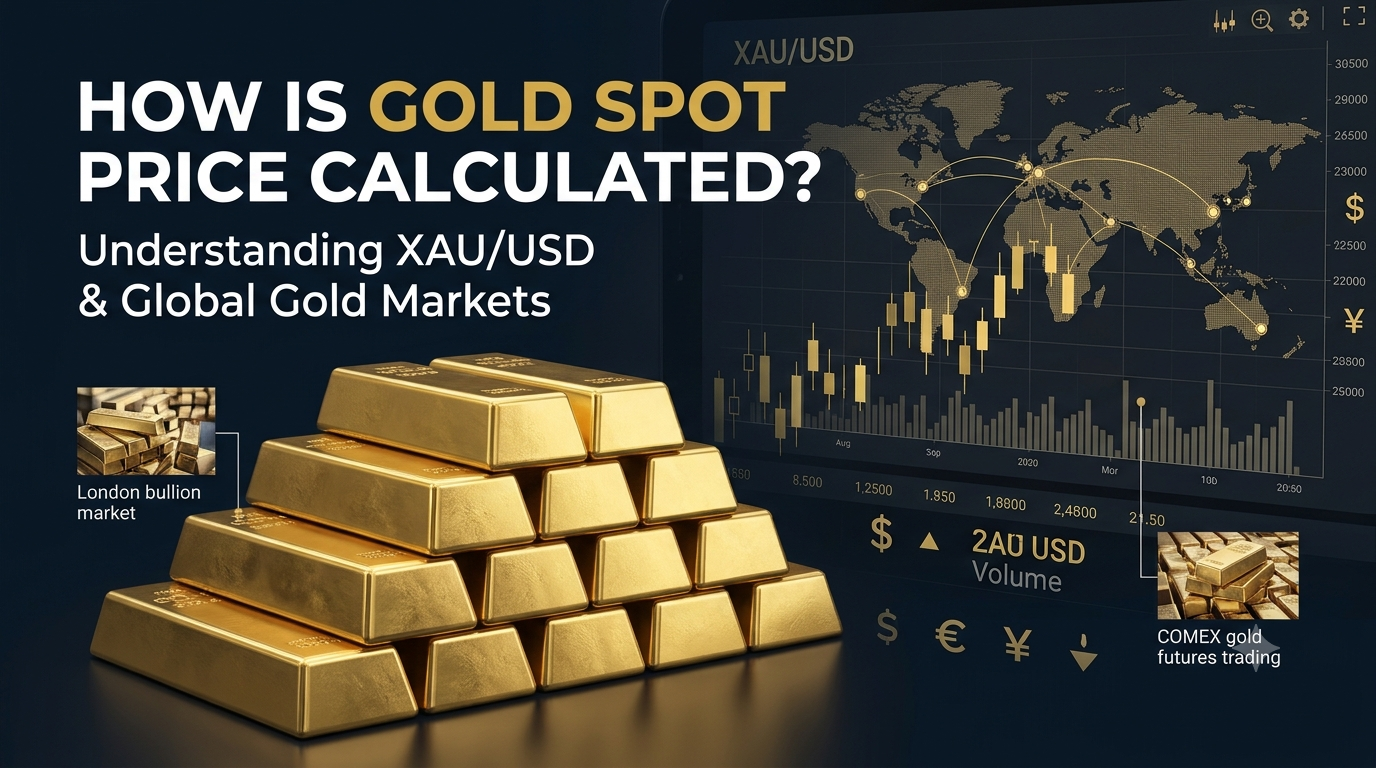
How Is the International Gold Spot Price Calculated? A Complete Guide
Gold has been considered one of the world’s most valuable assets for thousands of years. Today, it plays an important role in international trade, investment portfolios, central bank reserves, jewellery manufacturing and financial markets. Whether someone is purchasing a gold coin in India, investing in a gold ETF in the United States, or trading gold contracts in London, the price they see is closely connected to the international gold market.
But have you ever wondered who actually decides the international gold price? Is it determined by a particular bank, government, gold mining company or stock exchange? And how does the price displayed on financial websites change every few seconds?
The answer is more interesting than it might initially seem.
The international gold price is not fixed by a single organisation or individual. Instead, it develops through continuous buying and selling activity across global financial markets. Banks, bullion dealers, institutional investors, central banks, mining companies and other market participants influence the price through their trading decisions.
The International Gold Spot Price (XAU/USD) represents the prevailing market price of gold against the US dollar for near-term delivery. It is commonly quoted in US dollars per troy ounce and acts as an important reference for investors, traders, bullion dealers and jewellery markets worldwide.
Several financial mechanisms contribute to this price, including the London over-the-counter (OTC) market, the London Bullion Market Association (LBMA) Gold Price benchmark, gold futures trading on COMEX, currency movements and physical gold demand.
Understanding these mechanisms helps explain why gold prices move throughout the day and why the price quoted in one country may differ from the price in another.
In this guide, we will explore how international gold spot prices are calculated, how global trading activity influences price discovery, what role the LBMA plays, and how international prices eventually affect local gold rates.
1. What Is the International Gold Spot Price (XAU/USD)?
The international gold spot price is the current market quotation at which gold can be bought or sold for near-term delivery. It represents the value of gold in the global marketplace at a particular moment.
Financial websites, trading platforms and commodity market applications commonly display this price using the symbol XAU/USD.
To understand this quotation, it is useful to break it into two parts:
-
XAU: The internationally recognised financial market code representing one troy ounce of gold.
-
USD: The United States dollar, which is the currency used to express the gold price.
For example, if the XAU/USD quotation is $3,000, it means that one troy ounce of gold is being quoted at approximately US$3,000.
This is an illustrative example, not a live market quotation.
Unlike the price of a gold necklace in a jewellery shop, the international spot price generally represents the underlying value of investment-grade bullion before retail premiums, manufacturing charges, local taxes and dealer margins are added.
How Does the Gold Spot Market Work?
The international gold spot market operates through a global network of financial institutions and bullion dealers.
Unlike a traditional stock exchange, where buyers and sellers place orders through a central exchange, much of the wholesale gold market operates through direct transactions between financial institutions and market participants.
These transactions take place through the Over-the-Counter (OTC) Gold Market.
Major financial institutions, bullion banks, institutional investors and professional dealers continuously communicate buying and selling prices. They negotiate transactions based on prevailing market conditions, available liquidity and the quantity of gold involved.
For example, imagine that a bullion dealer wants to purchase 500 ounces of gold from a financial institution.
The institution provides a buying and selling quotation based on the current market. If both parties agree on the price and transaction terms, the trade is completed.
Thousands of similar transactions, together with orders and quotations from other market participants, contribute to the constantly changing international gold price.
The important point is that there is no single global shop or exchange where every gold transaction must take place.
Instead, multiple trading venues contribute to a connected international market.
What Does Spot Price Mean in Gold Trading?
The word “spot” refers to a transaction involving delivery on a near-term settlement basis rather than delivery at a distant future date.
In the wholesale gold market, standard spot transactions commonly follow a T+2 settlement convention. This generally means that delivery and payment take place two good business days after the transaction date, subject to applicable market calendars and settlement arrangements.
It is important to understand that spot price does not necessarily mean that physical gold changes hands immediately when a transaction is agreed.
For example, a financial institution may agree to purchase a specified quantity of gold today, but the actual settlement may occur according to the market’s established settlement schedule.
The spot price is therefore a market quotation for near-term gold transactions, not necessarily the price of an immediately delivered retail gold product.
Why Is Gold Quoted in US Dollars?
Gold is internationally traded and commonly priced in US dollars because the dollar plays a major role in global financial markets and international commodity trading.
Using a common currency makes it easier for international buyers and sellers to compare prices.
Consider two investors:
-
An investor in India wants to purchase gold.
-
An investor in the United Kingdom wants to purchase the same quantity of gold.
Both can refer to the international XAU/USD quotation as a common starting point. They then convert that value into their respective currencies using prevailing exchange rates.
This makes the international gold spot price an important reference for local gold markets.
2. How Is the International Gold Spot Price Actually Calculated?
The international gold spot price is primarily determined through market-based price discovery.
In simple terms, price discovery is the process through which buyers and sellers establish the price at which they are willing to trade.
There is no universal mathematical formula that independently calculates the live international spot price using a fixed list of economic indicators.
Instead, the price emerges from actual trading activity, competing quotations, market expectations and the relationship between buying and selling interest.
The Gold Spot Market Price Discovery process involves several interconnected elements.
A. Buying and Selling Activity in the Global Market
The most direct influence on gold prices comes from the buying and selling decisions of market participants.
When buyers are willing to purchase gold at higher prices, and sellers are prepared to accept those prices, the market quotation can move upwards.
Similarly, when selling pressure increases and buyers are unwilling to pay existing prices, quotations may move downwards.
For example:
Imagine the following hypothetical situation:
-
Several investment funds increase their gold purchases.
-
Bullion banks receive more buying orders from institutional clients.
-
Gold dealers begin raising their selling quotations.
-
Other market participants observe the increased demand and adjust their own prices.
As buying interest increases relative to available selling interest, the gold price may rise.
The reverse can happen when investors sell gold to raise cash or reduce their exposure to precious metals.
This process continues throughout the trading day.
B. The Role of the Over-the-Counter (OTC) Gold Market
The Over-the-Counter (OTC) Gold Market is one of the most important parts of international gold price discovery.
The London bullion market is a major centre for wholesale OTC gold trading.
Unlike exchange-based trading, OTC transactions are generally negotiated directly between counterparties. Banks and bullion dealers quote prices to clients and other institutions, and transactions are agreed according to mutually accepted terms.
The OTC market supports different types of gold transactions, including:
-
Spot gold transactions.
-
Gold forward contracts.
-
Gold swaps.
-
Gold options.
-
Unallocated gold accounts.
-
Physical bullion transactions.
For example, a central bank may want to purchase a substantial quantity of gold for its reserves. It may work with bullion banks or other authorised counterparties to arrange the transaction.
Similarly, a mining company may use gold-related financial contracts to manage the risk associated with future production.
These activities contribute to market liquidity and influence the prices quoted by dealers.
An important distinction is that the OTC market does not operate through one centralised order book displaying every transaction worldwide. Consequently, different market data providers may display slightly different spot quotations depending on their contributing sources, liquidity providers and bid-ask conventions.
Nevertheless, arbitrage and competition between market participants help keep quotations across major trading centres closely connected.
C. Understanding Gold Bid and Ask Prices (Bid-Ask Spread)
When checking an international gold trading platform, you will often notice two different prices:
-
Bid price: The price at which a dealer or market participant is willing to buy gold.
-
Ask price: The price at which a dealer or market participant is willing to sell gold.
The difference between these two quotations is called the Bid-Ask Spread.
For example, consider this hypothetical XAU/USD quotation:
| Price type | Example quotation |
|---|---|
| Bid price | $2,998 |
| Ask price | $3,002 |
| Bid-ask spread | $4 |
If a trader wants to sell gold immediately, they generally transact at the bid price.
If the trader wants to buy gold immediately, they generally transact at the ask price.
The difference of $4 represents the spread in this example.
Why does this difference exist?
Market makers and dealers provide liquidity by being prepared to buy and sell gold. They face transaction costs, market risks and potential price movements while holding positions.
The spread compensates them for providing this service and managing those risks.
The bid-ask spread can become narrower when market liquidity is strong and competition between dealers is high.
During periods of market uncertainty, sudden price movements or reduced liquidity, the spread may widen.
This is particularly important for traders because the displayed mid-market price is not necessarily the exact price at which they can execute a transaction.
A commonly used reference is the midpoint:
Mid-Market Price = (Bid Price + Ask Price) ÷ 2
Using the previous example:
($2,998 + $3,002) ÷ 2 = $3,000.
This gives a reference midpoint of $3,000 per troy ounce.
However, the midpoint is not necessarily an executable transaction price.
D. The London Bullion Market Association (LBMA) Gold Price Benchmark
Another important component of the international gold market is the London Bullion Market Association (LBMA) Gold Price Benchmark.
The LBMA is a leading organisation associated with the global wholesale precious metals market. Its gold price benchmark is widely used by financial institutions, bullion dealers, investors and other market participants.
However, it is important to understand that the LBMA does not independently decide the live spot price of gold.
The LBMA Gold Price is established through an electronic auction administered by ICE Benchmark Administration (IBA).
The benchmark is published twice each London business day:
-
LBMA Gold Price AM: Auction starts at 10:30 a.m. London time.
-
LBMA Gold Price PM: Auction starts at 3:00 p.m. London time.
Both auctions establish a benchmark in US dollars per troy ounce.
How Does the LBMA Gold Price Auction Work?
The auction is designed to establish a price at which buying and selling interest can be sufficiently balanced.
Here is a simplified explanation of the process:
Step 1: An Initial Price Is Proposed
The auction begins with a starting price determined by the auction mechanism in line with prevailing market conditions.
Step 2: Participants Submit Buying and Selling Orders
Direct auction participants enter their buying and selling interest.
These orders represent the quantity of gold they wish to purchase or sell at the proposed price.
Step 3: Buying and Selling Interest Is Compared
The auction system calculates the difference between the aggregate buying and selling interest.
If buying interest is significantly greater than selling interest, the auction is not yet balanced.
If selling interest is greater than buying interest, the price may need to adjust in the opposite direction.
Step 4: The Price Is Adjusted
The auction continues through successive rounds.
The price is adjusted according to market conditions, and participants can update their orders.
Step 5: The Auction Reaches an Acceptable Balance
When the net imbalance falls within the permitted threshold, the auction can conclude.
The resulting price becomes the official LBMA Gold Price benchmark for that auction.
This process provides a transparent and structured mechanism for establishing a widely recognised reference price.
Is the LBMA Gold Price the Same as the International Spot Price?
No. Although the two prices are closely related, they serve different purposes.
The international spot price reflects continuously changing market quotations and trading activity.
The LBMA Gold Price is a benchmark established through a specific auction process at two scheduled times each London business day.
For example, the international XAU/USD price may change several times between the morning and afternoon LBMA auctions.
Therefore, investors should not assume that the LBMA benchmark and a live trading platform quotation will always be identical.
Both are useful, but they represent different aspects of the international gold market.
3. What Factors Influence International Gold Prices?
Gold prices are affected by a combination of financial, economic, political and physical market conditions.
Some factors influence buying and selling activity directly, while others change investor expectations and trading behaviour.
Understanding these factors helps explain why the international gold spot price can increase or decrease even when there is no major change in gold production.
A. Gold Supply and Demand Dynamics
One of the fundamental drivers of gold prices is Gold Supply and Demand Dynamics.
The relationship between the quantity of gold available in the market and the quantity buyers want to purchase influences its market value.
Gold supply comes from several sources:
-
Newly mined gold.
-
Recycled gold.
-
Existing above-ground bullion stocks.
-
Gold released from private or institutional holdings.
Gold demand also comes from different sectors:
-
Jewellery manufacturing.
-
Investment demand.
-
Gold bars and coins.
-
Gold-backed exchange-traded funds.
-
Technology and industrial applications.
-
Central bank purchases.
When demand increases relative to available supply, prices may move higher.
When demand weakens or selling activity increases, prices may experience downward pressure.
For example, imagine that investors become concerned about a global economic slowdown.
They may increase purchases of gold bars, coins and gold-backed investment products.
At the same time, central banks may continue adding gold to their reserves.
If this additional demand is not matched by an equivalent increase in available supply, the market may experience upward price pressure.
However, supply and demand do not always produce immediate or predictable price movements. Expectations about future demand, existing inventories and financial market positioning also matter.
B. US Dollar Index (DXY) and Gold Price Correlation
Another important factor is the relationship between gold and the US dollar.
Gold is generally quoted internationally in US dollars, so changes in the dollar’s value can influence gold demand and pricing.
The US Dollar Index (DXY) measures the performance of the US dollar against a basket of major foreign currencies.
Gold and the dollar have often demonstrated an inverse relationship, although this relationship is not constant.
In many market situations:
-
A stronger US dollar can make gold more expensive for international buyers using other currencies.
-
A weaker US dollar can make gold relatively cheaper for those buyers.
-
Changes in currency purchasing power can influence investment demand for gold.
For example, imagine that the international gold price remains at $3,000 per troy ounce.
If the US dollar strengthens against the Indian rupee, an Indian buyer may need to spend more rupees to purchase the same dollar-valued quantity of gold.
Even without a change in the international dollar price, the local currency cost can increase.
However, the relationship between the DXY and gold is not a fixed mathematical rule.
Gold can sometimes rise alongside a strengthening dollar when geopolitical uncertainty, inflation concerns or institutional demand create strong buying interest.
Therefore, investors should analyse currency movements alongside other market indicators rather than treating the DXY as a standalone gold price predictor.
C. Inflation and Interest Rates
Inflation and interest rates are also important influences on international gold prices.
Gold is often viewed as a store of value because it is a physical asset that cannot be created by simply increasing the supply of currency.
When inflation rises and investors become concerned about the purchasing power of money, some may increase their exposure to gold.
However, inflation alone does not determine gold prices.
Real interest rates are particularly important.
Real interest rates represent the return on interest-bearing assets after accounting for inflation.
Gold does not normally generate interest income or dividends.
Therefore, when inflation-adjusted interest rates rise, investors may find interest-bearing assets more attractive relative to gold.
Conversely, when real interest rates decline, the opportunity cost of holding gold may decrease.
For example:
Suppose government bonds offer an attractive real return.
Some investors may prefer holding those bonds instead of gold.
If real returns decline substantially, gold may become more attractive as an alternative store of value.
This relationship is one reason why investors closely monitor central bank monetary policy and government bond yields.
D. Central Bank Gold Reserves and Institutional Gold Demand
Central banks are important participants in the international gold market.
Many central banks hold gold as part of their foreign exchange reserves because it provides diversification and is not a liability issued by another government.
The buying and selling decisions of central banks can influence the balance of demand in the global gold market.
The role of Central Bank Gold Reserves and Institutional Gold Demand extends beyond individual transactions.
Central bank purchases can signal confidence in gold as a reserve asset, particularly during periods of geopolitical uncertainty or concerns about international financial stability.
For example, if several central banks increase their gold reserves over an extended period, their combined purchases can contribute to overall investment demand.
Institutional investors also influence gold prices.
These include:
-
Pension funds.
-
Hedge funds.
-
Asset management companies.
-
Investment banks.
-
Commodity trading firms.
-
Gold-backed ETF investors.
Their decisions may involve large amounts of capital, meaning changes in institutional positioning can influence market liquidity and short-term price movements.
However, central bank purchases are only one part of the broader gold market. They do not independently determine the spot price.
E. Geopolitical Events and Global Economic Uncertainty
Gold is often considered a safe-haven asset.
This means investors may increase their gold exposure during periods of political instability, military conflict, financial market stress or uncertainty about the global economy.
For example, during a major international crisis, investors may become concerned about currencies, stock markets and government debt.
Some may respond by purchasing gold to diversify their portfolios.
Increased buying interest can contribute to higher gold prices.
On the other hand, when geopolitical tensions decline and investor confidence improves, some investors may reduce their gold holdings.
The relationship is not automatic, however.
Gold prices depend on how investors interpret an event, how markets have positioned themselves beforehand and whether other financial factors are moving in the opposite direction.
F. Gold Mining Production and Recycling
The physical supply of gold also matters.
Mining companies extract gold from deposits around the world. Their production levels, operating costs, investment decisions and mining disruptions affect the amount of newly produced gold entering the market.
Recycled gold provides another important source of supply.
For example, when gold prices rise significantly, some individuals may sell old jewellery, coins or bullion.
This additional recycled supply can partially offset increased demand.
However, gold mining supply generally responds slowly to price changes because developing and operating a mine requires substantial investment and time.
This means that a sudden increase in investment demand cannot always be matched immediately by new mining production.
4. How Do Gold Futures Contracts and COMEX Trading Affect the Spot Price?
The international gold market is not limited to physical bullion transactions and OTC trading.
Financial exchanges also play an important role in gold price discovery.
One of the most important centres for gold derivatives trading is COMEX, which operates as part of CME Group.
COMEX provides a regulated exchange environment where market participants can trade gold futures and options contracts.
A gold futures contract is an agreement to buy or sell a specified quantity of gold at a predetermined price for delivery or settlement at a future date, subject to the contract specifications.
These contracts allow investors, mining companies, bullion dealers and other market participants to manage price exposure.
What Is the Difference Between Spot Gold and Gold Futures?
Although spot gold and gold futures are closely connected, they are not the same thing.
| Feature | Gold Spot Price | Gold Futures Price |
|---|---|---|
| Meaning | Current market quotation for near-term delivery | Price agreed for a specified future contract |
| Market | Primarily OTC global market | Exchange-traded market such as COMEX |
| Settlement | Commonly near-term, often T+2 | According to contract delivery or settlement terms |
| Main use | Physical bullion pricing and near-term transactions | Hedging, speculation and price-risk management |
| Price drivers | Current market supply, demand and liquidity | Spot price, interest rates, storage and financing costs, expectations |
For example, suppose international spot gold trades at $3,000 per troy ounce.
A COMEX futures contract for delivery several months later might trade at $3,035.
The difference does not necessarily mean that the market expects gold to increase by exactly $35.
It may reflect financing costs, storage expenses, insurance, interest rates and other components associated with holding gold until the futures contract’s delivery date.
Understanding Contango and Backwardation
The relationship between spot and futures prices is often described using two market terms.
Contango occurs when futures prices are higher than the current spot price.
This is a common condition in gold markets because holding physical gold involves financing, storage and insurance costs.
Backwardation occurs when futures prices are lower than the current spot price.
This can occur under certain market conditions, including situations involving strong immediate demand for physical gold or unusual supply constraints.
These relationships are important because they explain why a futures quotation should not automatically be treated as the current international spot price.
How Does COMEX Influence International Gold Price Discovery?
COMEX trading contributes to gold price discovery because futures contracts are actively traded by institutional and professional market participants.
The exchange provides information about market expectations, buying interest, selling pressure and the cost of holding gold.
For example, if investors suddenly become concerned about inflation, they may increase their purchases of gold futures.
This additional buying interest can push futures prices higher.
Arbitrage traders may then compare futures prices with spot prices and related financing costs.
If the difference becomes inconsistent with prevailing market conditions, they may execute transactions designed to take advantage of the pricing difference.
These activities help connect futures and spot markets.
As a result, significant changes in COMEX gold trading can influence the quotations observed in the international spot market.
It is important to remember that COMEX does not independently set the global spot gold price.
Rather, it is one of the major trading venues contributing to the wider international price discovery process.
5. How Is Gold Price Quoted Per Troy Ounce and Converted Into Local Currency?
Once the international gold price has been established, it must be expressed in a standard unit of measurement.
In international precious metals trading, gold is commonly quoted in US dollars per troy ounce.
A troy ounce is different from the standard avoirdupois ounce used for everyday weight measurements.
One troy ounce equals approximately:
31.1034768 grams
This conversion is important when comparing international gold prices with local prices quoted per gram, 10 grams or kilogram.
How to Convert International Gold Price Into Price Per Gram
The basic calculation is straightforward.
Gold Price Per Gram = International Gold Price Per Troy Ounce ÷ 31.1034768
For example, assume the international gold spot price is $3,000 per troy ounce.
Calculation:
$3,000 ÷ 31.1034768 = approximately $96.45 per gram.
Therefore, the international spot value is approximately $96.45 per gram.
This is a hypothetical example used to demonstrate the conversion method.
How to Convert International Gold Price Into Indian Rupees
In India, gold is commonly priced in rupees per gram or per 10 grams.
Since international gold is quoted in US dollars, the USD/INR exchange rate must also be considered.
The basic conversion formula is:
Gold Price in INR Per Gram = (International Gold Price in USD Per Troy Ounce × USD/INR Exchange Rate) ÷ 31.1034768
Let’s understand this with an example.
Assume:
-
International gold spot price: $3,000 per troy ounce.
-
USD/INR exchange rate: ₹85 per US dollar.
-
Troy ounce conversion: 31.1034768 grams.
Calculation:
$3,000 × ₹85 = ₹2,55,000 per troy ounce.
₹2,55,000 ÷ 31.1034768 = approximately ₹8,198.24 per gram.
To calculate the international converted value per 10 grams:
₹8,198.24 × 10 = approximately ₹81,982.40.
This is the approximate converted international gold value before applicable Indian import duties, taxes, domestic premiums, logistics costs and other local adjustments.
Why Is the Indian Gold Price Different From the International Spot Price?
The price displayed by an international trading platform is not necessarily the same as the price quoted by an Indian jeweller.
Several additional components influence the domestic price.
1. Currency Exchange Rate
India imports a significant amount of its gold requirements.
Therefore, changes in the rupee-dollar exchange rate directly influence the domestic cost of imported gold.
If the rupee weakens against the dollar, imported gold generally becomes more expensive in rupee terms, assuming other factors remain unchanged.
2. Import Duty
Import duties increase the landed cost of imported gold.
The applicable rate can change depending on government policy, so buyers and businesses should verify the prevailing customs duty rather than relying on outdated figures.
3. Goods and Services Tax (GST)
Applicable GST affects the final amount paid by consumers.
For jewellery purchases, the treatment of GST can differ depending on whether the transaction involves bullion, jewellery or making charges.
4. Domestic Market Premium or Discount
Local demand and supply conditions can influence the difference between international converted prices and domestic bullion quotations.
For example, strong physical demand or limited availability can create a premium.
5. Transportation, Insurance and Other Costs
Imported bullion must be transported, insured, handled and distributed.
These expenses contribute to the cost of making gold available in the domestic market.
6. Jewellery Making Charges
Jewellery prices include manufacturing and design-related charges.
These depend on the type of jewellery, workmanship, retailer and product.
Consequently, the retail price of a gold necklace should not be compared directly with the international spot price without accounting for these additional costs.
Understanding the Indian Bullion Market
In India, the Indian Bullion and Jewellers Association (IBJA) publishes reference gold rates used by market participants.
Domestic gold prices are influenced by international bullion prices, exchange rates, import-related costs and local market conditions.
This is why gold prices in India may move differently from the dollar-denominated international quotation over certain periods.
For anyone tracking gold rates, it is important to distinguish between:
-
International spot gold price.
-
Converted international gold price in INR.
-
Domestic wholesale bullion price.
-
Retail jewellery price.
Each represents a different stage in the gold pricing process.
Conclusion
The international gold spot price is not decided by one bank, government or financial exchange. It develops through a connected global marketplace where buyers and sellers continuously trade gold and gold-related financial instruments.
The International Gold Spot Price (XAU/USD) reflects prevailing market quotations, particularly across the global OTC bullion market. The Gold Spot Market Price Discovery process is influenced by buying and selling activity, bid-ask spreads, institutional transactions and arbitrage between different trading venues.
The LBMA Gold Price Benchmark provides an important twice-daily reference through an electronic auction administered by ICE Benchmark Administration. Meanwhile, COMEX gold futures contracts contribute additional information about market expectations and the relationship between current and future gold prices.
Economic factors such as inflation, real interest rates, the US Dollar Index, central bank reserves, geopolitical uncertainty and physical gold demand also influence market behaviour.
Finally, the international gold quotation is converted from US dollars per troy ounce into local currency and measurement units. Additional factors such as exchange rates, import duties, taxes and domestic market premiums determine the final price in countries such as India.
The next time you see gold prices moving on a financial website, remember that the number represents much more than the value of a precious metal. It reflects the combined decisions, expectations and trading activities of participants across the global financial system.
Want to understand gold prices more accurately? Follow international XAU/USD movements, monitor the USD/INR exchange rate, compare LBMA benchmark prices and track important global market developments. Understanding these interconnected factors can help you make better-informed decisions when analysing gold prices, whether for investment, trading or jewellery purchases.
Frequently Asked Questions (FAQs)
1. What is the international gold spot price?
The international gold spot price is the prevailing market price at which gold is quoted for near-term delivery. It is commonly expressed in US dollars per troy ounce using the XAU/USD symbol.
2. How is the international gold spot price calculated?
The international gold spot price is determined through global buying and selling activity across OTC bullion markets and other trading venues. Supply, demand, institutional transactions, currency movements and market expectations influence the price.
3. Who decides the international gold price?
No single organisation or government independently decides the international gold price. It develops through trading activity involving bullion banks, financial institutions, dealers, investors and other market participants.
4. What does XAU/USD mean in gold trading?
XAU/USD is the financial market symbol representing the price of one troy ounce of gold in US dollars. XAU represents gold, while USD represents the United States dollar.
5. Why is gold measured in troy ounces?
The precious metals industry traditionally uses troy ounces as its standard measurement unit. One troy ounce equals approximately 31.1034768 grams, making it different from the standard ounce used for everyday goods.
6. What is the LBMA Gold Price benchmark?
The LBMA Gold Price is an internationally recognised benchmark established through electronic auctions administered by ICE Benchmark Administration. It provides a reference price for wholesale gold transactions.
7. How many times is the LBMA Gold Price published?
The LBMA Gold Price is established twice each London business day. The morning auction starts at 10:30 a.m. London time, while the afternoon auction starts at 3:00 p.m. London time.
8. Is the LBMA Gold Price the same as the spot gold price?
No. The LBMA Gold Price is a benchmark established through scheduled auctions, whereas the international spot price reflects continuously changing market quotations and trading activity.
9. What is the OTC gold market?
The Over-the-Counter gold market is a decentralised trading network where buyers and sellers negotiate gold transactions directly. It includes bullion banks, financial institutions, dealers and institutional investors.
10. How does gold price discovery work?
Gold price discovery is the process through which buyers and sellers establish market prices. Their orders, quotations, executed transactions and changing market expectations influence the prevailing gold price.
11. What are gold bid and ask prices?
The bid price is the price at which a dealer is willing to buy gold, while the ask price is the price at which the dealer is willing to sell it.
12. What is the bid-ask spread in gold trading?
The bid-ask spread is the difference between the buying and selling quotations of gold. It represents part of the transaction cost and can change depending on market liquidity and volatility.
13. Why does the international gold price change every few seconds?
Gold prices change because global trading activity is continuous across major financial markets. New orders, economic announcements, currency movements and changes in investor sentiment can quickly influence market quotations.
14. How does the US dollar affect international gold prices?
Gold is commonly quoted in US dollars. A stronger dollar can make gold more expensive for buyers using other currencies, potentially reducing demand. A weaker dollar can have the opposite effect, although this relationship is not always consistent.
15. What is the US Dollar Index (DXY)?
The US Dollar Index measures the value of the US dollar against a basket of major international currencies. Gold traders monitor it because changes in dollar strength can influence international gold prices.
16. Does inflation increase gold prices?
Inflation can increase demand for gold when investors seek to protect their purchasing power. However, gold prices also depend on real interest rates, currency movements, investment demand and other market conditions.
17. How do interest rates affect gold prices?
Higher real interest rates can make interest-bearing investments more attractive compared with gold, which does not generate interest income. Lower real interest rates may reduce the opportunity cost of holding gold.
18. What is the relationship between gold spot prices and COMEX?
COMEX is a major exchange for gold futures trading. Its futures prices contribute to international price discovery and influence spot market quotations through arbitrage and connections between the two markets.
19. What is the difference between gold spot and futures prices?
The spot price represents the current market quotation for near-term delivery, while a futures price relates to a contract for a specified future delivery or settlement date.
20. Why are gold futures sometimes more expensive than spot gold?
Gold futures may trade above spot prices because of financing, storage, insurance and other carrying costs. This market condition is known as contango.
21. What is gold backwardation?
Backwardation occurs when gold futures prices trade below the current spot price. It can arise under certain market conditions, including unusually strong immediate demand for physical gold.
22. How do central banks influence international gold prices?
Central banks influence gold demand through their purchasing and selling decisions. Large-scale purchases can contribute to investment demand and affect market sentiment, particularly during periods of economic uncertainty.
23. Does gold mining production affect international gold prices?
Yes. Newly mined gold contributes to global supply. Changes in production, mining costs and operational disruptions can influence the balance between gold supply and demand.
24. How does recycled gold affect the gold market?
Recycled gold adds previously owned jewellery, coins and bullion back into the market. Higher gold prices can encourage more people to sell existing gold, potentially increasing available supply.
25. How is the international gold price converted into Indian rupees?
The international gold price in US dollars per troy ounce is multiplied by the USD/INR exchange rate and divided by 31.1034768 to calculate the approximate rupee value per gram.
26. Why is the gold price in India different from the international gold price?
Indian gold prices include currency conversion, import duties, applicable taxes, transportation costs and domestic market premiums. Jewellery prices may also include making charges and retailer margins.
27. Does the USD/INR exchange rate affect Indian gold prices?
Yes. When the Indian rupee weakens against the US dollar, imported gold generally becomes more expensive in rupee terms, assuming other market conditions remain unchanged.
28. What is the difference between international gold prices and retail jewellery prices?
International gold prices represent the underlying wholesale market value of gold. Retail jewellery prices additionally include purity adjustments, making charges, applicable taxes and retailer margins.
29. Can geopolitical events influence international gold prices?
Yes. Wars, political instability, financial crises and global economic uncertainty can increase safe-haven demand for gold. However, the actual price reaction depends on broader market conditions.
30. Where can I check the international gold spot price?
You can monitor international gold spot prices through financial market platforms, bullion dealers and precious metals market data providers. Look for the XAU/USD quotation and check whether the displayed figure represents the bid, ask or midpoint price.
Also Read: How to Check Live Commodity Prices Around the World
