

How China Influences Global Critical Mineral Supply Chains
1. Why China Holds a Powerful Position in the Global Mineral Economy
Imagine a company planning to manufacture electric vehicles, a technology manufacturer developing advanced semiconductors, or a country investing billions of dollars in renewable energy infrastructure.
All three may have different business objectives, but they share one important requirement: access to critical minerals.
Lithium, cobalt, graphite, nickel, copper and rare earth elements are essential materials used in modern batteries, electric motors, solar technologies, electronics, telecommunications and defence equipment.
However, there is a major challenge in the global mineral economy. Although these resources are mined in different parts of the world, a substantial portion of their processing and refining capacity is concentrated in China.
This gives China a particularly influential position in the international supply chain.
The country’s importance does not come only from the minerals extracted within its borders. Its influence extends to refining raw materials, manufacturing battery components, producing permanent magnets, developing industrial technologies and investing in overseas mining projects.
For example, a lithium deposit may be located in Australia or South America, while some of the processing required to convert that material into battery-grade chemicals takes place in China. The resulting materials can then enter battery manufacturing networks that supply automobile companies across several continents.
This demonstrates an important reality: the country that controls mineral processing and industrial manufacturing can hold significant economic influence even when it does not produce all the raw materials itself.
Over the past two decades, China has developed a strong position across several stages of critical mineral supply chains. Its industrial policies, infrastructure investment, manufacturing ecosystem and international resource partnerships have contributed to this development.
At the same time, governments in the United States, India, Japan, Australia and the European Union are increasingly concerned about concentrated supply chains.
They are exploring alternative suppliers, supporting domestic refining projects and developing strategic partnerships to reduce dependence on a limited number of countries.
The issue is no longer simply about mining more minerals. It is about who processes them, who manufactures the components, who controls access to technology and how international trade can influence the availability of strategic resources.
Understanding how China influences global critical mineral supply chains is therefore essential to understanding modern industrial competition, clean energy investment and international economic relations.
2. China’s Critical Mineral Processing and Refining Dominance
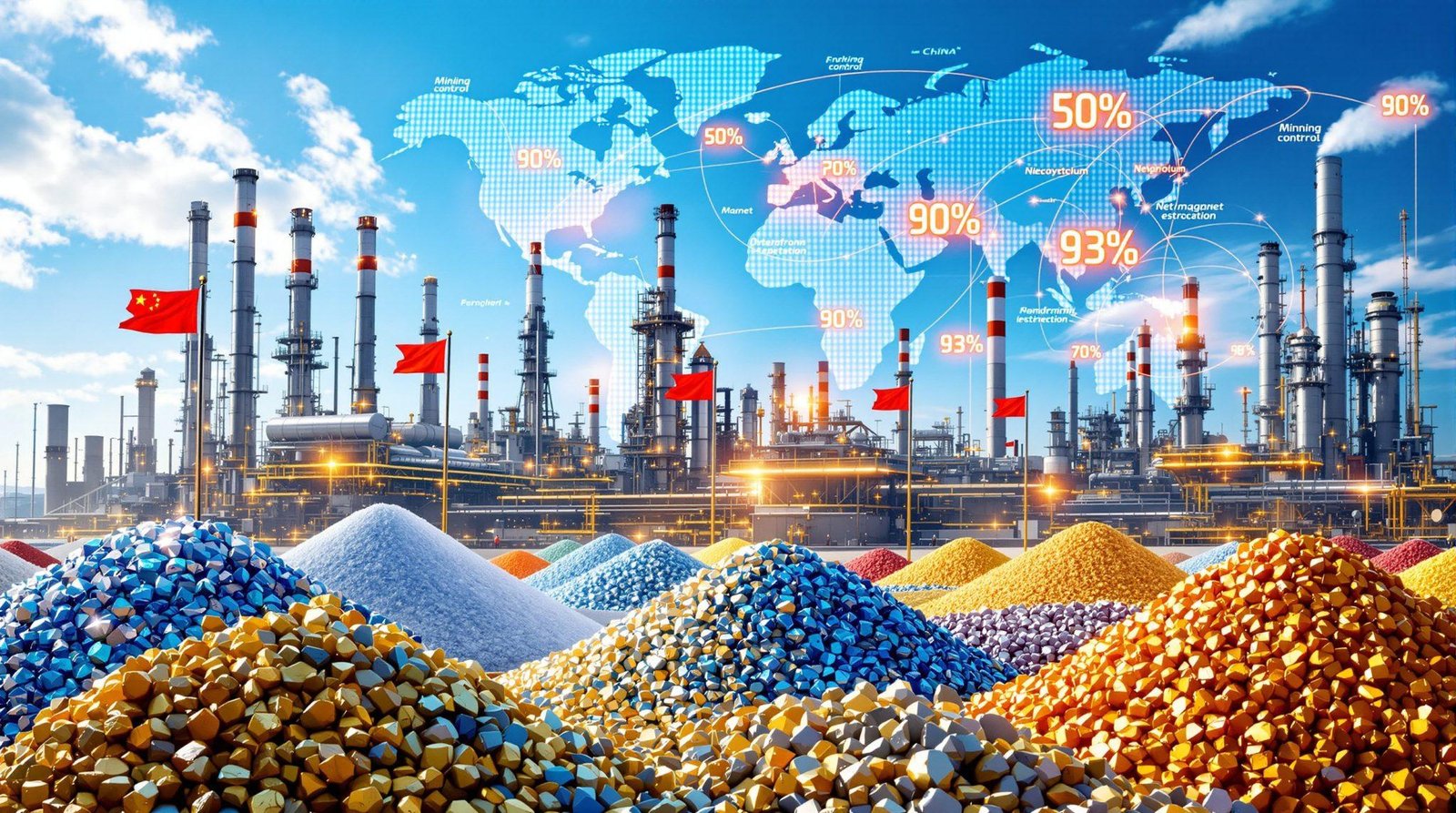
China’s biggest advantage in the critical mineral industry is not simply the amount of minerals it extracts. Its real strength comes from its ability to process, refine and transform raw mineral resources into materials required by modern manufacturing industries.
This distinction is extremely important.
Mining produces mineral-bearing ores and concentrates. However, automobile manufacturers, electronics companies and battery producers generally require refined materials that meet specific chemical and technical standards.
Producing these materials requires specialised equipment, chemical processing technologies, skilled workers, industrial infrastructure and substantial investment.
China has spent decades developing these capabilities.
According to the International Energy Agency’s Global Critical Minerals Outlook 2025, China accounted for approximately:
|
Mineral |
China’s share of global refining or processing |
|---|---|
|
Lithium |
70–75% |
|
Cobalt |
70–75% |
|
Rare earth elements |
More than 90% |
|
Battery-grade graphite |
More than 90% |
|
Copper |
Approximately 44% |
These figures represent the 2025 report’s estimates and should not be treated as fixed market shares for every subsequent year.
Why has China become a leading mineral processing centre?
There are several interconnected reasons behind China’s position.
1. Long-term industrial planning
China recognised the strategic importance of mineral processing and advanced manufacturing decades ago.
Instead of focusing exclusively on extracting natural resources, the country invested in the industrial capabilities needed to transform those resources into valuable materials.
This created an ecosystem involving mining companies, chemical manufacturers, engineering firms, battery producers and technology developers.
2. Large-scale industrial infrastructure
Mineral refining requires electricity, water, chemical inputs, transportation networks and specialised industrial facilities.
China’s established manufacturing regions provide access to many of these supporting services.
The presence of related industries also creates efficiencies. A battery manufacturer can operate closer to suppliers of cathode materials, anode materials, electrolytes and battery components.
3. Technical expertise and accumulated experience
Processing critical minerals is not a simple industrial activity.
For example, rare earth elements have similar chemical properties, making the separation of individual elements technically challenging.
China has developed substantial expertise in processes such as solvent extraction, chemical separation, purification and permanent magnet manufacturing.
This accumulated technical knowledge creates an advantage that cannot be replicated simply by opening a new mine.
4. Economies of scale
Large processing facilities can spread fixed costs across higher production volumes.
They may also benefit from established supplier relationships, specialised labour, research infrastructure and access to downstream manufacturers.
These factors can make it difficult for smaller processing projects in other countries to compete on cost.
5. Integration with manufacturing industries
China’s mineral processing industry is closely connected to its battery, electronics, automotive and industrial manufacturing sectors.
This creates a powerful commercial advantage.
Rather than selling only refined minerals, companies can move further downstream into higher-value products.
The importance of the midstream mineral industry
The global mineral supply chain is commonly divided into three broad stages:
Mining and extraction
Geological exploration, mineral deposits, drilling, mining and ore production.
Processing and refining
Beneficiation, chemical separation, purification, refining and production of battery-grade materials.
Industrial manufacturing
Battery cells, permanent magnets, electronic components, electric motors and finished products.
China’s competitive position becomes especially significant in the midstream and downstream stages.
A country may possess lithium deposits, cobalt mines or rare earth resources but still depend on Chinese processing facilities to produce the materials required by its manufacturers.
This creates a form of industrial dependency.
The lesson for other economies is clear: developing mining capacity without developing refining and manufacturing capabilities may not be enough to secure long-term mineral independence.
How China’s processing dominance affects global businesses
Consider a hypothetical European electric vehicle manufacturer.
The company may purchase lithium from Australia, cobalt from the Democratic Republic of the Congo and graphite from another international supplier.
However, if the materials must pass through Chinese processing facilities before they become suitable for battery manufacturing, the company remains exposed to China’s industrial supply chain.
A disruption in processing, export licensing or transportation can affect its production schedule.
The impact may extend beyond the direct price of the mineral.
Manufacturers may face:
-
Longer delivery times.
-
Higher procurement costs.
-
Limited availability of specialised materials.
-
Difficulties finding qualified alternative suppliers.
-
Delays in battery and vehicle production.
This is why companies increasingly examine the origin of processed materials, not just the country where raw minerals were mined.
3. Global Rare Earth Elements (REEs) Supply Chain Control and China’s Strategic Advantage
Rare earth elements are among the most strategically important materials in modern manufacturing.
The term refers to a group of 17 metallic elements: the 15 lanthanides, scandium and yttrium.
Despite the name, rare earth elements are not necessarily extremely rare in the Earth’s crust. The challenge is finding economically viable deposits and separating the individual elements into commercially usable forms.
Their importance comes from their distinctive magnetic, optical, electrical and chemical properties.
They are used in:
-
Electric vehicle motors.
-
Wind turbine generators.
-
Advanced electronics.
-
Smartphones and communication systems.
-
Aerospace and defence equipment.
-
Medical imaging technologies.
-
Precision industrial machinery.
Why are rare earth elements so important?
Certain rare earth elements are essential for producing high-performance permanent magnets.
For example, neodymium is widely used in neodymium-iron-boron (NdFeB) magnets.
Dysprosium and terbium can be added to improve the high-temperature performance and coercivity of certain magnets.
These materials are particularly important in applications where powerful magnets must operate reliably under demanding conditions.
An electric vehicle manufacturer may require high-performance magnets for specific motor designs.
A wind turbine manufacturer may use rare earth permanent magnets in certain generator configurations.
Defence manufacturers also depend on specialised magnetic materials for advanced equipment.
This makes rare earth availability an industrial and national security concern.
How China developed its rare earth industry
China’s rare earth industry developed through decades of resource development, government support, industrial investment and manufacturing expansion.
The country identified rare earth elements as strategically important and progressively consolidated its domestic industry.
Its advantage was not created overnight.
Over time, Chinese companies developed capabilities in:
-
Rare earth mining and concentrate production.
-
Mineral beneficiation.
-
Chemical separation.
-
Rare earth oxide production.
-
Metal refining.
-
Alloy manufacturing.
-
Permanent magnet production.
The development of capabilities across these stages created an integrated industrial ecosystem.
A particularly important aspect is the ability to manufacture finished magnets rather than simply export raw rare earth materials.
Why rare earth processing is difficult to replace
Rare earth processing involves complex separation procedures because many elements have similar chemical characteristics.
Producing individual rare earth oxides with high purity requires specialised chemical processes, trained personnel, suitable equipment and extensive technical experience.
New processing plants also need to meet environmental and safety requirements.
As a result, countries cannot quickly establish competing industries simply by identifying a rare earth deposit.
They must develop the complete processing ecosystem.
The Manohar Parrikar Institute for Defence Studies and Analyses has highlighted that China’s advantage extends beyond mineral extraction into processing technologies, intellectual property and the accumulation of specialised industrial expertise.
China’s rare earth export controls and global consequences
China’s rare earth position has become particularly important because of its ability to regulate the export of selected materials and related products.
In April 2025, China introduced export licensing requirements covering seven medium and heavy rare earth elements:
-
Samarium
-
Gadolinium
-
Terbium
-
Dysprosium
-
Lutetium
-
Scandium
-
Yttrium
The restrictions affected international buyers that depend on these materials for manufacturing and specialised industrial applications.
The issue was not simply whether these minerals were available in the ground.
Companies also needed to obtain the necessary export licences and comply with applicable regulatory requirements.
According to the IEA’s 2026 assessment, the April 2025 controls had significant downstream effects, including disruptions for some automotive manufacturers.
What happens when rare earth supplies are disrupted?
The consequences can spread across multiple industries.
For example, a shortage of dysprosium or terbium could affect manufacturers that depend on certain high-performance permanent magnet designs.
A company may need to:
-
Search for alternative suppliers.
-
Adjust magnet compositions.
-
Redesign specific components.
-
Increase inventory.
-
Delay production.
-
Invest in alternative manufacturing technologies.
These adjustments require time and money.
The impact can therefore extend well beyond the original mineral market.
Rare earth dominance is also about technology and intellectual property
An important but sometimes overlooked aspect of China’s position is its accumulated technical expertise.
Producing rare earth concentrates is different from producing high-performance permanent magnets.
The latter requires sophisticated metallurgical processes, specialised machinery, quality control and manufacturing knowledge.
The IDSA analysis of China’s critical mineral strategy highlights the significance of processing technology, intellectual property accumulation and the consolidation of midstream capabilities.
This creates a deeper competitive advantage because other countries need to develop not only new facilities but also the associated technical expertise.
In other words, control over industrial knowledge can be as important as control over physical mineral resources.
4. Critical Mineral Export Controls, Overseas Investments and China’s Geopolitical Influence
China’s influence over critical mineral markets also comes from its ability to combine domestic industrial policy with international trade and investment.
Minerals have become an important part of global economic diplomacy.
Countries need them for advanced manufacturing, defence production, digital infrastructure and clean energy technologies.
Consequently, access to mineral supplies can influence international relationships.
This is where strategic mineral geopolitics and economic leverage become important.
A. Critical mineral export controls and trade restrictions
Export controls are government regulations that restrict or regulate the movement of specific products, technologies or materials across international borders.
They may involve export licences, destination restrictions, end-user checks or outright prohibitions.
Governments generally justify these measures through national security, non-proliferation, industrial policy or other legal considerations.
In China’s case, several critical mineral export controls have attracted international attention.
Some important developments include:
|
Period |
Material or technology |
Main development |
|---|---|---|
|
August 2023 |
Gallium and germanium |
Export licensing requirements |
|
December 2023 |
Natural graphite |
Export licensing requirements |
|
September 2024 |
Antimony |
Export controls introduced |
|
December 2024 |
Selected dual-use materials |
Restrictions on exports to the United States |
|
February 2025 |
Tungsten, tellurium, bismuth, molybdenum and indium-related items |
Additional export licensing |
|
April 2025 |
Seven medium and heavy rare earth elements |
Export licensing requirements |
|
October 2025 |
Additional rare earth and battery-related measures |
Broader proposed controls and licensing requirements |
These developments demonstrate how mineral supply chains can become connected to international trade disputes and national security policies.
It is important to distinguish between an export licensing requirement and a complete export ban.
A licensing requirement does not automatically mean that all exports have stopped. It means exporters must comply with the relevant regulatory process, and the resulting approval or delay can affect deliveries.
The actual commercial impact depends on the material, destination, licence conditions, implementation and subsequent policy changes.
Why do export controls matter to global manufacturers?
Imagine a semiconductor manufacturer that requires gallium-based materials for specialised components.
If export licensing becomes more restrictive, the company may experience delays in obtaining the required inputs.
The business might need to increase inventory or identify alternative suppliers.
A similar situation can affect battery manufacturers requiring graphite products or automotive suppliers that depend on rare earth magnets.
Export controls can therefore influence:
-
Commodity availability.
-
International prices.
-
Manufacturing costs.
-
Contract negotiations.
-
Investment decisions.
-
Supply-chain diversification.
The International Energy Agency reported in its 2026 outlook that the number of mineral tariff codes subject to Chinese export controls had tripled since 2023. It also highlighted the price differences that emerged between Chinese domestic markets and overseas markets for certain controlled materials.
B. Chinese overseas mining investments and resource acquisition
China’s mineral strategy does not depend exclusively on domestic mineral deposits.
Chinese companies have invested in overseas mining operations, mineral processing facilities and supporting infrastructure to improve access to resources around the world.
This approach is particularly important because some of the world’s largest mineral deposits are located outside China.
The Democratic Republic of the Congo, for example, is a major global source of cobalt.
Australia is an important lithium producer.
Indonesia has become a major nickel-producing and processing centre.
South American countries such as Chile and Argentina are important in the lithium industry.
Chinese companies have participated in mining projects, joint ventures, acquisitions and processing operations across several of these regions.
The strategy allows companies to secure access to raw materials while connecting overseas production to established Chinese industrial networks.
The Democratic Republic of the Congo: A major cobalt example
The Democratic Republic of the Congo is particularly important in the global cobalt industry.
Cobalt is used in several battery chemistries, superalloys and specialised industrial applications.
The country’s mineral resources have attracted international investment, including participation by Chinese mining companies.
The US International Development Finance Corporation has described how Chinese companies own or operate a substantial share of critical mineral production in the DRC, with much of the material moving to China for processing.
Its Lobito Corridor project is one example of efforts to create alternative transportation infrastructure for mineral exports.
This illustrates how mineral supply chains involve much more than mining rights.
Access to railways, ports, electricity and logistics networks also determines which companies can move materials efficiently to international markets.
Indonesia: Nickel and battery manufacturing
Indonesia provides another important example.
The country has large nickel resources and has pursued policies to encourage domestic mineral processing and downstream industrial development.
Chinese companies have invested in Indonesian nickel mining, smelting and battery-related industrial operations.
These investments have helped connect Indonesian mineral production with Chinese processing technology, capital and manufacturing networks.
The result is a cross-border production ecosystem.
Raw materials are mined in Indonesia, processed through industrial facilities and incorporated into supply chains that serve battery and stainless steel manufacturers.
However, this relationship is not simply a story of Chinese influence.
Indonesia’s own industrial policies, export restrictions, domestic investment priorities and economic interests have also played a major role in shaping its nickel industry.
Latin America and lithium investments
South America’s lithium resources are another important part of the global mineral competition.
Chile and Argentina have significant lithium industries, while Bolivia also possesses substantial identified lithium resources.
Chinese companies have pursued investments, partnerships and technology agreements in the region.
These activities are connected to the growing demand for lithium chemicals used in rechargeable batteries.
The commercial objective is to establish access to raw materials and develop processing capabilities closer to important resource deposits.
C. State-Owned Enterprises (SOEs) and Chinese policy financing
China’s overseas mineral strategy involves a mixture of private companies, publicly listed businesses and state-owned enterprises.
State-owned enterprises (SOEs) can play an important role in strategic industries because they may operate within broader national industrial and economic priorities.
They can participate in mining acquisitions, processing infrastructure, international partnerships and long-term resource agreements.
Policy financing can also support large projects that require significant initial capital and long development periods.
This may involve state-owned banks, development finance institutions, export credit support and other financial arrangements.
Why is policy financing important?
Mining and mineral processing projects are expensive.
A new mining operation may require:
-
Geological surveys and exploration.
-
Land development.
-
Mining machinery.
-
Processing facilities.
-
Electricity and water infrastructure.
-
Railways and transportation systems.
-
Environmental management.
-
Long-term working capital.
These projects may take years before generating commercial returns.
Access to patient financing can therefore create an advantage for companies willing to invest in long-term mineral supply chains.
How Chinese financing creates international industrial connections
Consider a mineral-rich country that needs investment in a new mine.
The project may require a mining company, a financing partner, engineering expertise and a transportation network.
If these elements are supplied through connected commercial relationships, the investor can become involved in multiple stages of the mineral supply chain.
The same relationships can extend into processing facilities and long-term purchasing agreements.
This can create durable economic relationships between the host country and foreign investors.
However, it is important not to assume that every Chinese mining investment is directly controlled by the Chinese government. Ownership structures, financing arrangements and corporate governance differ between projects.
The Belt and Road Initiative and mineral infrastructure
China’s Belt and Road Initiative (BRI) has supported infrastructure and connectivity projects across several regions.
Railways, ports, roads and industrial facilities can influence how minerals are transported from mining locations to processing centres and international markets.
This infrastructure can improve commercial efficiency while also creating long-term economic relationships.
The DFC’s Lobito Corridor investment offers an interesting comparison.
The US-backed initiative aims to improve rail and port connections between mineral-producing areas in the DRC and Zambia and Angola’s Atlantic coast.
The DFC reported a $553 million loan for the railway and port-related upgrades, intended to diversify transportation routes and improve access to international markets.
The larger lesson is that competition for critical minerals is also competition over infrastructure, logistics and investment networks.
D. Environmental, Social and Governance (ESG) standards in Chinese mining companies
China’s expansion across global mineral supply chains also raises important environmental, social and governance questions.
Mining can create significant environmental and social impacts if projects are not properly managed.
These include:
-
Water consumption and contamination.
-
Land degradation.
-
Tailings and industrial waste.
-
Air pollution.
-
Occupational health and safety risks.
-
Labour conditions.
-
Community displacement.
-
Biodiversity loss.
The issue is particularly important in mineral-rich developing countries, where mining investment can bring employment and infrastructure but may also create environmental and governance challenges.
What does ESG mean in critical mineral mining?
ESG stands for Environmental, Social and Governance.
|
ESG pillar |
What it covers |
|---|---|
|
Environmental |
Water management, emissions, waste, biodiversity and land restoration |
|
Social |
Worker safety, labour rights, local communities and human rights |
|
Governance |
Transparency, accountability, anti-corruption and responsible business practices |
The International Institute for Sustainable Development published a 2026 report examining the ESG practices of Chinese companies in critical mineral supply chains, using nickel processing in Indonesia as a case study.
The report identifies improvements in Chinese companies’ ESG management while also highlighting gaps compared with leading international standards.
It recommends stronger alignment with global ESG benchmarks, better due diligence, technical cooperation and financial incentives linked to verified sustainability performance.

Why ESG standards influence mineral trade
International buyers increasingly consider more than the price and availability of raw materials.
Automobile companies, battery manufacturers and technology businesses also need to understand where their materials originate and how they were produced.
A mineral supplier with weak environmental controls or inadequate labour protections may face reputational, legal and commercial risks.
Stronger ESG systems can help companies:
-
Improve access to international markets.
-
Reduce environmental and social risks.
-
Improve investor confidence.
-
Support responsible sourcing.
-
Strengthen relationships with local communities.
-
Improve long-term operational stability.
For China, the ability of its mining and processing companies to meet internationally recognised ESG expectations will influence their competitiveness in global supply chains.
For resource-rich countries, stronger ESG requirements can help ensure that mineral development generates lasting economic benefits rather than short-term extraction gains.
5. Critical Mineral Supply Chain Diversification and De-Risking: How the World Is Responding to China
China’s position in the mineral economy has encouraged other countries to reconsider their supply-chain strategies.
The objective is not necessarily to eliminate trade with China.
That would be difficult because China has developed extensive processing, refining and manufacturing capabilities.
Instead, many governments are focusing on reducing excessive dependence on a single supplier or geographical region.
This approach is commonly described as critical mineral supply chain diversification and de-risking.
It involves developing alternative sources, investing in domestic capabilities, building international partnerships and improving access to recycling technologies.
A. United States: Building alternative mineral supply chains
The United States considers critical minerals important to national security, advanced manufacturing and clean energy development.
It has introduced various initiatives to improve access to strategic minerals, expand domestic production and strengthen partnerships with international suppliers.
One example is the US International Development Finance Corporation (DFC).
The DFC supports overseas projects through loans, equity investments, guarantees and other financial instruments.
Its objective includes mobilising private capital for strategic industries in developing and emerging markets.
The Lobito Corridor is one example of this approach.
Another example is DFC’s support for critical mineral projects in Brazil, including a $30 million investment in a nickel and cobalt mining project associated with TechMet.
These investments demonstrate how governments can use development finance to support mineral supply-chain diversification.
B. European Union: Reducing strategic dependencies
The European Union has also introduced policies aimed at strengthening its access to critical raw materials.
The European Critical Raw Materials Act establishes benchmarks for domestic extraction, processing and recycling capacity, alongside a target to avoid excessive dependence on any single third country for a strategic raw material at relevant processing stages.
The legislation also supports strategic projects, supply-chain monitoring and international partnerships.
Its broader objective is to strengthen European industrial competitiveness while supporting the clean energy transition.
C. Australia: Strengthening its position as a mineral supplier
Australia is already an important global supplier of several critical minerals.
Its lithium industry is particularly significant.
The country is also seeking to expand mineral processing and refining activities so that more value can be generated domestically.
Australia’s advantage includes substantial mineral resources, established mining expertise, infrastructure and partnerships with international manufacturers.
The challenge is to compete with established processing ecosystems, especially where China’s economies of scale are substantial.
D. Japan and South Korea: Securing industrial materials
Japan and South Korea are major manufacturing economies with strong electronics, automotive and battery industries.
Both countries require reliable access to lithium, cobalt, nickel, graphite and rare earth materials.
Their strategies include supplier diversification, international resource partnerships, recycling and investment in alternative battery technologies.
For these economies, mineral security is directly connected to industrial competitiveness.
E. India’s response: Building a stronger domestic ecosystem
India is particularly important in this discussion because its manufacturing and energy requirements are growing.
The country needs reliable supplies of minerals for electric vehicles, renewable energy, electronics, telecommunications, infrastructure and defence.
India’s critical mineral strategy includes domestic exploration, overseas acquisitions, recycling, technology development and international cooperation.
Important initiatives include:
1. National Critical Mineral Mission
Approved in January 2025, the mission aims to strengthen India’s entire critical mineral value chain, from exploration and mining to processing, recycling and overseas resource acquisition.
2. Khanij Bidesh India Limited (KABIL)
KABIL works to identify and acquire overseas critical mineral assets to improve India’s long-term access to strategic resources.
3. Domestic exploration
The Geological Survey of India and other agencies are working to identify mineral resources and improve geological understanding.
4. Mineral processing and refining
India needs to expand domestic capabilities to convert mineral resources into industrially useful materials.
5. Recycling and resource recovery
Recovering minerals from used batteries and electronic waste can provide additional sources of materials.
6. International partnerships
India can collaborate with resource-rich countries to secure access to raw materials, develop processing technology and strengthen industrial relationships.
Why India must focus on processing technology
One of the most important lessons from China’s experience is that access to raw minerals does not automatically create industrial independence.
India may identify a mineral deposit, but it also needs the technology and infrastructure to process the material into usable products.
For example, developing a domestic lithium supply chain requires more than discovering lithium-bearing resources.
It also requires:
-
Commercial extraction technologies.
-
Chemical processing infrastructure.
-
Battery-grade material production.
-
Skilled technical professionals.
-
Research and development.
-
Long-term industrial investment.
-
Environmental management systems.
The same principle applies to rare earth elements.
India needs capabilities in mineral separation, refining, alloy manufacturing and permanent magnet production.
Developing these technologies can help the country move from raw material dependence towards higher-value industrial manufacturing.
F. Minerals Security Partnership and international cooperation
International partnerships are another important part of global mineral diversification.
The Minerals Security Partnership (MSP) was launched in 2022 by a group of countries and the European Union to support responsible investment in critical mineral supply chains.
Its objectives include improving supply-chain resilience, supporting responsible mining practices and encouraging investment in projects across the value chain.
Other international frameworks, including the Quad Critical Minerals Initiative and bilateral mineral agreements, also reflect growing interest in supply-chain cooperation.
The IDSA’s 2026 analysis highlights that diversification must extend beyond acquiring mineral deposits. It also requires technological cooperation, research, processing expertise and intellectual property development.
G. Why complete independence from China will be difficult
Although diversification is necessary, replacing China’s industrial ecosystem will not be easy.
There are several challenges.
High investment requirements: New mines and processing facilities require significant capital.
Technology gaps: Some mineral processing technologies are highly specialised and protected by patents or industrial know-how.
Cost competitiveness: Established Chinese facilities may benefit from economies of scale and integrated industrial infrastructure.
Environmental approvals: New projects must meet increasingly demanding environmental and social requirements.
Time: Building a commercially competitive mineral processing industry can take many years.
Market uncertainty: Investors need confidence that mineral demand, prices and government policies will support long-term projects.
Therefore, diversification should be considered a long-term industrial transformation rather than a short-term response to geopolitical tensions.

The future: A more diversified but interconnected mineral economy
The future global mineral industry is likely to involve a wider network of mining, refining and manufacturing countries.
China will remain an important participant because of its established industrial capacity and technical expertise.
However, other countries are likely to increase investments in alternative processing facilities, mineral recycling and advanced manufacturing.
The most resilient supply chains will probably combine:
-
Multiple mineral-producing countries.
-
Several independent processing centres.
-
Strong transportation infrastructure.
-
Transparent sourcing arrangements.
-
Responsible ESG practices.
-
Advanced recycling systems.
-
International research partnerships.
The objective is to build an interconnected global mineral economy that is less vulnerable to individual supply disruptions.
Conclusion: China’s Mineral Influence Will Shape the Future of Global Trade
China’s influence over global critical mineral supply chains is the result of decades of industrial planning, technological development, strategic investment and manufacturing expansion.
Its competitive advantage extends beyond mineral extraction. The country has established strong capabilities in processing, refining, rare earth separation, battery materials, permanent magnets and downstream manufacturing.
This integrated industrial ecosystem gives China an influential position in the global mineral economy.
Its overseas mining investments, state-backed industrial financing, international infrastructure relationships and export-control policies further demonstrate how critical minerals have become connected to economic diplomacy and geopolitical competition.
However, China’s position also creates challenges for countries that depend heavily on its processing and manufacturing capabilities.
The United States, European Union, India, Japan, Australia and other economies are increasingly investing in alternative supply chains.
Their objective is to reduce concentration risks, improve domestic industrial capabilities and develop stronger international partnerships.
For India, the biggest lesson is that mineral security cannot be achieved through mining alone. The country must invest in exploration, mineral separation, refining, battery manufacturing, rare earth technologies, recycling and research and development.
At the same time, responsible sourcing and environmental, social and governance standards must remain central to the development of the global mineral industry.
Ultimately, the next phase of global industrial competition will not be determined only by who possesses the most mineral resources. It will also be determined by who can process, refine, manufacture and supply these materials reliably.
China has established a significant advantage in this area. Whether other countries can build competitive alternatives will influence the future of electric vehicles, renewable energy, advanced technology and international trade.
For businesses, investors and policymakers, understanding these developments is essential.
The global critical mineral economy is changing, and supply-chain resilience is becoming just as important as access to natural resources.
FAQs: How China Influences Global Critical Mineral Supply Chains
1. Why does China dominate global critical mineral supply chains?
China has developed substantial mining, processing, refining and manufacturing capabilities through decades of industrial investment, technological development, infrastructure expansion and strategic government policies. Its strongest influence is particularly visible in the processing of several critical minerals.
2. What percentage of critical minerals does China control?
There is no single percentage covering all critical minerals. China’s market share differs by mineral and supply-chain stage. The IEA’s 2025 outlook estimated that China accounted for more than 90% of global rare earth and battery-grade graphite refining, and approximately 70–75% of lithium and cobalt processing.
3. Why is China important in rare earth elements?
China has developed extensive rare earth mining, separation, refining and permanent magnet manufacturing capabilities. These materials are important for electric vehicles, wind turbines, electronics, aerospace and defence technologies.
4. What are the main critical minerals controlled or processed by China?
China has particularly strong positions in the processing and refining of rare earth elements, graphite, lithium, cobalt, gallium, germanium, tungsten and several other strategic materials. Its exact market share varies by mineral and processing stage.
5. Why is critical mineral processing more important than mining?
Mining produces raw mineral materials, while processing converts them into industrially usable products. Manufacturers require refined materials with specific chemical and technical properties. A country controlling processing capacity can therefore influence access to important industrial inputs.
6. How does China influence global lithium supply chains?
China has a significant position in lithium chemical processing, refining and battery manufacturing. It also maintains international investments and supply relationships with lithium-producing countries, including Australia and South American producers.
7. Why is China important in the cobalt industry?
China has significant cobalt refining and battery-material manufacturing capabilities. Chinese companies also participate in overseas cobalt mining operations, particularly in the Democratic Republic of the Congo.
8. What is China’s role in graphite production?
China is a major producer and processor of natural graphite and has a dominant position in battery-grade graphite refining and anode material manufacturing. These materials are essential for many lithium-ion batteries.
9. What are rare earth elements (REEs)?
Rare earth elements are a group of 17 metallic elements used in permanent magnets, electronics, electric vehicle motors, wind turbines, aerospace equipment and advanced technologies.
10. Why are rare earth elements difficult to replace?
Rare earth elements have specialised magnetic, electrical and optical properties. Although alternatives exist for some applications, replacing them may require changes in product design, manufacturing processes and performance specifications.
11. What are China’s critical mineral export controls?
These are government regulations that require licences or impose other restrictions on the export of selected minerals, mineral products and processing technologies. They can influence international supply availability and trade flows.
12. Which critical minerals has China restricted through export controls?
China has introduced export controls or licensing requirements involving materials such as gallium, germanium, graphite, antimony, tungsten, tellurium, bismuth, molybdenum, indium-related products and selected rare earth elements.
13. How do China’s export restrictions affect electric vehicle manufacturers?
Restrictions affecting lithium battery materials, graphite or rare earth magnets can increase procurement uncertainty, delay deliveries and raise manufacturing costs for companies dependent on affected materials.
14. What is strategic mineral geopolitics?
Strategic mineral geopolitics refers to the relationship between mineral resources, international power, national security, trade policies and diplomatic relationships. It examines how countries use mineral access and supply-chain capabilities to protect economic interests.
15. How does China invest in overseas mining projects?
Chinese companies invest through acquisitions, joint ventures, equity participation, financing agreements and partnerships with local mining businesses. These investments can provide access to mineral deposits and connect overseas production with Chinese processing facilities.
16. Why is the Democratic Republic of the Congo important to China?
The DRC is a major global cobalt producer and an important copper-producing country. Chinese companies participate in its mining industry, and a significant share of the country’s mineral production enters international processing and manufacturing networks connected to China.
17. What is China’s role in Indonesia’s nickel industry?
Chinese companies have invested in Indonesian nickel mining, smelting and downstream processing. These investments connect Indonesia’s mineral resources with international battery and stainless steel manufacturing supply chains.
18. What is the Belt and Road Initiative’s connection to critical minerals?
The Belt and Road Initiative supports international infrastructure and economic connectivity projects. Roads, railways, ports and industrial facilities can improve the transportation of minerals and strengthen commercial relationships between China and resource-producing countries.
19. What are State-Owned Enterprises (SOEs) in China’s mineral industry?
State-Owned Enterprises are companies in which the Chinese government has an ownership interest. Some operate in strategic mineral sectors and participate in mining, processing, infrastructure development and overseas resource investments.
20. How does Chinese policy financing support critical mineral investments?
Policy financing can provide capital, loans and other financial support for large industrial projects. Such financing can help mining and processing companies develop infrastructure and secure long-term mineral supply arrangements.
21. What is vertical integration in critical mineral supply chains?
Vertical integration refers to controlling multiple stages of production within the same business or connected industrial network. In critical minerals, this may include mining, refining, chemical processing, component manufacturing and finished-product production.
22. What is critical mineral supply chain diversification?
Supply-chain diversification involves obtaining minerals from multiple countries and developing alternative processing and manufacturing facilities to reduce dependence on a single supplier or geographical region.
23. What does de-risking from China mean?
De-risking means reducing excessive economic and supply-chain dependence on China without necessarily ending commercial relationships. It includes developing alternative suppliers, investing in domestic processing and building international partnerships.
24. How is the United States reducing dependence on China for critical minerals?
The United States is supporting domestic mining and refining, international mineral investments, development finance, strategic partnerships, recycling and alternative transportation routes. Its DFC is one of the institutions supporting overseas supply-chain projects.
25. What is the Lobito Corridor and why is it important?
The Lobito Corridor is a transportation initiative connecting mineral-producing areas in the Democratic Republic of the Congo and Zambia with Angola’s Atlantic port of Lobito. It aims to improve mineral transportation and provide alternative export routes.
26. How can India reduce its dependence on Chinese critical minerals?
India can strengthen domestic exploration, develop mineral processing facilities, acquire overseas mining assets, invest in research and development, expand battery recycling and establish partnerships with resource-rich countries.
27. What is the National Critical Mineral Mission in India?
The National Critical Mineral Mission is an Indian government initiative approved in January 2025. It aims to strengthen domestic exploration, mining, processing, recycling and international access to critical minerals.
28. What are ESG standards in Chinese mining companies?
ESG standards refer to environmental, social and governance practices used to evaluate responsible business operations. In Chinese mining companies, these include pollution management, worker safety, community engagement, responsible sourcing and corporate accountability.
29. Can other countries compete with China’s mineral processing industry?
Yes, but developing competitive alternatives requires substantial investment, specialised technology, skilled labour, infrastructure, environmental approvals and long-term industrial planning. Diversification is possible, although it may take years.
30. Will China continue to dominate global critical mineral supply chains?
China is likely to remain an important participant because of its established processing, refining and manufacturing capabilities. However, investments in alternative supply chains, new technologies, recycling and international partnerships may gradually reduce concentration in selected mineral markets.
