
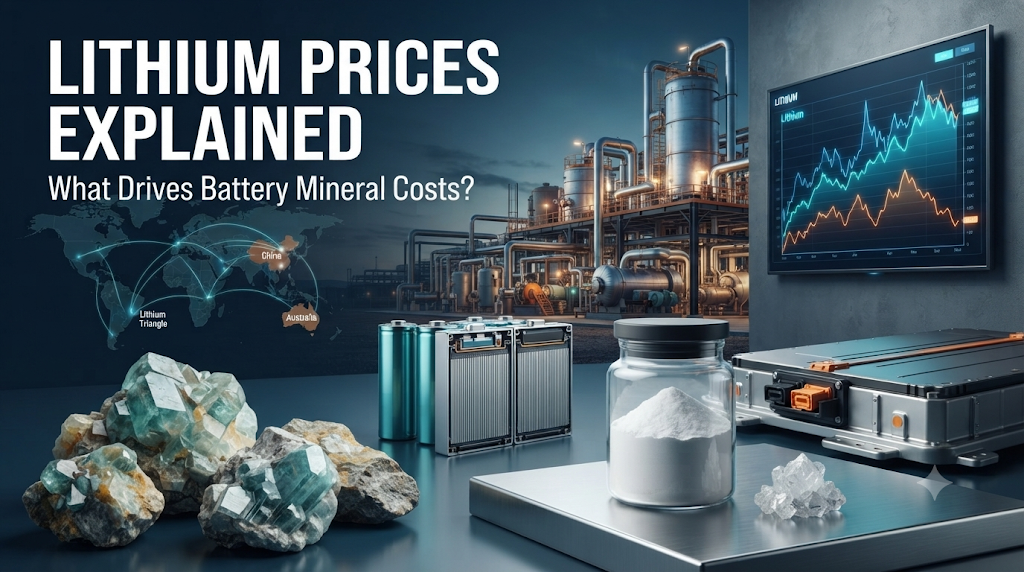
Lithium Prices Explained What Drives Battery Mineral Costs
Understand lithium prices, battery-grade lithium carbonate and hydroxide, EV battery demand, mining costs, global supply and the factors driving market volatility.
Lithium has become one of the most closely watched materials in the global energy market. It is a key ingredient in rechargeable batteries used in electric vehicles, smartphones, laptops, power tools and large-scale energy storage systems. As countries invest in electrification and renewable energy, demand for lithium has grown into a major influence on mining investment, chemical processing, battery manufacturing and commodity markets.
Yet lithium prices can be difficult to understand. A rise in electric vehicle sales does not automatically mean lithium prices will increase. Prices can fall even while battery demand expands, particularly when new mines and refining facilities add supply faster than manufacturers consume it. Equally, a temporary disruption at a major mine, a change in Chinese inventory levels or a delay in a processing project can tighten the market and move prices sharply.
There is another important distinction: the price of lithium raw materials is not the same as the cost of a finished lithium-ion battery. Battery costs also include cathode and anode materials, separators, electrolytes, cell manufacturing, battery management systems, pack design, testing, certification and logistics. Lithium is an important cost driver, but it is only one part of a much larger industrial supply chain.
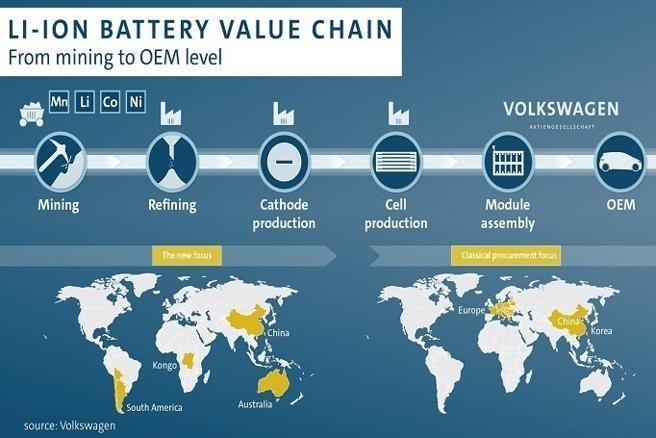
This guide explains how global lithium price trends work, why battery-grade lithium carbonate and lithium hydroxide can have different prices, how mining and refining costs influence supply, and why EV battery demand does not always translate into higher commodity prices. It also looks at the difference between spot and contract prices, the role of major producing countries, and the factors worth monitoring when assessing the lithium market.
1. Understanding Global Lithium Prices and the Market Behind Them
What determines the price of lithium?
Lithium is a commodity, but it does not trade in exactly the same way as widely standardised metals such as copper, gold or aluminium. Lithium is sold in different chemical forms, grades and specifications. The price a buyer pays depends on the product being purchased, its quality, delivery location, contract terms and the prevailing market conditions.
The two most widely discussed lithium chemicals for rechargeable batteries are lithium carbonate and lithium hydroxide. They are not interchangeable in every application, and their prices can move differently depending on the needs of cathode manufacturers and the availability of suitable feedstock.
Lithium prices are influenced by several connected forces:
-
Supply: How much lithium is being mined, extracted, refined and made available to buyers.
-
Demand: How much battery manufacturers and other industrial users need.
-
Inventory: How much material is held by producers, traders, converters and battery manufacturers.
-
Production costs: The cost of extracting lithium from brine or hard-rock deposits and converting it into saleable chemicals.
-
Processing capacity: Whether refineries can produce the chemical grade and quality required by battery customers.
-
Policy and trade: Export rules, mining licences, environmental regulations, tariffs and industrial incentives.
-
Market expectations: Whether traders expect future shortages, oversupply, new projects or stronger battery demand.
These factors interact. For example, a new mine may increase the amount of lithium-bearing material available, but if conversion capacity is limited, the additional output may not immediately become battery-grade lithium chemicals. Similarly, a battery manufacturer may increase purchases ahead of an expected supply disruption, temporarily strengthening prices even before actual consumption rises.
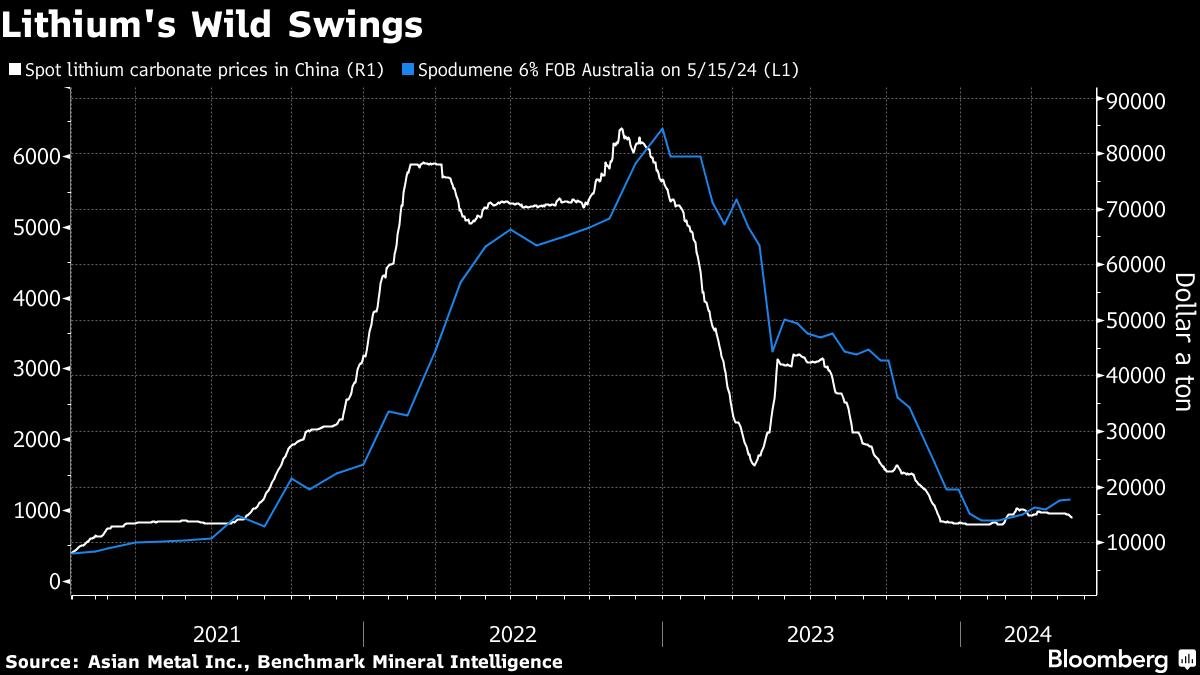
Historical lithium price movements and market volatility
The lithium market has experienced dramatic price cycles. During periods of strong EV demand, limited supply and rapid purchasing by battery manufacturers, prices can rise sharply. When producers expand capacity and inventories build, the market can move in the opposite direction.
Trading Economics provides a useful example of why lithium prices need to be viewed over time rather than through a single daily quotation. Its lithium series tracks battery-grade lithium carbonate, with a China-based reference specification of 99.5% minimum Li₂CO₃. On 20 November 2026, the page reported a reference price of CNY 91,450 per tonne. It also showed that the market had declined 10.95% over the preceding month and 0.92% over the year, while its historical series recorded a peak of CNY 600,000 per tonne in November 2022. These figures are a dated market snapshot, not a universal price for every lithium product or delivery location.
Market data note: Lithium prices vary by product, grade, region and assessment methodology. Always check the unit, currency, chemical specification and date before comparing quotations.
The 2022 peak illustrates how quickly a tight commodity market can change. Strong battery demand, supply-chain concerns and limited immediately available material contributed to an extraordinary price environment. High prices then encouraged investment in new mines, expansions and chemical conversion facilities. As additional capacity entered the market and buyers adjusted purchasing strategies, prices came under pressure.
This is a familiar pattern in commodity markets: high prices encourage investment, investment increases future supply, and additional supply can eventually reduce prices. The difficulty is timing. Mining projects take years to develop, and a project announced during a price boom may not produce saleable lithium until market conditions have changed.
For buyers, manufacturers and investors, the lesson is straightforward: lithium prices are cyclical. A short-term rally does not necessarily indicate a permanent shortage, and a price decline does not automatically mean long-term battery demand has weakened.

Why one lithium price does not tell the whole story
When someone searches for the lithium price today, they may expect one global benchmark. In practice, a quoted price should be treated as a specific assessment of a particular product and market.
A lithium carbonate quotation may differ from a lithium hydroxide quotation. Battery-grade material may command a different price from technical-grade material. A spot transaction for prompt delivery may also differ from a long-term supply contract.
Before comparing two prices, check:
-
Is the product lithium carbonate or lithium hydroxide?
-
Is it battery grade or technical grade?
-
What purity and impurity limits apply?
-
Is the price quoted per tonne, kilogram or another unit?
-
Is the currency Chinese yuan, US dollars or another currency?
-
Does the quotation refer to the mine, refinery, warehouse or delivered customer location?
-
Is it a spot assessment, a futures-linked value or a negotiated contract price?
Without these details, two apparently different prices may not actually be comparable.
Lithium carbonate and lithium hydroxide pricing
Lithium carbonate (Li₂CO₃) is widely used in lithium-ion battery supply chains, including the production of cathode materials for lithium iron phosphate and other battery chemistries. It is also an important industrial lithium compound.
Lithium hydroxide (LiOH) is another major battery chemical. It is particularly relevant to certain nickel-rich cathode manufacturing routes, including some NMC and NCA materials. Its production can involve conversion from lithium carbonate or processing of suitable hard-rock feedstock.
The relationship between their prices depends on several factors:
-
The relative demand for different cathode chemistries.
-
The availability and cost of suitable lithium feedstock.
-
Conversion capacity and operating rates.
-
Chemical processing yields and energy costs.
-
Customer specifications and qualification requirements.
-
Regional supply-demand conditions.
A change in the popularity of a particular battery chemistry can influence demand for one lithium compound more than another. This is why analysts monitor carbonate and hydroxide prices separately rather than assuming that they always move together.
Spot prices, contract prices and futures markets
Lithium buyers can source material through spot purchases, longer-term contracts or pricing arrangements linked to market assessments. Each approach serves a different commercial purpose.
Spot prices generally reflect transactions or assessments for material available over a relatively short period. They can respond quickly to changes in inventory, buying interest and supply disruptions. However, spot markets may be less liquid than markets for more established commodities, and the number of observable transactions can vary.
Contract pricing is negotiated between buyers and sellers for an agreed supply period. Contracts can specify volumes, quality, delivery schedules, pricing formulas and adjustment mechanisms. Some contracts use fixed prices; others refer to market assessments or include periodic price reviews.
Futures and derivatives can provide ways to manage price exposure, but lithium trading is not as uniform or transparent as trading in major exchange-traded metals. Different exchanges and contracts may use distinct specifications and settlement arrangements. Global X has highlighted the historically less transparent nature of lithium contract trading compared with established commodity futures markets.
Price reporting agencies and market-data providers help participants understand market conditions by publishing assessments based on defined products, locations and methodologies. These assessments are useful reference points, but they should not be mistaken for a guaranteed transaction price available to every buyer.
For manufacturers, a long-term contract may provide more predictable supply. For traders, spot prices may offer a clearer view of immediate market tightness. For investors, benchmark assessments and futures-linked products can provide market signals, although the structure of each instrument matters.
2. Lithium Supply, Demand and the Economics of Extraction
The global lithium supply and demand balance
The most important long-term influence on lithium prices is the balance between available supply and actual consumption. When lithium production and refined chemical output exceed demand, inventories tend to rise and prices can weaken. When consumption grows faster than available supply, buyers may compete for material, creating upward price pressure.
However, the balance is more complicated than comparing total mine production with total battery demand. Lithium passes through several stages before it reaches a battery manufacturer:
-
Exploration and development identify economically viable lithium resources.
-
Mining or extraction produces lithium-bearing material or brine.
-
Concentration and initial processing create a suitable intermediate product.
-
Chemical conversion produces lithium carbonate, lithium hydroxide or another saleable compound.
-
Refining and quality control bring the material to the required specification.
-
Battery manufacturers qualify and use the chemical in cathode production.
A shortage at any one of these stages can constrain the amount of material available to the next stage. For example, a region may produce plenty of spodumene concentrate but lack sufficient conversion capacity. In that situation, the market may have ample lithium-bearing raw material while battery-grade chemical supply remains comparatively tight.
This distinction is essential when interpreting market reports. Mine output, lithium chemical production, refined supply and battery-grade availability are related measures, but they are not identical.
What happens when the market has a surplus?
A lithium surplus occurs when available supply exceeds consumption over a defined period. It does not mean that every producer has excess material or that every chemical product is readily available. A market surplus can coexist with regional shortages, quality constraints or processing bottlenecks.
When a surplus develops, several outcomes are possible:
-
Producers and traders may accumulate inventories.
-
Buyers may delay purchases while waiting for lower prices.
-
Chemical converters may reduce operating rates.
-
Higher-cost mines may become uneconomic.
-
New projects may be postponed or cancelled.
-
Producers may renegotiate contracts or offer more competitive terms.
This process can take time. A mine with high fixed costs may continue operating even after prices fall, especially if the owner expects prices to recover or has contractual commitments. Another operation may suspend production quickly if its cash costs are above the market price.
The reverse can happen during a shortage. Buyers may increase safety stocks, secure long-term contracts and compete for qualified material. Producers may bring forward expansions, while developers seek financing for new projects.
Why EV demand does not automatically guarantee higher lithium prices
Electric vehicles are a major source of expected lithium demand growth, but commodity prices respond to the relationship between demand and supply, not demand alone.
Imagine that global EV production increases strongly over several years. This supports lithium consumption. But if lithium producers, chemical converters and recycling businesses expand capacity even faster, the market could still experience a surplus.
Conversely, moderate demand growth can lead to a sharp price increase if a major producing region experiences disruptions or if new projects fail to reach commercial production on schedule.
Demand forecasts also depend on assumptions about EV adoption, battery sizes, charging infrastructure, government incentives, vehicle affordability and consumer preferences. A change in any of these factors can alter the expected rate of lithium consumption.
The role of inventory and purchasing behaviour
Inventory is one of the most useful indicators of short-term market conditions. Battery manufacturers generally need reliable access to raw materials, but they do not necessarily purchase every requirement immediately. Their buying decisions depend on current stock levels, production schedules, contract coverage and expectations about future prices.
When prices are rising, buyers may purchase more material to protect against further increases. This can add to immediate demand and amplify a rally. When prices are falling, some buyers may reduce spot purchases and consume existing inventories. That behaviour can weaken spot demand even when their factories continue operating.
Inventory data must also be interpreted carefully. Stocks may be held at mines, ports, warehouses, refineries or battery plants. Not all inventory is immediately available to the open market. Material may already be committed to a customer, may not meet battery-grade specifications, or may be located far from the intended buyer.
A reported increase in stocks can therefore be bearish for prices, but the scale of the effect depends on the quality, ownership and location of the material.
Electric vehicle and energy storage demand
The EV industry is a central driver of lithium market expectations. Lithium-ion batteries are used in electric cars, buses, commercial vehicles, two-wheelers and other transport applications. Larger battery packs generally require more active battery material than smaller packs, so the mix of vehicles being produced also matters.
But electric mobility is not the only source of demand. Stationary energy storage systems are increasingly used to store electricity from solar and wind generation, support power grids and provide backup power. Consumer electronics, industrial equipment and other rechargeable products also contribute to lithium consumption.
Global X’s lithium overview describes the connection between lithium-ion batteries, electric vehicles and renewable energy storage, while also noting lithium’s use in industrial applications such as glass, ceramics, lubricants and casting powders. Its figures are historical estimates from the article’s 2020 publication and should not be treated as current market shares.
For price analysis, it is useful to separate three questions:
-
How quickly is total battery capacity being installed?
-
Which battery chemistries are gaining or losing market share?
-
How efficiently can producers supply the lithium chemicals required by those batteries?
The answers help explain why EV sales growth, battery production and lithium chemical prices do not always move in the same direction.
Battery manufacturing costs and the role of lithium
A common misconception is that lithium alone determines the price of a lithium-ion battery. In reality, battery manufacturing costs include multiple materials, production stages and engineering requirements.
A lithium-ion cell typically contains a cathode, anode, electrolyte, separator and casing. The cathode is particularly important because its chemistry determines the use of lithium and other materials such as nickel, manganese, iron and phosphate. The anode commonly uses graphite, although alternative materials are also being developed.
After cell production, manufacturers must assemble cells into modules or packs, depending on the design. The finished system may require a battery management system, cooling or thermal management, protective enclosures, electrical connections and safety features.
EpecTec identifies cells as a major cost contributor and highlights materials, protection systems, custom pack design, testing and certification as important sources of battery manufacturing expense. Its article also explains that the cost of raw materials can change with supply-demand conditions and geopolitical factors.

This means that even a substantial movement in lithium prices does not necessarily produce an equally large movement in the retail price of an EV or battery pack. The effect depends on lithium’s share of the total cost, the amount of lithium used, inventory purchased at earlier prices, contract structures and the manufacturer’s ability to absorb or pass on cost changes.
3. Mining Methods, Refining Costs and Lithium Quality
Hard-rock lithium extraction: spodumene mining
One of the main sources of lithium is hard-rock mining, particularly deposits containing the mineral spodumene. Australia is a major producer of hard-rock lithium. The process generally involves extracting ore from a mine, crushing and grinding it, separating the lithium-bearing mineral and producing a concentrate that can be processed further.
The concentrate is commonly converted into lithium chemicals through high-temperature and chemical processing steps. The exact route depends on the mineral characteristics, processing technology and target product.
Hard-rock operations can offer relatively direct access to lithium-bearing ore, but they also face significant costs:
-
Drilling, blasting and material handling.
-
Crushing, grinding and mineral separation.
-
Processing reagents and energy.
-
Transport from mine to port or converter.
-
Waste management and environmental controls.
-
Labour, maintenance and capital equipment.
-
Refining and chemical conversion.
The economics of a hard-rock project depend on ore grade, recovery rates, mining conditions, energy prices, logistics and the market price of the final lithium chemical. A high-grade deposit may require less ore processing per unit of lithium produced, but that does not automatically make the operation low-cost. Infrastructure, depth, scale and processing efficiency also matter.
Lithium brine extraction
Another major source is lithium-rich brine found beneath salt flats and in underground reservoirs. Brine operations are particularly associated with parts of South America, including Chile and Argentina.
Traditional brine extraction pumps underground brine into evaporation ponds. Water evaporates over time, concentrating lithium and other dissolved salts. The concentrated material is then processed to remove impurities and produce lithium chemicals.
Brine projects can benefit from favourable natural conditions and relatively low direct mining requirements. However, they may involve long processing times, water-management challenges, climate dependence and complex chemistry. The composition of brine varies from one deposit to another, so extraction methods cannot simply be copied from one site to every other project.
The economics of a brine operation depend on:
-
Lithium concentration in the brine.
-
Magnesium-to-lithium and other impurity ratios.
-
Evaporation rates and climate.
-
Water availability and environmental requirements.
-
Recovery efficiency.
-
Chemical reagent consumption.
-
Infrastructure and transport.
-
The time required to produce saleable material.
Some producers are developing direct lithium extraction (DLE) technologies. These methods aim to selectively capture lithium from brine without relying entirely on conventional evaporation ponds. DLE approaches vary and can involve adsorption, ion exchange, membranes or other separation techniques. Their commercial performance depends on the brine chemistry, energy and reagent requirements, recovery rates, water use and the ability to operate reliably at scale.
It is important not to assume that every DLE project will be cheaper or more environmentally efficient than conventional brine production. The technology must be assessed on a project-specific basis.
Hard rock versus brine: which is cheaper?
There is no universal answer. A low-cost brine operation may have an advantage under suitable geological and climatic conditions, while a well-designed hard-rock mine can remain competitive through efficient extraction and processing.
|
Cost factor |
Hard-rock spodumene |
Lithium brine |
|---|---|---|
|
Main source |
Lithium-bearing ore |
Underground lithium-rich brine |
|
Initial process |
Mining, crushing and concentration |
Pumping and brine concentration or direct extraction |
|
Major cost drivers |
Mining, energy, concentration, transport |
Brine chemistry, recovery, water, reagents and processing |
|
Time considerations |
Mine development and construction |
Brine chemistry, evaporation or extraction process |
|
Key risks |
Ore grade, operating costs and logistics |
Water management, climate, impurities and recovery |
|
Conversion requirement |
Concentrate usually needs chemical conversion |
Concentrated brine needs purification and chemical processing |
The cost comparison should focus on the cost of producing a specified quantity of saleable lithium chemical, not simply the cost of extracting raw material from the ground.
Lithium refining and conversion costs
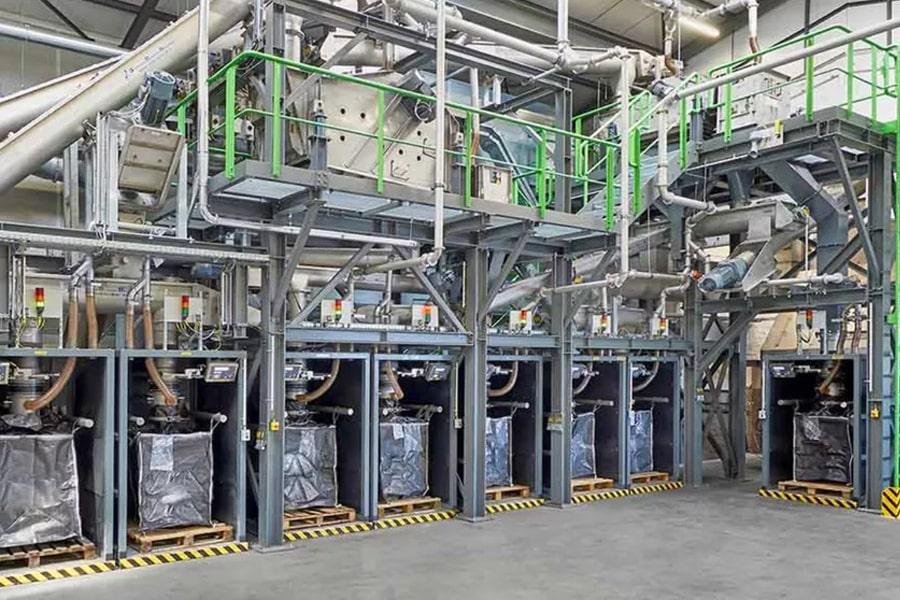
Mining is only the beginning. Lithium-bearing material must be processed into a chemical product that customers can use. This is where lithium refining and conversion costs become important.
A spodumene concentrate, for example, is not equivalent to battery-grade lithium carbonate or lithium hydroxide. It must undergo additional processing and chemical conversion. Brine-derived material also requires purification and conversion to achieve the necessary product specifications.
Refining costs can include:
-
Energy for heating, roasting or other processing stages.
-
Chemicals and reagents used during conversion.
-
Water treatment and waste management.
-
Labour and maintenance.
-
Equipment depreciation and plant financing.
-
Recovery losses and process inefficiencies.
-
Quality testing and product qualification.
-
Transport of feedstock and finished chemicals.
A converter’s profitability depends on the cost and quality of its feedstock, the price received for the final chemical, processing yields, plant utilisation and contract terms.
If conversion capacity is insufficient, a market can experience a bottleneck even when mine production is increasing. If new refineries come online faster than feedstock supply or customer demand, conversion margins may come under pressure.
Battery-grade versus technical-grade lithium purity
Not all lithium chemicals are suitable for battery manufacturing. Technical-grade lithium is used in industrial applications where the product specification is designed for a particular use. Battery-grade lithium must meet more demanding chemical specifications and impurity limits required by battery material producers.
Purity is important because unwanted impurities can affect the performance, consistency and manufacturing quality of cathode materials. Buyers may specify limits for elements such as sodium, calcium, magnesium, iron and other contaminants, depending on the product and manufacturing process.
Battery-grade material is therefore not defined simply by a high headline purity percentage. The full chemical specification, consistency between batches, moisture content, particle characteristics where relevant, and quality assurance procedures can all matter.
For a buyer, the practical questions include:
-
Does the product meet the agreed chemical specification?
-
Are impurity limits documented?
-
Is the supplier able to maintain consistent quality between shipments?
-
Has the material been tested and qualified by the intended customer?
-
Can the producer provide reliable certificates of analysis and traceability?
A material may be chemically close to battery grade but still require further processing or customer qualification before it can be used in a particular battery supply chain.
Why conversion capacity and quality can affect prices
Suppose a region has access to substantial spodumene concentrate but only limited capacity to convert it into battery-grade chemicals. In that case, the value of the concentrate and the value of the finished chemical may diverge. The converter must cover its processing costs and earn a margin, while the battery manufacturer needs a product that meets its specifications.
If conversion plants experience outages, maintenance delays or quality problems, the supply of qualified lithium chemicals can tighten even when upstream mine output remains healthy.
This is one reason why lithium market analysis should track both upstream production and downstream chemical output. A mine production chart alone cannot explain every movement in battery-grade lithium prices.
4. Battery Chemistry, Global Producers and the Future Lithium Market
LFP, NMC and NCA: why battery chemistry matters
Lithium-ion batteries are not all built using the same chemistry. Different cathode materials are selected to balance energy density, cost, safety, durability and performance. These choices influence the type and quantity of raw materials required by battery manufacturers.
Three widely discussed cathode chemistries are lithium iron phosphate (LFP), nickel manganese cobalt (NMC) and nickel cobalt aluminium (NCA).
Lithium iron phosphate (LFP) batteries use lithium iron phosphate as the cathode material. They do not require nickel or cobalt in the cathode, which can help reduce exposure to the prices and supply risks of those metals. LFP batteries are widely used in electric vehicles and stationary energy storage applications. They are often attractive where cost, durability and thermal characteristics are important.
LFP still requires lithium. Its growth can therefore support lithium demand even as it reduces the need for certain other battery minerals.
NMC batteries combine nickel, manganese and cobalt in the cathode. The proportions can vary across different formulations. Nickel-rich NMC chemistries are designed to deliver high energy density, making them relevant to applications where driving range and battery weight are important. These formulations can influence demand for nickel, cobalt and lithium chemicals.
NCA batteries use nickel, cobalt and aluminium in their cathode composition. They are associated with high-energy-density applications and have been used in certain electric vehicle platforms.
The key point is that the growth of LFP does not remove lithium from the battery supply chain. It changes the mix of other materials used alongside lithium and can influence which lithium compounds are preferred by particular manufacturers.
Does battery chemistry change lithium consumption?
Battery chemistry can influence lithium requirements, but it is not the only factor determining lithium consumption. Battery size, cell design, manufacturing efficiency, energy density and production yields also matter.
A manufacturer producing a larger battery pack may consume more lithium-containing material than one producing a smaller pack, even if both use the same cathode chemistry. Similarly, improvements in cell design can change the amount of material required for a given unit of energy storage.
Lithium intensity is therefore better understood as the amount of lithium required per unit of battery capacity or energy storage, rather than simply the number of vehicles sold.
Another important distinction is between the lithium content of a battery and the mass of lithium carbonate equivalent (LCE) used to report industry production and consumption. LCE is a common way of expressing lithium quantities on a comparable basis. It is not the same as saying that a battery contains that exact mass of lithium carbonate.
When reading market forecasts, check whether the figures refer to lithium metal content, lithium carbonate, lithium hydroxide or LCE. Mixing these units can lead to misleading comparisons.
Global lithium production and supply chain concentration
Lithium resources and production are geographically concentrated. Australia is a major hard-rock producer, while Chile and Argentina are important brine-producing countries. China is a major participant in lithium processing and refining, as well as battery materials and battery manufacturing.
The wider South American lithium region, often called the Lithium Triangle, includes parts of Argentina, Bolivia and Chile. It is recognised for its substantial lithium brine resources, although resources, reserves and actual commercial production should not be treated as interchangeable measures.
The supply chain can be understood through several major roles:
-
Australia: A leading source of hard-rock lithium, particularly spodumene concentrate.
-
Chile: An established producer with major lithium brine operations.
-
Argentina: A growing lithium producer with a pipeline of brine projects.
-
China: A major lithium processing and refining centre and an important battery manufacturing hub.
-
Other emerging producers: Countries in North America, Europe, Africa and elsewhere are developing projects to diversify supply.
Canada also has lithium resources and is working to develop its critical minerals sector. Government mineral information is useful for understanding its resource base, production context and the wider importance of lithium to industrial supply chains.
Why China matters so much to lithium prices
China plays a significant role in the lithium value chain because it is involved in chemical conversion, battery materials, cell production and EV manufacturing. This means that developments in China’s industrial activity can influence demand for lithium chemicals as well as the availability of processed material.
For example, stronger battery production can increase demand for lithium carbonate and lithium hydroxide. On the other hand, slower EV production, high inventories or reduced battery orders can weaken purchasing interest.
Trading Economics’ 20 November 2026 market commentary reported that Chinese lithium carbonate prices had fallen below CNY 90,000 per tonne amid concerns about softer demand and ample stocks. It also described a revision to Chinese inventory data and reported restarts and investment in lithium projects in Australia and Argentina. This illustrates how changes in stock estimates, mine restarts and demand expectations can influence market sentiment.
China’s influence should not be interpreted as control over every part of the global lithium market. Mining takes place across multiple countries, and chemical buyers and battery manufacturers operate internationally. Nevertheless, China’s position in refining and battery manufacturing makes its industrial activity an important indicator for market participants.
Supply chain concentration and geopolitical risk
Concentrated production can create vulnerabilities. If a small number of regions account for a large share of supply, disruptions in those locations may have a disproportionate impact on the market.
Potential risks include:
-
Changes in mining licences and environmental approvals.
-
Export restrictions or changes in trade policy.
-
Political instability and resource nationalism.
-
Water availability and environmental constraints.
-
Labour disputes and infrastructure disruptions.
-
Delays in mine construction or refinery commissioning.
-
Transport bottlenecks and port congestion.
-
Restrictions on technology, equipment or investment.
Governments and manufacturers are increasingly interested in diversifying supply. This can encourage investment in domestic mining, refining, recycling and strategic partnerships. However, building a new supply chain takes time, capital, technical expertise and customer qualification.
A new mine in a different country does not automatically create a fully independent supply chain if its concentrate still needs to be processed elsewhere. Diversification must consider mining, conversion, refining, battery materials and manufacturing together.
Recycling and secondary lithium supply
Lithium-ion battery recycling is another developing part of the supply picture. As EVs and energy storage systems become more widespread, more batteries will eventually reach the end of their useful first life. Recycling can recover valuable materials and reduce the need for some new mined inputs.
The economics of recycling depend on the type and condition of batteries, collection systems, transport costs, processing technology, recovery rates and the value of recovered materials. Battery chemistries also matter. Batteries containing higher-value nickel and cobalt may offer different recycling economics from LFP batteries, although lithium recovery can still be important.
Recycling is not an immediate substitute for primary lithium production. The volume of end-of-life batteries available depends on the number of batteries installed in previous years and how long they remain in service. During periods of rapid EV adoption, the market may still need substantial new mined supply because many recently manufactured batteries will not be ready for recycling for years.
Over time, however, recycling can become a more significant secondary source. It may help reduce waste, recover materials and improve supply resilience.
What could drive lithium prices in the coming years?
The future direction of lithium prices will depend on the interaction of demand growth, new production, chemical conversion capacity, inventories and technological change. Rather than relying on one forecast, market participants should consider several possible scenarios.
Scenario 1: EV and storage demand grows faster than supply.
If electric vehicle production and stationary storage installations expand rapidly while mine and refinery capacity lag, the market could tighten. Buyers may compete for available battery-grade chemicals, inventories may decline and prices could rise.
Scenario 2: New projects create a sustained surplus.
If mines and conversion facilities ramp up faster than demand, the market may have more material than buyers need. Inventories could build, spot prices could weaken and higher-cost producers may reduce output or delay expansions.
Scenario 3: Demand grows, but battery technology changes.
A shift in battery chemistry, improvements in energy density or more efficient manufacturing could change the amount and type of lithium chemicals required. Total battery deployment may rise while lithium intensity per unit of capacity changes.
Scenario 4: Supply disruptions create temporary price spikes.
Weather events, permitting delays, geopolitical developments, transport problems or refinery outages can temporarily reduce available supply. Prices may react quickly, even if the long-term market remains adequately supplied.
Scenario 5: Recycling becomes more commercially important.
As more batteries reach the end of their first life, recovered lithium may contribute a growing share of supply. The impact will depend on collection rates, recycling technology, recovery economics and the volume of material available.
The most useful approach is to monitor leading indicators rather than rely on a single headline about EV sales or mine production.
Key indicators to monitor when analysing lithium prices
|
Indicator |
What it reveals |
Why it matters |
|---|---|---|
|
Battery-grade lithium carbonate prices |
Market value of a key lithium chemical |
Shows price direction in a major battery material |
|
Lithium hydroxide prices |
Pricing of another important battery chemical |
Reflects demand and supply for relevant cathode supply chains |
|
Spodumene concentrate prices |
Upstream hard-rock feedstock costs |
Helps assess mine economics and conversion margins |
|
Brine project output |
Supply from major brine-producing regions |
Indicates the contribution of brine operations |
|
Mine production and capacity |
Potential upstream supply |
Helps identify expansions, restarts and closures |
|
Refinery operating rates |
Chemical conversion availability |
Reveals whether feedstock can become saleable chemicals |
|
Chinese lithium inventories |
Stocks in a major market |
Offers insight into short-term supply-demand conditions |
|
EV and battery production |
Demand from transport electrification |
Helps assess a major source of lithium consumption |
|
LFP, NMC and NCA market mix |
Changes in battery chemistry |
Shows how battery technology affects material demand |
|
Recycling capacity and recovery |
Secondary supply potential |
Indicates future contribution from recycled batteries |
No single indicator provides a complete picture. For example, a rise in mine production may be offset by lower refinery output, while higher battery production may be met from existing inventory rather than new spot purchases.
For this reason, lithium market analysis should combine price data with physical supply-chain information.
Conclusion: Lithium Prices Reflect More Than EV Demand
Lithium prices are shaped by a complex relationship between mining, chemical processing, battery manufacturing and global demand. Electric vehicles and energy storage systems are important sources of consumption, but they are only part of the story. Mine production, refinery capacity, inventory levels, battery chemistry, product quality, logistics and government policy all influence the price buyers ultimately pay.
The distinction between lithium carbonate and lithium hydroxide, and between battery-grade and technical-grade material, is particularly important. A headline price is meaningful only when its product specification, location, currency and unit are understood. Likewise, hard-rock spodumene and lithium brine have different extraction economics, but neither method is automatically the lowest-cost option in every market.
Battery technology adds another layer. LFP, NMC and NCA chemistries create different material requirements, while improvements in cell design and recycling may change future lithium intensity. Meanwhile, the concentration of mining and refining capacity across countries such as Australia, Chile, Argentina and China makes supply-chain developments an important part of price analysis.
For anyone tracking lithium prices, the most reliable approach is to watch several indicators together: benchmark chemical prices, mine and refinery output, inventories, EV and battery production, project developments and recycling capacity. This provides a more balanced understanding than reacting to a single daily price movement.
Lithium is not simply an EV growth story. It is a global industrial commodity whose price reflects the entire journey from mineral resource to battery-ready chemical. Understanding that journey is the key to interpreting market volatility and evaluating where battery mineral costs may go next.
Editorial note: This article is for general market education, not investment advice. Lithium price assessments can differ by product, grade, location, unit and methodology. Verify current quotations with the relevant price reporting service or supplier before making commercial decisions.
FAQs: Lithium Prices Explained What Drives Battery Mineral Costs
1. What determines the global price of lithium?
Lithium prices are mainly influenced by supply and demand, mine production, refining capacity, battery manufacturing activity, inventories, product quality, logistics and government policies. Market expectations can also cause prices to move before physical supply or demand changes.
2. Why are lithium prices so volatile?
Lithium prices can be volatile because supply projects require significant investment and time to develop, while demand and purchasing decisions can change quickly. Inventory cycles, mine restarts, refinery disruptions and changes in EV production can create sharp movements.
3. What is the difference between lithium carbonate and lithium hydroxide?
Lithium carbonate and lithium hydroxide are two important lithium chemicals used in battery supply chains. They have different chemical properties and applications. Lithium hydroxide is particularly relevant to certain nickel-rich cathode production routes, while lithium carbonate is used in several battery and industrial applications.
4. Which is more expensive: lithium carbonate or lithium hydroxide?
Neither is consistently more expensive. Their relative prices depend on feedstock costs, conversion capacity, battery chemistry demand, regional availability, quality specifications and contract conditions.
5. What is battery-grade lithium?
Battery-grade lithium is lithium chemical material that meets the purity and impurity specifications required by battery material manufacturers. The exact limits depend on the product, customer and manufacturing process.
6. What is the difference between battery-grade and technical-grade lithium?
Battery-grade lithium is manufactured to meet demanding specifications for battery production. Technical-grade lithium is intended for other industrial applications and may have different impurity limits and quality requirements.
7. What is lithium carbonate equivalent (LCE)?
Lithium carbonate equivalent is a standardised way to express different lithium products or quantities on a lithium carbonate-equivalent basis. It helps analysts compare production, consumption and resources across different chemical forms.
8. Why does EV production affect lithium prices?
Electric vehicles use rechargeable lithium-ion batteries. When EV production and battery capacity installations increase, demand for lithium chemicals can rise. The actual price impact depends on whether supply expands at a similar or faster rate.
9. Does every electric vehicle battery use lithium?
Most mainstream rechargeable EV battery systems today use lithium-ion technology, but battery chemistries and designs differ. The specific lithium requirement depends on the battery technology and cell design.
10. How do LFP batteries affect lithium demand?
LFP batteries use lithium iron phosphate cathodes. They do not require nickel or cobalt in the cathode, but they still require lithium. Growing LFP adoption can therefore support lithium demand while changing demand for other battery minerals.
11. What is the difference between LFP, NMC and NCA batteries?
LFP uses lithium iron phosphate in its cathode. NMC uses nickel, manganese and cobalt, while NCA uses nickel, cobalt and aluminium. These chemistries offer different combinations of cost, energy density, performance and material requirements.
12. Which countries produce the most lithium?
Australia, Chile, China and Argentina are among the major lithium-producing countries. Their roles differ across hard-rock mining, brine extraction and chemical processing.
13. What is the Lithium Triangle?
The Lithium Triangle refers to the lithium-rich region spanning parts of Argentina, Bolivia and Chile in South America. It is particularly known for its large lithium brine resources.
14. Why is Australia important to the lithium market?
Australia is a major hard-rock lithium producer, particularly through spodumene mining. Its output supplies feedstock to chemical conversion facilities and battery supply chains.
15. Why is China important to lithium prices?
China is a major participant in lithium refining, battery material processing and battery manufacturing. Its industrial activity, inventories and purchasing behaviour can influence global lithium market sentiment and prices.
16. What is spodumene?
Spodumene is a lithium-bearing mineral found in hard-rock deposits. It is mined, concentrated and processed to produce lithium chemicals such as lithium carbonate or lithium hydroxide.
17. What is lithium brine extraction?
Lithium brine extraction involves recovering lithium from underground saline water. Conventional operations may use evaporation ponds to concentrate lithium, followed by chemical processing and purification.
18. Is hard-rock lithium more expensive than brine lithium?
Not always. Costs depend on ore grade, brine chemistry, recovery rates, energy use, water availability, processing technology, logistics and project scale. A well-designed hard-rock operation can be competitive, while a challenging brine project may have high costs.
19. What is direct lithium extraction (DLE)?
Direct lithium extraction refers to technologies designed to selectively recover lithium from brine using processes such as adsorption, ion exchange or membranes. Commercial performance depends on the specific brine, technology, recovery rate and operating costs.
20. Why are lithium refining costs important?
Mining produces lithium-bearing material, but battery manufacturers generally require processed lithium chemicals that meet specific quality standards. Refining and conversion costs determine how economically raw material can be turned into usable products.
21. Can lithium prices fall when EV sales increase?
Yes. Prices can fall if mine production, chemical conversion capacity and inventories increase faster than consumption. Commodity prices reflect the supply-demand balance, not demand growth in isolation.
22. What causes a lithium market surplus?
A surplus develops when available lithium supply exceeds consumption over a defined period. New mine capacity, refinery expansions, weaker battery production or slower purchasing can contribute to a surplus.
23. What happens when lithium supply is lower than demand?
A supply deficit can lead to lower inventories, stronger competition among buyers, higher spot prices and efforts to secure longer-term contracts. The impact depends on available stocks and the ability of producers to increase output.
24. What is the difference between lithium spot prices and contract prices?
Spot prices relate to material bought or sold for relatively prompt delivery. Contract prices are negotiated between buyers and sellers under agreed terms and may use fixed prices or market-linked formulas.
25. Can lithium be traded through futures markets?
Lithium-related derivatives and futures contracts exist, but market structures and product specifications differ. They are not as standardised or widely transparent as futures markets for established commodities such as gold or copper. Traders should understand contract specifications and settlement terms before using them.
26. How do lithium prices affect EV battery costs?
Lithium is an important battery input, so changes in its price can influence cell manufacturing costs. However, finished battery prices also depend on other raw materials, manufacturing efficiency, cell design, pack components, warranties and logistics.
27. Why can two lithium suppliers quote different prices?
Suppliers may offer different chemical grades, purity levels, delivery locations, volumes, payment terms, contract durations and quality guarantees. Two quotations should only be compared after these specifications are aligned.
28. Will lithium recycling reduce demand for newly mined lithium?
Recycling can provide secondary lithium supply and reduce the need for some newly mined material. However, its contribution depends on battery collection, end-of-life volumes, recovery technology and economics. Primary production will remain important while battery deployment continues to expand.
29. What indicators should I monitor to understand lithium price trends?
Monitor lithium carbonate and hydroxide prices, spodumene concentrate prices, mine output, refinery operating rates, inventories, EV and battery production, battery chemistry shares, project developments and recycling capacity.
30. How can I follow lithium prices and market trends?
Use established commodity market-data providers, price reporting agencies, industry reports and government mineral statistics. Always verify the product specification, unit, currency, location and reporting date before comparing prices.
