

Why Do Petrol and Diesel Prices Differ Between Countries?
Discover why petrol and diesel prices differ between countries. Learn how crude oil prices, fuel taxes, exchange rates, subsidies, refining costs and government policies affect fuel prices.
Why Does the Same Fuel Cost Different Amounts Around the World?
Have you ever wondered why filling a car’s fuel tank costs significantly more in one country than in another? A litre of petrol may be relatively affordable in an oil-producing country, while motorists in another country may pay several times more for the same quantity of fuel. Even neighbouring countries can have noticeably different petrol and diesel prices.
At first glance, this difference may seem confusing. After all, crude oil is traded in international markets, and petrol and diesel are produced from the same basic raw material. If the global oil market influences fuel prices everywhere, why don’t all countries charge approximately the same amount at the pump?
The answer lies in the journey between crude oil production and the fuel station.
The price consumers pay is not simply the international price of crude oil divided into litres. It includes several additional costs, such as refining, transportation, storage, distribution, insurance, import duties, government taxes and retail margins. Countries also follow different economic policies. Some governments allow fuel prices to move according to international market conditions, while others use subsidies, tax reductions or price controls to protect consumers.
Currency exchange rates also matter. Crude oil and many petroleum products are traded internationally in US dollars. When a country’s currency loses value against the dollar, importing oil can become more expensive even if the international crude oil price remains unchanged.
Another important factor is the difference between petrol and diesel. These fuels have different production requirements, market demand patterns and tax treatments. Diesel is widely used in commercial transportation, agriculture, construction, shipping and industrial machinery, while petrol is primarily associated with passenger vehicles in many markets. These differences influence their wholesale prices and retail costs.
Understanding these factors is important for more than just motorists. Fuel prices influence public transportation fares, delivery charges, agricultural expenses, manufacturing costs, airline operations and the overall cost of living. When fuel becomes expensive, businesses often face higher operating expenses, which can eventually affect the prices consumers pay for everyday products.
In this guide, we will explore why petrol and diesel prices differ between countries, how international crude oil benchmarks influence domestic markets, why taxation creates major price differences, and how government policies and currency movements affect the final amount at the fuel station.
1. International Crude Oil Prices: The Global Starting Point for Fuel Costs
How crude oil prices influence petrol and diesel
Crude oil is the primary raw material used to produce conventional petrol and diesel. It is extracted from underground reservoirs and offshore fields, transported to refineries, and processed into different petroleum products.
Because crude oil is traded in international markets, its price is influenced by global supply and demand rather than the economic conditions of one individual country.
This creates an important connection between international crude oil prices and domestic fuel costs.
When crude oil prices rise, refineries generally face higher feedstock expenses. If wholesale petrol and diesel prices also increase, fuel retailers may eventually pass some of these additional costs to consumers. When crude oil prices decline, the cost of producing petroleum products may fall, potentially creating room for lower retail prices.
However, the relationship is not always immediate or identical across countries. Refining margins, currency movements, taxes, government regulations and existing fuel inventories can change how much of an international price movement reaches consumers.
Understanding Brent and WTI crude oil benchmarks
Two of the most widely followed international crude oil benchmarks are Brent and West Texas Intermediate (WTI).
Brent crude oil is a major international pricing benchmark associated with crude oil produced in the North Sea. It is commonly used as a reference for oil traded in Europe, Africa and many other international markets.
West Texas Intermediate (WTI) is a benchmark for light, sweet crude oil associated with the United States. It is widely followed in North American energy markets.
These benchmarks help traders, refiners, governments and energy companies understand changes in the global oil market.
However, Brent and WTI are not the prices of petrol or diesel at a fuel station. They represent crude oil benchmarks. The final price of refined products depends on additional factors, including refining capacity, product specifications, transportation and local market conditions.
For example, two countries may purchase crude oil at prices linked to similar international benchmarks but still have very different petrol prices because one applies higher fuel taxes and the other provides government subsidies.
Global petroleum supply-demand dynamics
International crude oil prices respond to the balance between supply and demand.
When global economic activity expands, industries may require more energy, airlines may increase operations, and transportation networks may consume more petroleum products. This can increase demand for crude oil.
On the supply side, production decisions by major oil-producing countries can influence the quantity of crude oil available to international markets.
The Organization of the Petroleum Exporting Countries (OPEC), along with other participating producers, plays an important role in global oil supply decisions. Production adjustments can influence market expectations and contribute to changes in crude oil prices.
Geopolitical developments can also create uncertainty. Conflicts, sanctions, trade restrictions, shipping disruptions and instability in major oil-producing regions may affect the availability or transportation of crude oil.
Consider a situation in which a major shipping route becomes difficult to use. Even if oil production continues, longer transportation routes, higher insurance costs and delivery uncertainty may increase the cost of bringing crude oil and refined products to buyers.
These changes can eventually affect petrol and diesel prices in countries that depend on imported petroleum.
Why crude oil price changes do not affect every country equally
Imagine that the international crude oil price increases by 10%.
A country with relatively low fuel taxes and a market-based pricing system may experience a noticeable change in retail petrol prices. Another country with higher fixed excise duties or government-controlled prices may experience a smaller or delayed change.
The reason is that crude oil is only one component of the final retail price.
A useful distinction is between the international cost of fuel supply and the domestic price paid by consumers. International markets influence the first, while national policies and supply-chain conditions determine how that cost is reflected in the second.
This is why comparing crude oil prices alone cannot explain why petrol and diesel prices differ between countries.
2. Fuel Taxes and Government Policies: Why National Pricing Decisions Matter
Fuel taxation structure: Excise duty, VAT and sales tax
One of the biggest reasons for differences in petrol and diesel prices across countries is the fuel taxation structure.
Governments impose taxes on petroleum products to generate public revenue, fund infrastructure, support public services and, in some cases, discourage excessive fossil-fuel consumption.
The exact tax structure varies considerably from one country to another.
The main types of fuel taxes include:
Excise duty: This is generally a specific tax charged on a fixed quantity of fuel, such as each litre or gallon sold. It can be collected at the production, import or distribution stage, depending on the country’s tax system.
Value Added Tax (VAT): VAT is a consumption tax applied to goods and services. Some countries apply VAT to petrol and diesel, while others use different tax arrangements.
Sales tax: Certain countries or regions apply sales taxes to fuel purchases. The amount may vary depending on the state, province or local authority.
Import duties and customs charges: Countries importing crude oil or refined petroleum products may apply customs duties or other import-related charges. These can increase the landed cost of fuel.
The combined effect of these taxes can be substantial.
For example, consider two hypothetical countries that purchase and refine crude oil at similar costs.
Country A applies a relatively low excise duty and a modest consumption tax. Country B applies a higher fixed fuel levy and a higher VAT rate. Even if their underlying petroleum supply costs are similar, motorists in Country B may pay considerably more at the pump.
This is one reason why countries with comparable access to international oil markets can have very different retail fuel prices.
Why petrol and diesel taxes differ
Governments do not always tax petrol and diesel at the same rate.
In some countries, diesel receives preferential tax treatment because it is widely used by freight operators, farmers, manufacturers and public transportation providers. Keeping diesel affordable may help reduce the cost of moving goods and operating essential services.
Other countries may tax diesel more heavily because of environmental policy objectives, differences in fuel consumption or the need to raise government revenue.
The important point is that there is no universal rule requiring petrol and diesel to have the same tax rate.
A country can deliberately maintain a lower diesel tax to support commercial activity, while another may apply a higher diesel tax to reflect environmental or fiscal priorities.
Government fuel subsidies
Fuel subsidies are another major reason for international price differences.
A government subsidy reduces the amount consumers or selected fuel buyers pay compared with the cost that would otherwise be charged under market-based pricing.
Subsidies can operate in several ways:
-
The government compensates fuel suppliers for selling below an approved reference price.
-
Public funds cover part of the difference between international supply costs and domestic retail prices.
-
Tax reductions lower the final price paid by consumers.
-
Certain groups, industries or transportation services receive targeted fuel assistance.
Oil-producing countries may have access to domestic petroleum resources and government revenues that allow them to support lower domestic fuel prices. However, being an oil producer does not automatically mean that a country will have cheap petrol or diesel. Domestic refining capacity, export opportunities, taxes and pricing policy still matter.
Subsidies can provide short-term relief during periods of high international oil prices. They can also protect household purchasing power and help businesses manage operating expenses.
However, subsidies create fiscal costs. When governments compensate suppliers or keep retail prices below market levels, public money must cover the difference. If subsidies are broad and continue for a long period, they can place pressure on government budgets.
They may also encourage higher fuel consumption because consumers do not face the full economic cost of the product.
Price controls and regulated fuel pricing mechanisms
Not every country allows fuel prices to change freely.
Some governments use regulated pricing mechanisms to manage how international market changes reach consumers.
These mechanisms may include:
-
Official maximum retail prices.
-
Fixed prices reviewed periodically.
-
Formula-based pricing linked to international fuel benchmarks.
-
Temporary price freezes.
-
Government compensation for fuel suppliers.
-
Limits on the frequency or size of retail price changes.
For example, a government may review international fuel costs every month and adjust domestic prices according to a predetermined formula. Another government may allow prices to change weekly, while a third may keep retail prices stable during a temporary international oil shock.
The IMF’s 2026 note on fuel pricing explains that government interventions can occur at different stages of the supply chain, including fuel availability, distribution and final sale. It also highlights the importance of transparent and consistent pricing mechanisms. Source: IMF fuel-pricing note.
Why two countries respond differently to the same oil shock
Imagine that global crude oil prices rise sharply over a short period.
In Country A, fuel prices are adjusted frequently according to international market conditions. Motorists may see the increase relatively quickly.
In Country B, the government maintains a temporary retail price ceiling. Consumers may initially see little change, but the government or fuel suppliers may absorb the additional cost.
In Country C, the government reduces fuel taxes for a limited period. The price increase may be partly offset, although the policy reduces tax revenue.
All three countries face a similar international market movement, but their domestic retail prices behave differently.
This demonstrates why government policy is not simply an additional detail in fuel pricing. It can fundamentally change the relationship between international oil prices and what consumers pay.
3. Currency Exchange Rates, Refining Costs and Fuel Import Dependency
Why the US dollar matters in international oil trading
Crude oil and many refined petroleum products are priced and traded internationally in US dollars.
This means that countries using other currencies must consider exchange rates when purchasing imported oil.
Suppose an importer needs to purchase crude oil worth $100 million. The amount of local currency required depends on the exchange rate at the time of payment.
If the local currency weakens against the US dollar, the importer needs more domestic currency to purchase the same dollar value of oil.
As a result, fuel import costs may increase even if the international crude oil benchmark remains unchanged.
On the other hand, when a domestic currency strengthens against the dollar, imported crude oil and petroleum products may become less expensive in local-currency terms.
Currency exchange rates and US dollar–local currency fluctuations
Consider a simplified example.
Assume a hypothetical country imports crude oil worth $100 per barrel.
At an exchange rate of 80 local currency units per US dollar, the crude oil cost is equivalent to 8,000 local currency units per barrel.
If the local currency weakens and the exchange rate moves to 85 per dollar, the same $100 barrel now costs 8,500 local currency units.
The international oil price has not changed, but the local-currency cost has increased by 500 units per barrel.
This example excludes freight, insurance, refining, taxes and other costs. Its purpose is to demonstrate how currency depreciation can increase the domestic cost of imported energy.
The effect is especially important for countries that depend heavily on imported crude oil or refined fuel.
How import dependency affects domestic fuel prices
Countries meet their petroleum requirements through different combinations of domestic production, crude oil imports and refined fuel imports.
A country with significant domestic crude oil production may have more control over its physical supply. However, its domestic fuel prices may still be linked to international market prices because crude oil has an export value.
For example, selling crude oil domestically at a price substantially below the international market can involve an economic opportunity cost: the producer gives up potential export revenue.
An oil-importing country faces a different challenge. It must purchase crude oil or finished petroleum products from international suppliers and arrange transportation, insurance, financing and storage.
The cost of imported fuel can therefore include:
-
International crude oil or refined product prices.
-
Shipping and freight charges.
-
Marine insurance.
-
Port and handling charges.
-
Import duties and customs fees.
-
Currency conversion and financing costs.
-
Storage and inland transportation.
If a country has limited domestic refining capacity, it may need to import more finished petrol and diesel. This can make domestic supply more exposed to international refined-product prices and regional transportation conditions.
Domestic oil refining costs and refinery margins
Crude oil cannot normally be poured directly into a vehicle’s fuel tank. It must first be processed in an industrial facility known as an oil refinery.
Refineries use a combination of physical separation and chemical processing to convert crude oil into usable products.
These include petrol, diesel, aviation fuel, liquefied petroleum gas, fuel oil, lubricants and other petroleum-based materials.
The cost of refining depends on several factors:
-
The type and quality of crude oil being processed.
-
Refinery technology and processing complexity.
-
Energy and electricity consumption.
-
Labour and maintenance expenses.
-
Equipment reliability and operating efficiency.
-
Environmental and fuel-quality requirements.
-
The market value of the products being produced.
Different refineries are designed to process different types of crude oil. Some can handle heavier or higher-sulphur crude more efficiently than others.
A refinery’s location also matters. A facility close to crude oil supplies, ports and major consumer markets may have different operating and transportation costs from a refinery located far from those resources.
Understanding refinery margins and fuel crack spreads
A refinery purchases crude oil and sells the petroleum products it produces. The difference between the value of its output and the cost of its crude oil feedstock is central to refinery profitability.
A commonly used market indicator is the crack spread.
A crack spread represents the price difference between crude oil and refined petroleum products. It is used as an indicator of the potential margin from processing crude oil into products such as petrol and diesel.
For example, if wholesale diesel prices rise faster than crude oil prices, the diesel crack spread may widen. This can indicate stronger diesel refining margins.
A higher crack spread does not automatically mean that every refinery is earning the same profit. Actual profitability depends on its crude oil mix, operating costs, product yield, contracts and other factors.
The EIA uses crack spreads as indicators of refining margins and explains how the difference between crude oil and refined product prices can affect diesel pricing. Source: EIA petroleum product markets.
Why petrol and diesel refining costs are different
Petrol and diesel are different products with different chemical and performance specifications.
They are produced through different combinations of refining processes and blending operations. The cost of producing each fuel depends on the crude oil being processed, the refinery’s configuration and the required fuel standards.
Environmental regulations can also influence production expenses.
For example, producing ultra-low-sulphur diesel requires additional processing to remove sulphur. This can involve more energy, equipment and operational costs.
Petrol specifications may also vary across markets. Octane requirements, volatility limits, seasonal formulations and blending components can affect production costs.
Consequently, petrol and diesel do not always experience the same wholesale price movements, even when they originate from the same crude oil supply.
4. Transportation, Distribution and International Fuel Price Pass-Through
From refinery to fuel station: Understanding the supply chain
After crude oil has been refined, the finished petrol and diesel must be transported to consumers.
This process involves multiple stages, and every stage can add costs.
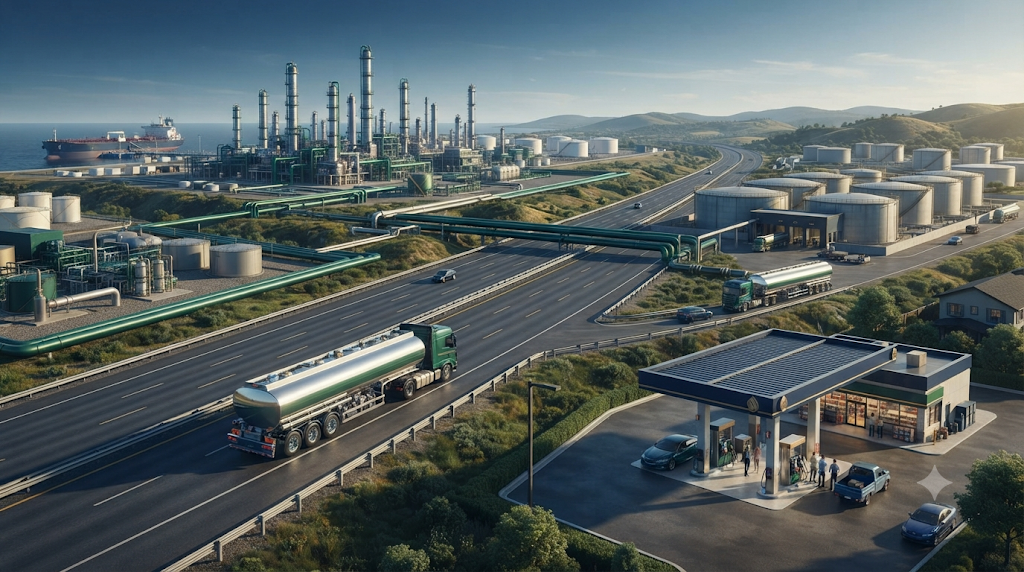
A simplified fuel supply chain looks like this:
Crude oil production → International transportation → Refining → Storage terminals → Wholesale distribution → Retail fuel stations → Consumers
Depending on the country, petroleum products may move through pipelines, ships, railways and road tankers.
Countries with extensive pipeline networks and strategically located refineries may be able to distribute fuel efficiently. Countries with limited infrastructure or difficult geographical conditions may face higher transportation expenses.
For example, delivering fuel to a remote island may require marine transportation and additional storage facilities. Delivering fuel to a landlocked country may require imports through neighbouring countries, international pipelines or cross-border road and rail networks.
These logistical differences can influence the final price.
Fuel distribution, transportation, storage and retail marketing costs
Distribution expenses include much more than the cost of moving a tanker from one location to another.
They can include:
-
Pipeline transportation charges.
-
Road tanker and rail freight expenses.
-
Shipping and port handling costs.
-
Storage terminal operating expenses.
-
Inventory financing and working capital.
-
Fuel handling and quality control.
-
Insurance and security.
-
Retail station wages, maintenance and electricity.
-
Land rent, equipment costs and marketing expenses.
Fuel stations also have different business models. Some are owned by major oil companies, while others operate independently or under franchise arrangements.
Their retail margins may depend on location, competition, sales volume, operating expenses and supplier agreements.
A fuel station located near a major distribution terminal may face different delivery expenses from one situated in a remote region.
Why fuel prices vary within the same country
International price differences are only part of the story. Petrol and diesel prices can also vary between cities, states and regions within one country.
Consider two fuel stations in the same country.
The first station may be located close to a refinery or major fuel terminal. The second may be far away and depend on road transportation over long distances.
Even if both stations purchase fuel under the same national pricing framework, differences in local freight, taxes, retail expenses and competition can affect their final prices.
Regional tax policies can create additional variation. In countries where states or provinces have authority to impose local fuel taxes, the retail price may differ across administrative boundaries.
Local market conditions also matter. A fuel station with several nearby competitors may use a different pricing strategy from a station operating in an area with limited competition.
International fuel price pass-through
International fuel price pass-through describes how changes in international crude oil or refined petroleum prices are reflected in domestic wholesale and retail fuel prices.
A complete pass-through means that the relevant international cost change is ultimately reflected in domestic prices, after accounting for other components.
However, pass-through is not always immediate or equal across countries.
There are several reasons for this:
-
Inventory timing: Importers and distributors may still hold fuel purchased at earlier prices.
-
Existing contracts: Suppliers may have agreements that delay the effect of changing international prices.
-
Exchange rate movements: Currency appreciation or depreciation can amplify or offset crude oil price changes.
-
Tax structure: Fixed taxes can reduce the percentage impact of changes in the underlying fuel cost.
-
Government intervention: Price controls, subsidies and tax adjustments can delay or reduce retail price changes.
-
Retail competition: Distributors and fuel stations may adjust their margins at different speeds.
For example, a country that imports fuel and adjusts retail prices frequently may transmit international market changes relatively quickly.
Another country may review prices once a month or use a regulated formula. Consumers there may experience a delay.
The GlobalPetrolPrices fuel primer discusses how pricing arrangements influence adjustment periods and explains why regulated markets may respond more slowly than liberalized markets. Source: GlobalPetrolPrices fuel-pricing primer.
Why retail petrol prices do not always fall immediately
Consumers often notice that fuel prices appear to rise quickly when crude oil becomes expensive but decline more slowly when crude oil prices fall.
This can happen for several reasons, including inventory costs, wholesale market conditions, taxes, exchange rates, supplier contracts and government pricing decisions.
It is important not to assume that every delayed price reduction is automatically evidence of unfair pricing. The actual explanation depends on the country’s pricing mechanism and the timing of its supply contracts.
A proper analysis should compare international refined-product prices, local currency movements, taxes and domestic wholesale prices rather than looking at crude oil prices alone.
5. Why Petrol and Diesel Prices Differ: Demand, Product Specifications and Country Comparisons
Petrol vs diesel: Different products, different markets
Petrol and diesel are both refined from crude oil, but they serve different purposes across the economy.
Petrol is commonly used in passenger cars, motorcycles and certain light vehicles. Diesel is widely used in trucks, buses, tractors, construction equipment, ships, generators and industrial machinery.
This difference in usage creates different demand patterns.
For example, during a period of strong manufacturing and infrastructure activity, demand for diesel may increase because freight transportation, construction machinery and industrial equipment require more fuel.
Petrol demand may respond more strongly to passenger travel, commuting, tourism and private vehicle use.
These demand patterns can influence wholesale prices and the relative price of each fuel.
Why diesel can sometimes cost more than petrol
Many people assume diesel should always be cheaper than petrol because of differences in refining characteristics. However, that is not a universal rule.
Diesel prices can rise above petrol prices when demand for diesel is particularly strong or when the available supply becomes tight.
Several factors can cause this:
High commercial demand: Trucks, buses, agricultural equipment and industrial machinery depend heavily on diesel. Strong economic activity can increase consumption.
Heating fuel demand: In some markets, heating oil and diesel have closely related product characteristics and compete for similar refinery output. Cold weather can increase demand for heating-related distillates.
Refinery disruptions: Maintenance, unexpected outages or limited processing capacity can reduce diesel availability.
International trade: A country that depends on imported diesel may face higher prices when regional supply becomes tight.
Fuel specifications: Producing low-sulphur diesel and meeting environmental standards can increase processing costs.
Taxation also matters. A country that taxes diesel more heavily may have higher diesel retail prices even when its wholesale diesel price is relatively low.
Why petrol can be more expensive than diesel
In other markets, petrol may cost more than diesel.
This can happen because of differences in product demand, refining economics, seasonal requirements and tax policy.
For example, petrol demand may increase during a holiday travel season, placing pressure on wholesale prices. Certain petrol grades also require more expensive blending components or stricter specifications.
If diesel receives preferential tax treatment while petrol is taxed more heavily, the difference at the pump can become even larger.
Therefore, the relationship between petrol and diesel prices is influenced by both market conditions and government policy.
Why fuel prices differ between oil-producing and oil-importing countries
Oil-producing countries are often associated with cheaper fuel, but this is not a universal outcome.
A country may produce substantial crude oil yet still charge high retail prices because it applies significant fuel taxes, exports crude oil at international market-linked prices or has high domestic refining and distribution costs.
On the other hand, an oil-importing country may keep domestic fuel prices relatively low through subsidies, tax reductions or regulated pricing.
The key distinction is that crude oil production does not automatically determine the retail price paid by motorists.
What matters is the complete domestic pricing structure.
Comparing countries: What creates the biggest differences?
When comparing petrol and diesel prices between countries, it is useful to examine several factors together.
| Pricing factor | How it affects domestic fuel prices |
|---|---|
| International crude oil benchmarks | Influence the underlying cost of crude oil and petroleum supply |
| Excise duty and VAT | Increase the final retail price |
| Government subsidies | Reduce the price paid by consumers or selected users |
| Exchange rates | Change the local-currency cost of imported fuel |
| Refinery capacity | Influences domestic fuel availability and processing costs |
| Import dependency | Exposes countries to international product prices, freight and insurance |
| Transportation infrastructure | Affects the cost of delivering fuel to consumers |
| Retail competition | Influences local distribution margins and station pricing |
| Government price controls | Change the timing and extent of international price pass-through |
| Petrol and diesel demand | Influences product-specific wholesale prices and supply conditions |
This comparison helps explain why there is no single formula that produces identical fuel prices across the world.
A practical example: Two countries with different petrol prices
Imagine two fictional countries, Alpha and Beta.
Both countries purchase crude oil from international markets. Their underlying crude oil costs are broadly similar.
However, their domestic pricing policies are different.
Country Alpha has:
-
Lower excise duties.
-
A relatively modest VAT rate on fuel.
-
Domestic refining capacity.
-
Efficient fuel transportation infrastructure.
-
Frequent market-based retail price adjustments.
Country Beta has:
-
Higher fuel excise duties.
-
Additional consumption taxes.
-
Greater dependence on imported refined products.
-
Higher distribution expenses.
-
A regulated pricing mechanism that adjusts prices periodically.
Even if both countries face similar international crude oil conditions, Country Beta may have a higher retail fuel price.
Now imagine that Country Beta introduces a temporary fuel subsidy. The price paid by consumers may decline, even though the underlying international supply cost remains unchanged.
This example illustrates an important principle: international petroleum markets influence fuel costs, but domestic tax policy, currency movements, infrastructure and government intervention determine how those costs reach consumers.
How to compare petrol and diesel prices accurately
If you want to compare fuel prices across countries, looking only at the price per litre can be misleading.
A better comparison should consider the following:
1. Use the same fuel type. Compare regular petrol with regular petrol and standard automotive diesel with standard automotive diesel. Different grades and specifications may have different prices.
2. Convert prices into a common currency. Exchange rates are necessary when comparing prices reported in different currencies.
3. Check the measurement unit. Some countries report prices per litre, while others use gallons. Make sure the units are consistent.
4. Identify the tax component. Determine whether the reported price includes excise duty, VAT, sales tax and other fuel levies.
5. Check the date. Fuel prices change over time. Comparisons should use data from the same date or a clearly defined period.
6. Consider purchasing power. A low nominal fuel price does not necessarily mean fuel is affordable for local households. Income levels and household spending patterns also matter.
7. Review government interventions. A subsidized retail price may not reflect the full economic cost of supplying the fuel.
For a more complete comparison, analysts can also examine fuel prices as a percentage of average income or compare the cost of filling a standard-sized tank with household earnings.
This provides a better understanding of affordability than simply ranking countries from cheapest to most expensive.
Conclusion: What Really Determines Petrol and Diesel Prices Around the World?
Petrol and diesel prices differ between countries because fuel pricing is influenced by much more than the international price of crude oil.
Global petroleum benchmarks such as Brent and WTI establish important reference points for crude oil markets. However, the final retail price also includes refining expenses, refinery margins, transportation, storage, distribution and retail operating costs.
National fuel taxation structures can create particularly large differences. Excise duties, VAT, sales taxes and import duties increase the amount consumers pay, while subsidies and tax reductions can lower retail prices.
Currency exchange rates are another important factor. Because crude oil is commonly traded in US dollars, a weaker domestic currency can make imported oil more expensive even when global crude prices remain stable.
Government price controls and regulated pricing mechanisms also influence how quickly international market changes reach consumers. Some countries adjust prices frequently, while others use subsidies, price caps or periodic reviews to manage volatility.
Finally, petrol and diesel have different demand patterns, product specifications and refining requirements. Diesel demand is closely connected to freight, agriculture and industrial activity, while petrol demand is often associated with passenger transportation.
The next time you compare fuel prices between countries, remember that the difference is not simply about which country produces more oil. It is about the entire journey from the international petroleum market to the local fuel station.
Want to understand global energy markets better? Explore international crude oil benchmarks, petrol and diesel price trends, fuel taxes and commodity market movements to see how global economic changes affect the cost of everyday energy.

FAQs; Why Do Petrol and Diesel Prices Differ Between Countries
1. Why do petrol and diesel prices differ between countries?
Petrol and diesel prices differ because countries have different fuel taxes, subsidies, exchange rates, refining costs, import expenses, distribution networks and government pricing policies. International crude oil prices influence the underlying cost, but domestic factors determine the final retail price.
2. Does crude oil price determine petrol prices worldwide?
Crude oil is a major component of petrol production costs, but it does not determine the entire retail price. Refining, transportation, taxes, currency exchange rates and government policies also influence the price consumers pay.
3. Why is petrol cheaper in some oil-producing countries?
Some oil-producing countries provide fuel subsidies, charge lower fuel taxes or have lower domestic supply costs. However, oil production alone does not guarantee cheap petrol because taxes, refining expenses and domestic pricing policies also matter.
4. Why is petrol expensive in countries that import crude oil?
Importing countries may face additional costs such as international freight, marine insurance, import duties, currency conversion, port charges and storage. A weaker domestic currency can increase these costs further.
5. How do fuel taxes affect petrol and diesel prices?
Fuel taxes increase the final retail price. Governments may apply excise duties, VAT, sales taxes and other levies. Countries with higher fuel taxes often have higher pump prices, even when their underlying supply costs are similar.
6. What is excise duty on petrol and diesel?
Excise duty is a government tax generally charged on a specific quantity of fuel, such as each litre or gallon. It is one of the important components of retail fuel pricing in many countries.
7. What is the difference between VAT and excise duty on fuel?
Excise duty is commonly charged as a fixed amount per unit of fuel, while VAT is generally calculated as a percentage of the taxable value. The exact treatment depends on the country’s tax laws.
8. Why do governments subsidize petrol and diesel?
Governments may subsidize fuel to protect consumers from sudden price increases, support essential industries, reduce transportation costs and maintain affordability. However, subsidies can create significant pressure on public finances.
9. How do exchange rates affect petrol prices?
Oil is commonly traded in US dollars. When a country’s currency weakens against the dollar, importing crude oil and petroleum products becomes more expensive in local currency. This can increase domestic fuel prices.
10. What are Brent and WTI crude oil prices?
Brent and West Texas Intermediate (WTI) are major crude oil benchmarks. Brent is widely used in international oil markets, while WTI is an important benchmark for North American crude oil.
11. Why do petrol prices increase when crude oil prices rise?
Higher crude oil prices increase the feedstock cost for refineries. When wholesale petrol prices also increase, suppliers may pass some of the additional costs to retailers and consumers.
12. Why do petrol prices sometimes remain high after crude oil prices fall?
Retail prices may adjust slowly because of existing fuel inventories, supplier contracts, refining margins, exchange rate movements, taxes and government pricing mechanisms. The timing of price adjustments differs between countries.
13. Why is diesel sometimes more expensive than petrol?
Diesel can become more expensive when demand from freight, agriculture, industry and heating-related markets increases or when diesel supply becomes tight. Refinery disruptions and fuel taxes can also contribute.
14. Why is petrol sometimes more expensive than diesel?
Petrol may cost more because of higher taxes, stronger seasonal demand, refining requirements or differences in wholesale market conditions. The price relationship varies between countries.
15. Does diesel cost less to refine than petrol?
The refining cost depends on crude oil quality, refinery technology and product specifications. Although diesel can be simpler to produce in some refining configurations, low-sulphur requirements and other processing needs can increase its production cost.
16. What are refinery margins?
Refinery margins represent the difference between the value of refined petroleum products and the cost of the crude oil used to produce them, before accounting for all other operating expenses. They help indicate the profitability of refining operations.
17. What is a crack spread in the oil market?
A crack spread measures the price difference between crude oil and refined products such as petrol or diesel. Traders and analysts use it as an indicator of potential refining margins.
18. How does OPEC influence petrol and diesel prices?
OPEC and participating oil-producing countries influence global crude oil supply through production decisions. Changes in production targets and market expectations can affect crude oil prices, which may eventually influence refined fuel prices.
19. How do geopolitical events affect global fuel prices?
Conflicts, sanctions, trade restrictions and shipping disruptions can affect oil production, transportation and supply availability. These developments may increase crude oil prices, freight costs and insurance expenses.
20. Why do fuel prices differ between neighbouring countries?
Neighbouring countries may have different tax rates, import costs, currencies, subsidies, refining capacities and pricing regulations. Their geographical proximity does not mean they have identical fuel pricing structures.
21. Why are petrol prices different within the same country?
Regional taxes, transportation expenses, local competition, distribution infrastructure and retail operating costs can cause fuel prices to vary between cities and regions.
22. What is international fuel price pass-through?
International fuel price pass-through describes how changes in international crude oil or refined petroleum prices affect domestic wholesale and retail fuel prices. The speed and extent of this adjustment depend on taxes, exchange rates and government policies.
23. What is a regulated fuel pricing mechanism?
A regulated fuel pricing mechanism is a government-controlled or government-supervised system used to determine domestic fuel prices. It may involve official price caps, periodic reviews or formulas linked to international reference prices.
24. How does fuel import dependency affect domestic prices?
Countries that depend heavily on imported crude oil or finished petroleum products are exposed to international market prices, freight expenses, insurance costs and exchange rate movements. This can make their domestic fuel costs more sensitive to global developments.
25. Why do countries with domestic oil production still have expensive petrol?
Domestic crude oil production does not automatically make retail fuel cheap. High taxes, export-linked pricing, refining expenses, import requirements for certain products and government policies can all contribute to higher prices.
26. How do transportation and storage costs affect fuel prices?
Fuel must be transported from refineries or import terminals to storage facilities and retail stations. Pipeline charges, tanker transport, shipping, storage, handling and insurance add to the final supply cost.
27. Do fuel subsidies always reduce the actual cost of petrol and diesel?
Subsidies reduce the price paid by consumers or selected users, but they do not necessarily reduce the underlying economic cost of supplying fuel. The government or another party covers some of the difference.
28. How can I compare petrol prices between countries accurately?
Use prices from the same date, compare equivalent fuel grades, convert them into a common currency and measurement unit, and check whether taxes and subsidies are included. Purchasing power and income levels should also be considered.
29. Why do global petrol and diesel prices change frequently?
Fuel prices respond to crude oil market movements, refined product supply and demand, refinery maintenance, geopolitical developments, currency fluctuations, transportation costs and changes in government policy.
30. Which factors have the biggest impact on petrol and diesel prices?
The most important factors generally include international crude oil and refined product prices, fuel taxation, currency exchange rates, refining margins, import dependency and government pricing policies. Their relative importance differs across countries and over time.
Also Read: How to Compare Commodity Prices Across Different Countries
