
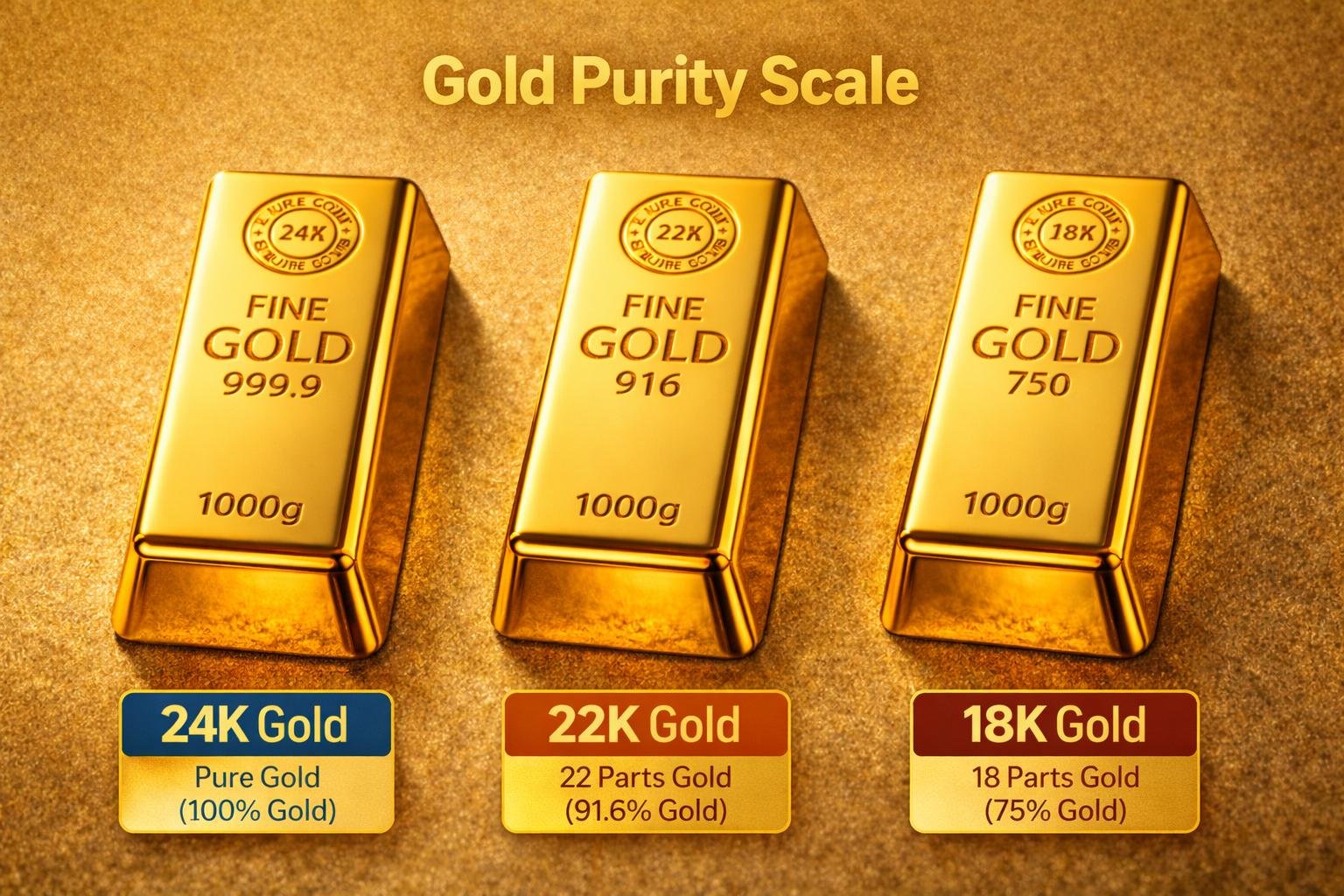
24K vs 22K vs 18K Gold Price, Purity and Value Explained
Gold is more than a precious metal. For many people, it represents financial security, cultural tradition, personal milestones and long-term value. Whether you are buying a gold coin for investment, choosing bridal jewellery or looking for a diamond ring, one important question often comes up: Should you buy 24K, 22K or 18K gold?
At first glance, the difference may seem simple. 24K gold is purer than 22K, and 22K is purer than 18K. However, purity is only one part of the decision. The amount of gold in an item also affects its price, while the other metals mixed into it influence its strength, colour, durability and suitability for everyday use.
For example, 24K gold is commonly preferred for investment coins and bars because of its high purity. 22K gold is popular for traditional Indian jewellery, including bridal ornaments, while 18K gold is widely used for diamond jewellery and modern designs that require a stronger metal structure.
Understanding these differences can help you avoid paying for the wrong type of gold. It can also help you compare jewellery prices, understand hallmark markings and make better decisions when buying or selling gold.
In this guide, we will explain 24K vs 22K vs 18K gold, including purity percentages, BIS hallmark codes, gold prices per gram, durability, investment value and resale considerations.
1. Understanding Gold Karat (K), Purity Percentage and Hallmark Codes
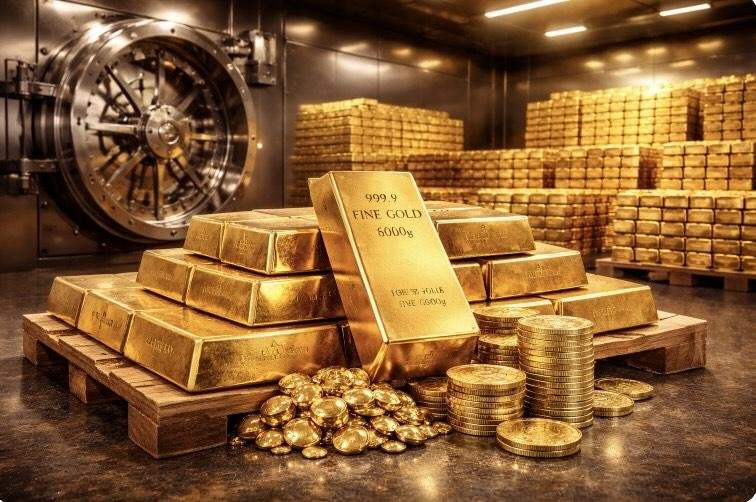
Before comparing prices, it is important to understand what gold karat actually means.
What does gold karat mean?
Gold karat, represented by the letter K, is a measurement of how much pure gold is present in a metal mixture.
Pure gold is represented by 24 parts. Therefore, 24K gold is considered nearly pure gold, while lower karat values indicate that the gold has been mixed with other metals.
The basic formula is:
Gold Purity Percentage = (Karat Value ÷ 24) × 100
For example:
-
24K gold = 24 ÷ 24 × 100 = 100% nominal purity
-
22K gold = 22 ÷ 24 × 100 = 91.67% gold
-
18K gold = 18 ÷ 24 × 100 = 75% gold
In actual commercial products, purity is expressed using fineness or parts per thousand. This is why 24K gold is commonly sold with a 999 or 995 fineness marking rather than a literal 1000 in every product.
It is also worth understanding the difference between karat and carat. Karat measures gold purity, whereas carat is a unit of weight used for gemstones such as diamonds.
24K vs 22K vs 18K gold purity comparison
The most important difference between these three gold types is the percentage of pure gold they contain.
| Gold Type | Gold Purity | Other Metals | Common Fineness |
|---|---|---|---|
| 24K | Approximately 99.9% or higher, depending on grade | Very small impurities or other permitted constituents | 999 |
| 22K | 91.67% | 8.33% | 916 |
| 18K | 75% | 25% | 750 |
These percentages explain why the price of 24K gold is generally higher per gram than 22K or 18K gold, assuming the same gold market price and comparable product conditions.
<em>Note:</em> Karat is a traditional purity scale. Commercial gold may be described using specific fineness grades, so always check the actual hallmark or product specification rather than assuming every item marked 24K has exactly the same composition.
What are gold fineness and BIS hallmark codes?
If you have purchased gold jewellery in India, you may have noticed small numbers stamped on the product. These numbers indicate the gold’s fineness.
Gold fineness represents the number of parts of pure gold in every 1,000 parts of the metal.
For example:
-
999 fineness means 999 parts of pure gold per 1,000 parts.
-
916 fineness means 916 parts of pure gold per 1,000 parts.
-
750 fineness means 750 parts of pure gold per 1,000 parts.
In India, the Bureau of Indian Standards (BIS) operates the hallmarking system for precious metal articles. BIS hallmarking helps consumers identify the declared purity of hallmarked gold.
Here are the commonly recognised fineness codes:
999 – 24K gold: This indicates 99.9% gold content. It is commonly associated with high-purity gold coins, bars and bullion.
916 – 22K gold: This indicates 91.6% gold content. It is widely used for traditional gold jewellery.
750 – 18K gold: This indicates 75% gold content. It is commonly used for diamond jewellery, gemstone settings and contemporary designs.
When buying hallmarked gold jewellery in India, look for the applicable BIS hallmark details and the six-character alphanumeric Hallmark Unique Identification (HUID) code. You can use the official BIS Care app to verify HUID details.
A hallmark is an important purity assurance, but it does not automatically mean that the jewellery has no additional charges or that a particular retailer will offer a specific resale price.
Why is 24K gold not always the best choice for jewellery?
Many buyers assume that higher purity automatically means better jewellery. That is not necessarily true.
Pure gold is naturally soft compared with many jewellery alloys. A delicate ring made from high-purity gold may be more vulnerable to bending, deformation and surface damage than a similar design made from a lower-karat alloy.
This is why jewellers mix gold with other metals to create stronger materials.
For investment products such as coins and bars, high purity is often desirable. For jewellery that must hold its shape and support gemstones, durability and construction are equally important.
The best gold purity depends on how you intend to use the product.
2. Gold Alloy Metals, Durability and Everyday Jewellery Use
Gold is naturally attractive, but its softness can create practical challenges when it is used in jewellery. To improve its physical properties, manufacturers combine it with other metals.
These combinations are called gold alloys.
What metals are mixed with gold?
The composition of an alloy affects the final product’s hardness, colour, strength and resistance to wear.
Some commonly used alloy metals include:
Copper: Copper is used to increase hardness and can give gold a warmer or reddish appearance. It is commonly found in rose gold and certain yellow-gold alloys.
Silver: Silver can improve the workability and influence the colour of gold. It is often used in yellow-gold alloys.
Zinc: Zinc may be added to improve the characteristics of certain gold alloys, including their suitability for manufacturing and casting.
Palladium: Palladium is a precious metal used in some white-gold alloys. It can help create a lighter-coloured appearance and is often used in higher-quality white-gold jewellery.
The exact combination varies between manufacturers and jewellery designs. Two pieces of 18K gold jewellery can have the same gold purity but different alloy compositions.
That means the karat value alone does not tell you everything about the product’s colour, hardness or performance.
Gold durability, hardness and scratch resistance
One of the biggest practical differences between 24K, 22K and 18K gold is how well each type handles everyday wear.
24K gold durability
24K gold contains almost entirely pure gold. It is relatively soft and can be more susceptible to scratches, dents and deformation.
This makes it less suitable for delicate jewellery that experiences frequent physical contact.
For example, a person wearing a gold ring every day while working with their hands may find that a high-purity gold ring develops visible marks or loses its original shape more easily.
However, 24K gold is an excellent choice for investment coins and bars because these products are not designed for constant physical wear.
22K gold durability
22K gold contains approximately 91.67% gold and 8.33% alloy metals.
The additional metals make it harder than 24K gold, although it is still relatively soft compared with lower-karat jewellery alloys.
It is widely used for traditional Indian jewellery, including necklaces, bangles, chains and bridal ornaments.
For many buyers, 22K offers a practical balance between high gold content and the strength required for jewellery.
18K gold durability
18K gold contains 75% pure gold and 25% other metals.
The higher proportion of alloy metals generally makes it more suitable for jewellery designs that need additional structural strength.
It is frequently used for diamond rings, gemstone settings, engagement rings and modern everyday jewellery.
However, an 18K item is not automatically scratch-proof or damage-proof. Its performance depends on the alloy composition, manufacturing quality, design and how the jewellery is used.
Which gold is best for everyday wear?
The answer depends on the jewellery item and your lifestyle.
| Jewellery Type | Commonly Suitable Gold | Reason |
|---|---|---|
| Investment coins | 24K | High gold purity |
| Gold bars | 24K | High-purity bullion |
| Traditional necklaces | 22K | High gold content and traditional preference |
| Bridal bangles | 22K | Popular for traditional designs |
| Diamond rings | 18K | Suitable for many gemstone settings |
| Engagement rings | 18K | Good balance of purity and structural strength |
| Daily-wear rings | 18K or suitable 22K alloy | Depends on design and usage |
| Lightweight fashion jewellery | 18K | Offers design flexibility |
Remember that jewellery durability is not determined by karat alone. Thickness, construction, setting style and craftsmanship also matter.
For example, a thin 18K ring with a delicate setting may still be damaged if handled roughly. Similarly, a well-made 22K necklace can last for generations when maintained properly.
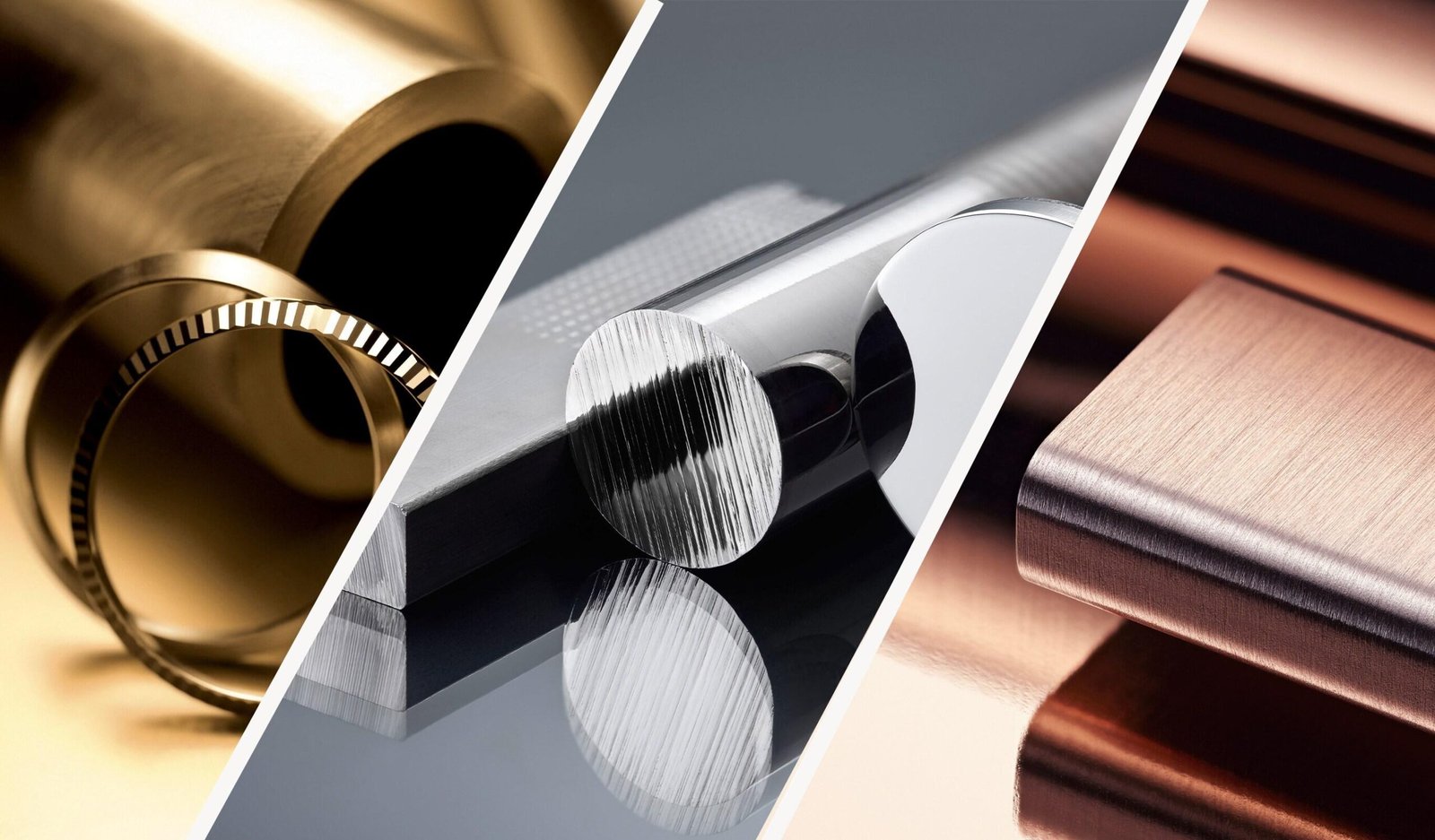
Why do diamond jewellery brands often use 18K gold?
Diamonds and other gemstones need secure settings. The metal surrounding the stone must hold its position while maintaining the intended design.
18K gold is often selected because its alloy composition can provide a useful balance of gold content and strength.
It also allows manufacturers to create different colours, including:
-
Yellow gold
-
White gold
-
Rose gold
For example, a diamond engagement ring may use 18K white gold to create a clean, modern appearance. A rose-gold diamond ring may use an 18K alloy containing copper.
However, 18K is not the only option for gemstone jewellery. The appropriate metal depends on the design, stone, setting and manufacturer’s specifications.
3. Gold Price per Gram: 24K vs 22K vs 18K
Price is one of the biggest factors when choosing between different gold purities.
Generally, 24K gold costs more per gram than 22K gold, while 18K gold has a lower intrinsic gold value per gram.
This happens because each gram of 24K gold contains more actual gold than a gram of 22K or 18K gold.
However, the final retail price of jewellery also includes making charges, applicable taxes, gemstone costs and other expenses.
How is gold price calculated by karat?
The simplest way to estimate the metal value of different gold purities is to start with the price of 24K gold.
The basic formula is:
Gold Price per Gram by Karat = 24K Gold Price per Gram × (Karat ÷ 24)
For example, assume the hypothetical market price of 24K gold is ₹8,000 per gram.
The estimated prices would be:
24K gold:
₹8,000 × 24 ÷ 24 = ₹8,000 per gram
22K gold:
₹8,000 × 22 ÷ 24 = ₹7,333.33 per gram
18K gold:
₹8,000 × 18 ÷ 24 = ₹6,000 per gram
These figures represent simplified gold-content values, not actual live market quotations or guaranteed retail prices.
24K vs 22K vs 18K gold price comparison
Using the same hypothetical 24K reference price of ₹8,000 per gram:
| Gold Purity | Gold Content | Estimated Price per Gram |
|---|---|---|
| 24K | 99.9% reference assumption | ₹8,000 |
| 22K | 91.67% | ₹7,333.33 |
| 18K | 75% | ₹6,000 |
<em>Illustrative example only. Actual market prices change throughout the day and vary by location, seller, purity specification and applicable charges.</em>
This comparison helps explain why a 10-gram 22K jewellery item generally contains less pure gold value than a 10-gram 24K gold bar, even when both weigh exactly the same.
Example: How much gold value is present in a 10-gram item?
Suppose you are comparing three products, each weighing 10 grams.
10 grams of 24K gold:
Approximately 9.99 grams of pure gold if the product is 999 fineness.
10 grams of 22K gold:
Approximately 9.166 grams of pure gold.
10 grams of 18K gold:
Approximately 7.5 grams of pure gold.
The remaining weight consists mainly of alloy metals and other permitted constituents.
This is the key reason that a lower-karat product can weigh the same as a higher-karat product but have a lower intrinsic gold value.
Why is the final jewellery price higher than the gold rate?
When you buy jewellery, you are not paying only for the gold content.
The final bill may include several components:
-
Gold value: The value of the gold used in the jewellery, based on its purity and applicable gold rate.
-
Making charges: The cost of designing, shaping, cutting, finishing and manufacturing the jewellery.
-
Wastage or manufacturing loss: Some jewellers may include a charge for production-related material loss, depending on their pricing policy.
-
Gemstone cost: Diamonds and other gemstones may add substantially to the final price.
-
Applicable taxes: Taxes are charged according to the relevant rules and the invoice structure.
For example, imagine you purchase a 10-gram 22K gold necklace.
Assume the illustrative 22K gold rate is ₹7,333.33 per gram.
The estimated gold value is:
10 × ₹7,333.33 = ₹73,333.30
If the jeweller charges ₹8,000 in making charges, the subtotal becomes ₹81,333.30 before applicable taxes and any other charges.
This example demonstrates why two necklaces with the same weight and purity may have different retail prices.
One may have a simple machine-made design, while the other may involve detailed handcrafted work.
Does 18K gold always cost 25% less than 24K?
On a pure gold-content basis, 18K gold contains 75% gold, so its intrinsic gold value per gram is approximately 25% lower than a 24K reference rate.
However, the actual retail price difference may not be exactly 25%.
Making charges, brand premiums, gemstones, design complexity and other costs can change the final price.
For instance, an expensive designer 18K diamond ring may cost more than a simple 22K gold chain because the diamond and craftsmanship contribute significantly to its price.
Therefore, always separate the gold metal value from the total product price when comparing jewellery.
4. Best Uses of 24K, 22K and 18K Gold: Investment, Traditional Jewellery and Diamonds
Each gold purity has a different purpose. Choosing the right one becomes easier when you understand how it is commonly used.
24K gold investment: Coins, bars and bullion
24K gold is widely preferred for physical gold investment because of its high purity.
Gold coins, bars and bullion products are commonly available in high-purity grades such as 999 or 995, depending on the product and manufacturer.
Unlike jewellery, investment gold is generally purchased for its metal value rather than its design or decorative appeal.
Why do investors prefer 24K gold?
There are several reasons:
-
High gold content per gram.
-
Easier comparison with international bullion prices.
-
Suitable for storing physical gold.
-
Available in different weights, such as 1 gram, 5 grams, 10 grams and larger bars.
-
No traditional jewellery-making charges in the same sense as decorative ornaments, although premiums and other costs may apply.
Suppose you want to buy gold as a long-term store of value rather than wear it.
A 24K gold coin or bar may be more suitable than a 22K necklace because a jewellery purchase can include design and manufacturing costs that may not be fully recovered when selling.
However, investment gold still has costs.
You should compare the purchase premium, applicable taxes, seller credibility, purity certification, invoice details and buyback terms before making a purchase.
Are 24K gold coins better than jewellery for investment?
They can be more straightforward for people whose main objective is to own physical gold.
A coin or bar typically has a clearer relationship with the underlying gold market price. Jewellery, on the other hand, includes additional costs that may not contribute equally to its resale value.
For example, if you purchase a necklace with high making charges, the resale buyer may primarily assess its recoverable gold content rather than refunding the original design cost.
This does not mean jewellery has no value. It simply means that investment decisions should account for the difference between buying gold for its metal value and buying it for personal use.
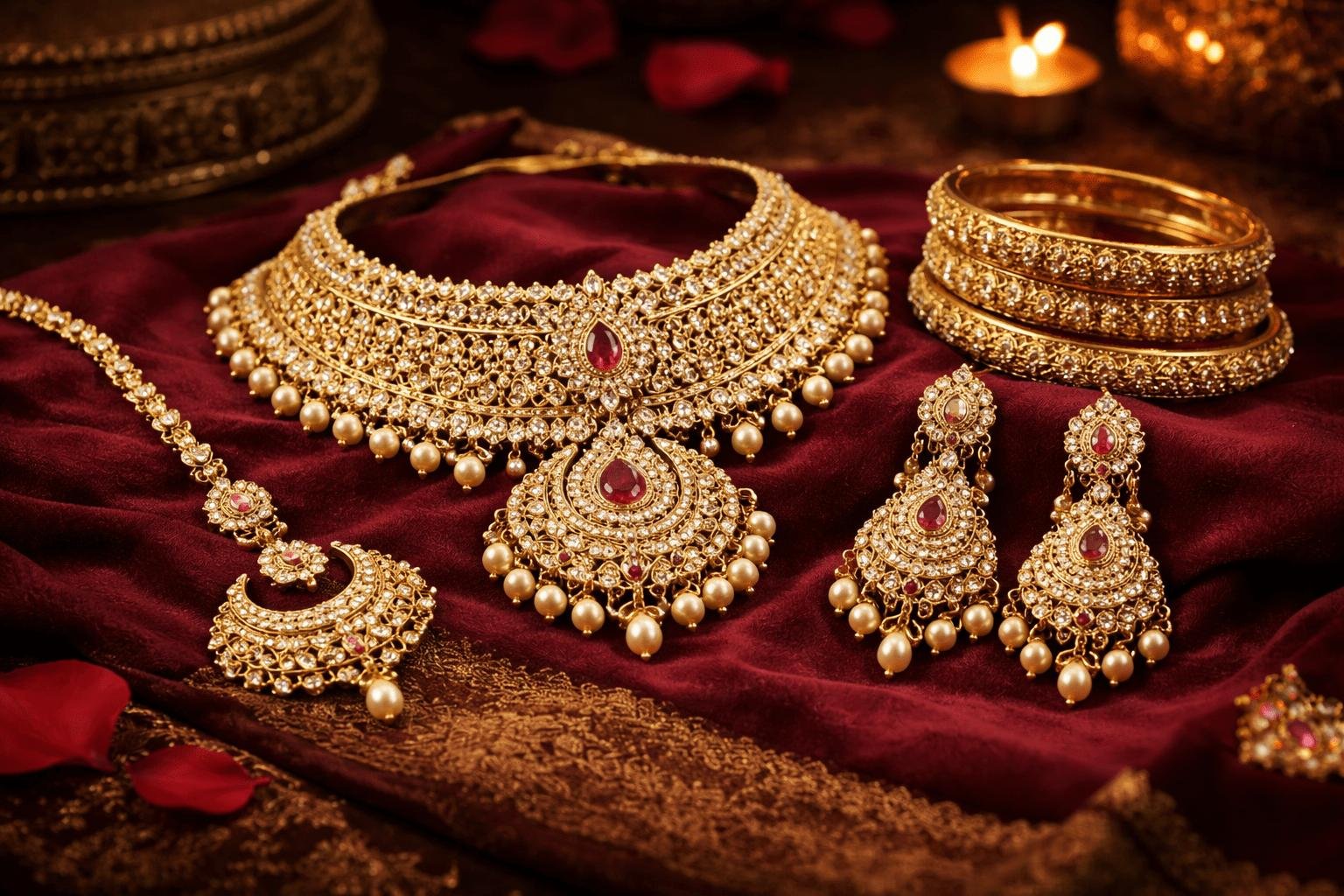
22K gold jewellery: Traditional and bridal ornaments
22K gold is especially popular in India because it combines relatively high gold purity with the alloy content needed for many traditional jewellery designs.
It is commonly used in:
-
Bridal necklaces
-
Gold bangles
-
Chains
-
Earrings
-
Traditional pendants
-
Wedding jewellery sets
-
Religious and ceremonial ornaments
Many Indian families purchase 22K jewellery for weddings, festivals and important family occasions.
The reason is not just its appearance. Buyers also value its high gold content and familiarity in the domestic jewellery market.
Why is 22K gold popular for bridal jewellery?
Traditional Indian bridal jewellery often includes elaborate necklaces, bangles, earrings and other ornaments.
22K gold offers a balance between purity and practical workability for many such designs.
It is also commonly recognised by consumers and jewellers, making purity comparison relatively straightforward when the item is properly hallmarked.
However, not every jewellery design is ideal for 22K gold.
Very delicate structures or certain gemstone settings may require a different alloy or construction approach.
If you are purchasing bridal jewellery, consider more than just the gold rate. Check the actual net gold weight, stone weight, making charges, hallmark details and written buyback conditions.
18K gold jewellery: Diamond and gemstone settings
18K gold is widely used for diamond jewellery and contemporary designs.
It contains 75% pure gold and 25% alloy metals, which can provide greater structural strength than higher-purity gold alloys, depending on the composition.
It is commonly used for:
-
Diamond engagement rings
-
Wedding bands
-
Gemstone rings
-
Diamond necklaces
-
Designer earrings
-
White-gold jewellery
-
Rose-gold jewellery
-
Contemporary everyday accessories
Why do jewellers use 18K gold for diamond settings?
A gemstone setting needs to hold the stone securely.
The additional alloy content in 18K gold can help manufacturers create settings with the required strength and design characteristics.
It also offers flexibility in colour and style.
For example, a white-gold diamond ring may be chosen by someone who prefers a modern, understated appearance. A rose-gold ring may appeal to someone looking for a warmer colour.
However, 18K gold is not automatically the best choice for every gemstone or design. The setting construction, alloy composition and quality of workmanship are important.
Which gold should you choose?
Your purchase objective should guide your decision.
| Your Purpose | Suggested Gold Type | Main Reason |
|---|---|---|
| Physical gold investment | 24K | High gold purity |
| Gold coins and bars | 24K | Common high-purity bullion grade |
| Traditional Indian jewellery | 22K | High gold content and popular usage |
| Bridal ornaments | 22K | Suitable for many traditional designs |
| Diamond engagement rings | 18K | Useful balance of purity and strength |
| Contemporary gemstone jewellery | 18K | Design and setting flexibility |
| Everyday jewellery | 18K or suitable 22K | Depends on design and lifestyle |
These are general guidelines, not strict rules. Always check the product’s actual specifications before purchasing.
5. Gold Resale Value, Making Charges and Buyback: What Buyers Should Know
Buying gold is only one part of the decision. If you plan to sell or exchange your jewellery in the future, you should understand how resale value is calculated.
Many buyers assume they will receive the same amount they originally paid when selling gold. In practice, this is rarely guaranteed.
The resale amount depends on several factors, including purity, weight, prevailing gold rates, the buyer’s assessment, deductions and the seller’s buyback policy.
How is gold resale value calculated?
The basic resale calculation starts with the recoverable gold content.
A simplified formula is:
Estimated Gold Value = Net Gold Weight × Applicable Gold Rate per Gram
For lower-karat gold, the applicable rate should reflect the actual purity.
For example, suppose you own a 10-gram 22K gold chain.
Assume the hypothetical current 22K gold rate is ₹7,500 per gram.
The estimated metal value is:
10 × ₹7,500 = ₹75,000
This is a simplified gross estimate. The final amount offered by a jeweller or gold buyer may be lower depending on testing results, deductions, fees and the buyer’s policies.
If the chain contains stones, the buyer may calculate the gold value using the net gold weight rather than the total weight of the jewellery.
Do gold making charges affect resale value?
Yes. Making charges can have a significant effect on the amount you recover when selling jewellery.
Making charges cover the labour, manufacturing and craftsmanship involved in producing an ornament.
Depending on the jeweller, they may be calculated as:
-
A fixed amount per gram.
-
A percentage of the gold value.
-
A fixed amount for the entire item.
These charges form part of the original purchase cost, but they are not necessarily recovered during resale.
For example:
Imagine you purchase a 22K necklace for ₹90,000.
The bill includes:
-
Gold value: ₹75,000
-
Making charges: ₹10,000
-
Other applicable charges: ₹5,000
Your total purchase price is ₹90,000.
If you later sell the necklace, the buyer may assess only the recoverable gold content using the prevailing rate, subject to applicable deductions and policies.
You should not assume that the original ₹10,000 making charge will be refunded.
This is why buyers who are primarily interested in investment value should compare coins and bars with jewellery before making a purchase.
What is a gold buyback policy?
A gold buyback policy explains the conditions under which a jeweller agrees to purchase or exchange previously sold gold.
Different retailers have different policies.
Some may offer buyback for jewellery purchased from their own stores, while others may accept gold from different sellers after purity testing.
Before purchasing, ask the retailer:
-
Do you offer cash buyback or only exchange?
-
Is buyback available for jewellery purchased from another store?
-
How is the gold purity tested?
-
Are there any deductions during resale?
-
Are making charges refundable?
-
How are stones and other non-gold components treated?
-
Is the buyback rate linked to the current market gold price?
Get the terms in writing wherever possible.
A product with a slightly higher purchase price may not be the best deal if its resale conditions are restrictive.
Does 24K gold have better resale value than 22K or 18K?
For the same weight, 24K gold generally has a higher intrinsic gold value because it contains more pure gold.
However, the resale value of a particular item also depends on its weight, actual purity, market price and buyer’s terms.
Consider three hypothetical 10-gram items:
-
10 grams of 24K gold contains approximately 9.99 grams of gold at 999 fineness.
-
10 grams of 22K gold contains approximately 9.16 grams of gold at 916 fineness.
-
10 grams of 18K gold contains approximately 7.5 grams of gold at 750 fineness.
The 24K item contains the most gold, but that does not mean every 24K product will automatically offer the best financial outcome.
Purchase premiums, taxes, storage costs, resale spreads and product-specific deductions matter.
Does hallmarking increase gold resale value?
Hallmarking does not automatically increase the market value of the gold itself. Its main purpose is to provide information about the declared purity and support consumer confidence.
A properly hallmarked item can make purity verification more straightforward, but a buyer may still conduct testing before offering a resale price.
Keep your purchase invoice, hallmark information, product details and any relevant certificates. These documents can help establish the product’s identity and purchase history.
Practical tips before buying gold
Whether you are purchasing a small gold coin or an expensive bridal set, follow these checks:
Check the purity: Confirm whether the product is 24K, 22K or 18K and verify the applicable fineness marking.
Verify the hallmark: For hallmarked gold jewellery in India, check the BIS hallmark details and HUID where applicable.
Compare the gold rate: Compare the quoted rate with a reliable market reference for the same purity, location and time.
Understand the weight: Ask for the net gold weight, especially when jewellery contains diamonds, gemstones, beads or other materials.
Review making charges: Ask whether the charges are fixed, percentage-based or calculated per gram.
Check taxes: Understand the applicable taxes and how they are shown on the invoice.
Read the buyback policy: Do not wait until you want to sell the jewellery to discover the retailer’s conditions.
Keep the invoice: Store the purchase invoice and supporting documents safely.
These simple steps can help you make a more informed purchase and reduce confusion when comparing different jewellers.
Conclusion: 24K vs 22K vs 18K Gold – Which One Offers the Best Value?
There is no single winner in the comparison of 24K, 22K and 18K gold. Each purity serves a different purpose.
24K gold is generally the preferred choice for high-purity investment products such as coins and bars. It contains the highest proportion of gold but is relatively soft for many everyday jewellery designs.
22K gold offers a balance of high gold content and practical use in traditional jewellery. It is especially popular for Indian bridal ornaments, necklaces and bangles.
18K gold contains 75% pure gold and a higher proportion of alloy metals. It is widely used for diamond jewellery, gemstone settings and contemporary designs where structural characteristics and design flexibility matter.
When comparing prices, remember that the gold rate per gram is only one part of the total cost. Making charges, gemstone costs, taxes, retailer premiums and buyback conditions can all influence the final value.
The smartest approach is to match the gold purity with your actual purpose.
If your priority is high-purity physical gold, consider 24K coins or bars. If you want traditional gold ornaments, 22K may be more suitable. If you prefer diamond jewellery or modern designs, 18K is worth considering.
Before making a purchase, verify the hallmark, compare the price per gram and understand the resale policy.
A good gold purchase is not simply about buying the highest karat. It is about choosing the right purity, paying a fair price and understanding the value you are getting.
Frequently Asked Questions: 24K vs 22K vs 18K Gold
1. What is the main difference between 24K, 22K and 18K gold?
The main difference is gold purity. 24K gold is approximately 99.9% pure, 22K gold contains 91.67% gold, and 18K gold contains 75% gold. The remaining percentage consists mainly of alloy metals.
2. Which gold is the purest: 24K, 22K or 18K?
24K gold is the purest of the three. It is commonly available in 999 fineness, meaning it contains 99.9% gold.
3. How much pure gold is present in 22K gold?
22K gold contains approximately 91.67% pure gold. The remaining 8.33% generally consists of other metals such as copper and silver.
4. What percentage of gold is present in 18K gold?
18K gold contains 75% pure gold and 25% alloy metals. Its common fineness marking is 750.
5. What does 916 mean in gold?
916 is a gold fineness marking indicating 916 parts of pure gold in every 1,000 parts of the alloy. It is commonly associated with 22K gold.
6. What does 750 mean in gold jewellery?
750 means the jewellery contains 75% pure gold. This marking is commonly used for 18K gold jewellery.
7. What does 999 mean in gold?
999 indicates 99.9% gold purity. It is commonly used to identify high-purity gold bars and coins.
8. Which gold is best for jewellery: 24K, 22K or 18K?
The best option depends on the design and purpose. 22K is popular for traditional jewellery, while 18K is commonly used for diamond jewellery and modern designs. 24K is generally preferred for investment products rather than everyday jewellery.
9. Why is 24K gold not commonly used for everyday jewellery?
24K gold is relatively soft and can be more vulnerable to scratches, dents and deformation. Lower-karat gold alloys are generally more suitable for jewellery that needs additional strength.
10. Why is 22K gold popular in India?
22K gold offers high gold content and is widely used for traditional Indian jewellery, including necklaces, bangles, earrings and bridal ornaments.
11. Is 18K gold suitable for everyday wear?
Yes. 18K gold is commonly used for everyday rings and other jewellery. However, durability depends on the alloy composition, design, thickness and quality of construction.
12. Which gold is better for diamond jewellery?
18K gold is commonly used for diamond jewellery because its alloy composition can provide a useful balance of gold purity and structural strength for gemstone settings.
13. Is 18K gold real gold?
Yes. 18K gold is real gold containing 75% pure gold. The remaining 25% consists of other metals added to influence its strength, colour and working properties.
14. Is 22K gold better than 18K gold?
22K gold has a higher gold content, but 18K gold generally offers greater design flexibility and is commonly used for gemstone settings. The better choice depends on whether purity or jewellery functionality is your priority.
15. Which gold is more expensive per gram?
For comparable products and market conditions, 24K gold generally has the highest gold-content value per gram, followed by 22K and 18K gold.
16. How do you calculate the price of 22K gold from 24K gold?
A simplified calculation is: 24K gold price per gram × 22 ÷ 24. This estimates the 22K gold-content value before retail premiums, making charges and applicable taxes.
17. How do you calculate the price of 18K gold from 24K gold?
Multiply the 24K gold price per gram by 18 and divide by 24. This gives a simplified estimate of the 18K gold-content value per gram.
18. Is 18K gold 25% cheaper than 24K gold?
Its intrinsic gold-content value is approximately 25% lower than an equivalent 24K reference price. However, actual retail prices can differ because of making charges, brand premiums, gemstones and taxes.
19. Which gold is best for investment?
24K gold coins and bars are commonly preferred for physical gold investment because they contain a high percentage of pure gold. Compare premiums, taxes, authenticity and resale conditions before purchasing.
20. Are 24K gold coins better than 22K gold jewellery for investment?
For buyers primarily interested in gold content, 24K coins may be easier to compare with bullion prices. Jewellery can include making charges and other costs that may not be recovered during resale.
21. What is the difference between 24K gold and 999 gold?
24K describes the karat category, while 999 describes fineness in parts per thousand. 999 gold contains 99.9% gold and is commonly classified as 24K.
22. What metals are mixed with gold to make 22K or 18K gold?
Common alloy metals include copper, silver and zinc. Palladium may also be used in certain alloys, particularly some white-gold compositions. The exact mixture varies by manufacturer.
23. Does lower-karat gold have better scratch resistance?
Lower-karat gold alloys are generally harder than pure gold, but scratch resistance depends on the specific alloy composition and product construction. No gold jewellery is completely scratch-proof.
24. Does 22K gold lose its value over time?
Gold’s market value changes with international prices, currency movements and local market conditions. The purity of a genuine 22K item does not normally change simply because time has passed, although its condition can affect resale.
25. Can 18K gold be resold?
Yes. 18K gold jewellery can be sold or exchanged, subject to the buyer’s purity assessment, prevailing gold rate and applicable deductions.
26. Are gold making charges refundable when selling jewellery?
Making charges are generally not guaranteed to be refundable. Many buyers calculate resale value primarily from the recoverable gold content, subject to their buyback policy.
27. Does BIS hallmarking guarantee gold purity?
BIS hallmarking provides an official purity-related assurance for hallmarked gold articles under the applicable Indian standards. Buyers should check the hallmark details and HUID where applicable.
28. How can I check whether my gold jewellery is genuine?
Check the hallmark and HUID details, retain the purchase invoice and use appropriate purity-verification services. In India, the BIS Care app can help consumers verify HUID details.
29. Which gold is better for bridal jewellery?
22K gold is a popular choice for traditional Indian bridal jewellery because of its high gold content. However, 18K gold may be more suitable for certain diamond or gemstone designs.
30. How should I choose between 24K, 22K and 18K gold?
Choose 24K for high-purity investment products, 22K for many traditional gold jewellery designs, and 18K for diamond jewellery and contemporary designs. Compare purity, price, hallmark details, making charges and resale conditions before buying.
Also Read: How Is the International Gold Spot Price Calculated
