
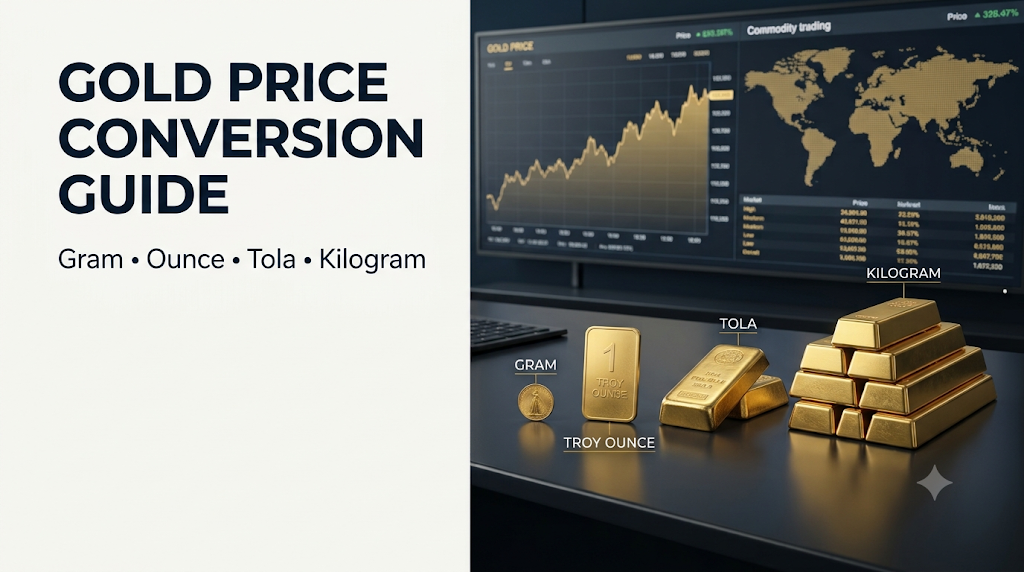
Gold Price per Gram, Ounce, Tola and Kilogram The Complete Guide
Gold is traded, purchased and valued across the world, but its price is not always displayed in the same measurement unit. In India, buyers commonly check the gold rate per gram or per 10 grams. In international bullion markets, gold is generally quoted in US dollars per troy ounce. In several South Asian and Middle Eastern markets, the traditional tola measurement is also widely recognised. Investors and bullion dealers may prefer to compare prices per kilogram when dealing with larger quantities.
This difference in measurement can create confusion, particularly when someone wants to compare an international gold price with a local jewellery rate. For example, if an international market report shows gold at a particular price per troy ounce, how can you calculate its value per gram, tola or kilogram? And how do you account for the difference between 24K, 22K and 18K gold?
The calculation becomes much easier once you understand the standard gold weight units, conversion formulas, purity percentages and market pricing methodology.
Whether you are purchasing a gold coin, comparing jewellery rates, tracking international bullion prices or calculating the value of your gold holdings, understanding these measurements can help you make better financial decisions.
In this complete guide, we will explain gold price per gram, troy ounce, tola and kilogram, how to convert between these units, how gold purity affects the price, and how international spot prices are translated into local currency rates.
1. Understanding Gold Measurement Units: Gram, Troy Ounce, Tola and Kilogram
Before calculating the value of gold, you need to understand how its weight is measured.
Gold is a physical commodity, so its price depends partly on how much metal is being purchased or sold. However, different countries and markets use different weight units.
The four most important measurements for understanding gold prices are:
-
Gram (g)
-
Troy ounce (ozt)
-
Tola
-
Kilogram (kg)
Although these units measure the same physical quantity, their values are different. A price quoted per gram cannot be directly compared with a price quoted per ounce or kilogram without conversion.
Gold price per gram
A gram is a metric unit of mass. It is one of the most commonly used measurements for gold jewellery and smaller gold purchases.
In India, jewellers frequently display gold rates per gram or per 10 grams. Buyers use these rates to estimate the metal value of necklaces, rings, bangles, earrings and other ornaments.
For example, suppose a jeweller displays a hypothetical 24K gold rate of ₹8,000 per gram.
The estimated gold value of different weights would be:
| Gold Weight | Calculation | Estimated Gold Value |
|---|---|---|
| 1 gram | 1 × ₹8,000 | ₹8,000 |
| 5 grams | 5 × ₹8,000 | ₹40,000 |
| 8 grams | 8 × ₹8,000 | ₹64,000 |
| 10 grams | 10 × ₹8,000 | ₹80,000 |
| 20 grams | 20 × ₹8,000 | ₹1,60,000 |
| 50 grams | 50 × ₹8,000 | ₹4,00,000 |
These figures are illustrative examples, not live gold rates or final jewellery prices.
The actual purchase price may also include making charges, applicable taxes, gemstone costs and other retailer-specific charges.
Why is gold priced per gram?
The gram is convenient for everyday transactions because jewellery and small gold products often weigh only a few grams.
It also makes it easier to compare different products. For example, if two gold chains have the same purity but different weights, their estimated gold content can be calculated using the same per-gram rate.
Gold price per troy ounce
The international gold market generally quotes gold prices in US dollars per troy ounce, commonly written as ozt.
A troy ounce is different from the ordinary ounce used for many everyday weight measurements.
1 troy ounce = 31.1034768 grams
This conversion is important because international gold prices are commonly reported per troy ounce, while local buyers may want to know the price per gram.
For example, suppose the hypothetical international gold spot price is $3,000 per troy ounce.
To calculate the price per gram:
Gold Price per Gram = Gold Price per Troy Ounce ÷ 31.1034768
Therefore:
$3,000 ÷ 31.1034768 = approximately $96.45 per gram.
This is the approximate international gold value per gram before currency conversion, local premiums, taxes and other charges.
Troy ounce vs ordinary ounce
A common mistake is confusing a troy ounce with an avoirdupois ounce, which is the ordinary ounce used in many everyday weight measurements.
| Measurement | Weight in Grams |
|---|---|
| 1 Troy Ounce | 31.1034768 g |
| 1 Ordinary Ounce | 28.349523125 g |
The troy ounce is heavier than the ordinary ounce.
This distinction matters because using the wrong conversion factor can produce an incorrect gold price calculation.
When reading an international gold market quotation, check whether the price is stated per troy ounce rather than assuming it refers to an ordinary ounce.
Gold price per tola
The tola is a traditional unit of weight used in parts of South Asia and some Middle Eastern gold markets.
It is particularly familiar to gold buyers in India, Pakistan, Bangladesh and neighbouring regions.
The commonly used modern conversion is:
1 Tola ≈ 11.6638 Grams
This means that one tola weighs approximately 11.66 grams.
For example, if the hypothetical gold price is ₹8,000 per gram, the estimated value of one tola would be:
₹8,000 × 11.6638 = ₹93,310.40
The value of five tolas would be:
₹93,310.40 × 5 = ₹4,66,552
Again, these figures are illustrative. The actual rate depends on the gold purity, market price and local buying conditions.
Why is tola still used?
Traditional weight units remain popular because of local buying habits and long-standing jewellery market practices.
In some markets, buyers may discuss gold prices per tola rather than per gram. This is especially relevant when comparing regional gold prices across different countries.
However, not every historical or regional definition of a tola has been identical. For modern price comparisons, use the standard conversion of approximately 11.6638 grams unless the seller specifies another measurement.
Gold price per kilogram
A kilogram is equal to 1,000 grams.
It is commonly used when discussing larger quantities of physical gold, wholesale bullion transactions and institutional holdings.
The conversion is straightforward:
1 Kilogram = 1,000 Grams
If the hypothetical 24K gold price is ₹8,000 per gram:
₹8,000 × 1,000 = ₹80,00,000
Therefore, the estimated gold value of one kilogram would be ₹80 lakh, before any applicable premiums, taxes or transaction costs.
Kilograms are especially useful for comparing large bullion quantities because they provide a standard metric measurement.
Gold weight conversion table
Here is a quick reference table for the most commonly used gold measurement units.
| Gold Measurement | Equivalent Weight |
|---|---|
| 1 gram | 1 gram |
| 10 grams | 10 grams |
| 1 tola | Approximately 11.6638 grams |
| 1 troy ounce | 31.1034768 grams |
| 100 grams | 100 grams |
| 1 kilogram | 1,000 grams |
| 1 kilogram | Approximately 85.735 tolas |
| 1 kilogram | Approximately 32.1507 troy ounces |
| 1 troy ounce | Approximately 2.6667 tolas |
These conversions provide a consistent foundation for comparing gold prices across markets.
2. How to Convert Gold Prices: Gram, Troy Ounce, Tola and Kilogram
Once you understand the measurement units, the next step is learning how to convert gold prices between them.
The basic principle is simple: first convert the weight into a common unit, then calculate the price using the appropriate rate.
For most comparisons, grams are a convenient starting point.
Troy ounce to gram conversion
The international gold market frequently displays prices per troy ounce. If you want to understand the value per gram, divide the quoted price by 31.1034768.
Formula:
Gold Price per Gram = Gold Price per Troy Ounce ÷ 31.1034768
Example:
Assume the international gold spot price is $3,000 per troy ounce.
$3,000 ÷ 31.1034768 = $96.45 per gram approximately.
The reverse calculation is equally useful.
Gold Price per Troy Ounce = Gold Price per Gram × 31.1034768
If gold is priced at $100 per gram:
$100 × 31.1034768 = $3,110.35 per troy ounce approximately.
Tola to gram conversion
The standard modern tola conversion is approximately 11.6638 grams.
To calculate the value of one tola using a per-gram gold rate:
Gold Price per Tola = Gold Price per Gram × 11.6638
Example:
Assume the gold rate is ₹8,000 per gram.
₹8,000 × 11.6638 = ₹93,310.40 per tola.
To calculate the price per gram from a tola quotation:
Gold Price per Gram = Gold Price per Tola ÷ 11.6638
For example, if gold is quoted at ₹95,000 per tola:
₹95,000 ÷ 11.6638 = approximately ₹8,145.46 per gram.
This conversion is useful when comparing a gold rate displayed in tolas with a rate displayed in grams.
Gram to kilogram conversion
Since one kilogram contains 1,000 grams, multiply the per-gram price by 1,000 to calculate the estimated value per kilogram.
Formula:
Gold Price per Kilogram = Gold Price per Gram × 1,000
Example:
If gold costs ₹8,000 per gram:
₹8,000 × 1,000 = ₹80,00,000 per kilogram.
To calculate the per-gram rate from a kilogram quotation:
Gold Price per Gram = Gold Price per Kilogram ÷ 1,000
For example:
₹82,00,000 ÷ 1,000 = ₹8,200 per gram.
Troy ounce to kilogram conversion
One kilogram contains approximately 32.1507 troy ounces.
Therefore:
1 Kilogram ≈ 32.1507 Troy Ounces
To convert a price per troy ounce into a price per kilogram:
Gold Price per Kilogram = Gold Price per Troy Ounce × 32.1507
Example:
If gold is trading at a hypothetical $3,000 per troy ounce:
$3,000 × 32.1507 = approximately $96,452.10 per kilogram.
This calculation is useful when comparing international bullion quotations with wholesale gold prices expressed in kilograms.
Gold price conversion formula reference
| Conversion | Formula |
|---|---|
| Troy ounce to gram | Troy ounce price ÷ 31.1034768 |
| Gram to troy ounce | Gram price × 31.1034768 |
| Tola to gram | Tola price ÷ 11.6638 |
| Gram to tola | Gram price × 11.6638 |
| Gram to kilogram | Gram price × 1,000 |
| Kilogram to gram | Kilogram price ÷ 1,000 |
| Troy ounce to kilogram | Ounce price × 32.1507 |
| Kilogram to troy ounce | Kilogram price ÷ 32.1507 |
Using a gold weight conversion calculator
A Gold Weight Conversion Calculator can simplify these calculations.
Instead of manually applying each formula, you enter the gold weight or price and select the units you want to convert.
A useful gold calculator should support:
-
Grams
-
Troy ounces
-
Tolas
-
Kilograms
-
Gold price per gram
-
Gold price per troy ounce
-
Gold price per tola
-
Gold price per kilogram
-
24K, 22K and 18K purity adjustments
-
Currency conversion
For example, imagine you find an international gold quotation of $3,000 per troy ounce and want to estimate the value of 5 tolas.
A calculator can first convert 5 tolas into grams:
5 × 11.6638 = 58.319 grams.
It can then convert the international price into a per-gram value:
$3,000 ÷ 31.1034768 = approximately $96.45 per gram.
Finally:
58.319 × $96.45 = approximately $5,625.
This is an illustrative calculation based on a hypothetical international price. It does not include currency conversion, local premiums, taxes or other transaction costs.
A calculator is particularly useful when comparing prices across countries or checking the approximate value of gold holdings.
3. Gold Spot Price, International Benchmark and Market Pricing Methodology
Gold prices are influenced by international trading activity, currency movements, investor demand and market conditions.
If you want to understand why the gold rate changes from one day to another, it is important to understand the gold spot price and how the international market determines its benchmark.
What is the international gold spot price?
The gold spot price is the market price associated with buying or selling gold for near-immediate delivery under the relevant market conventions.
International gold is commonly quoted as XAU/USD, meaning the price of one troy ounce of gold expressed in US dollars.
For example:
-
XAU represents gold in the international financial market.
-
USD represents the US dollar.
-
XAU/USD represents the US dollar price of gold per troy ounce.
When you see an international gold quotation, it is important to check its unit, currency and timestamp.
A price of $3,000 per troy ounce is not the same as $3,000 per gram.
The unit is an essential part of the quotation.
What is the international gold price benchmark?
The global gold market uses different pricing references for trading, valuation and reporting.
One widely recognised benchmark is the LBMA Gold Price, administered through an electronic auction process managed by ICE Benchmark Administration.
The benchmark is established in US dollars per troy ounce, with additional benchmark currencies and units available through the relevant market arrangements.
It is important to distinguish between a benchmark price and a continuously changing spot-market quotation.
A benchmark is established through a defined methodology at specified times, while spot-market prices can move throughout the trading day.
The World Gold Council also publishes information about gold market data and pricing methodology, helping market participants understand the sources and conventions behind reported gold prices.
Gold bid price and ask price
When looking at a live gold trading screen, you may see two different prices: the bid price and the ask price.
These prices represent different sides of a transaction.
Bid price: The price at which a buyer is willing to purchase gold.
Ask price: The price at which a seller is willing to sell gold.
The difference between the two is called the bid-ask spread.
For example, suppose a hypothetical trading platform displays:
-
Bid price: $2,998 per troy ounce
-
Ask price: $3,002 per troy ounce
The spread is:
$3,002 − $2,998 = $4 per troy ounce.
The spread can vary depending on market liquidity, trading conditions, product type and the provider.
A jewellery shop may also quote a retail rate that differs from the international spot-market price because its price includes local costs and commercial margins.
Therefore, do not assume that every gold price displayed online represents the exact price at which you can purchase physical gold.
How is the international gold price determined?
Gold prices are influenced by several market factors.
Supply and demand: Gold mining production, recycled gold supply, jewellery consumption, investment demand and central bank purchases all influence the broader market.
US dollar movements: Since international gold is commonly quoted in US dollars, changes in the dollar’s value can affect the price of gold in dollar terms and the cost of gold for buyers using other currencies.
Interest rates: Interest rates and expectations about monetary policy can influence investor demand for gold because gold does not generate interest income.
Inflation expectations: Investors may consider gold when assessing inflation risks and the purchasing power of currencies.
Geopolitical uncertainty: Economic uncertainty and geopolitical events can influence demand for assets perceived as stores of value.
Futures market activity: Gold futures traded on exchanges such as COMEX contribute to price discovery and market expectations. However, futures prices and spot prices are related but are not identical.
These factors interact with each other. A change in one variable does not guarantee a predictable movement in gold prices.
Why does the local gold price differ from the international spot price?
An international gold price is a useful reference, but the rate paid by a local buyer may be different.
Several factors can create this difference:
-
Currency exchange rates.
-
Import duties and applicable taxes.
-
Local market premiums or discounts.
-
Transportation and insurance expenses.
-
Refining and distribution costs.
-
Dealer margins.
-
Product purity and manufacturing costs.
For example, an international gold price converted into Indian rupees does not automatically equal the retail price of 24K or 22K gold in an Indian jewellery store.
The local market may include additional charges and adjustments.
This distinction is important when using international gold prices to estimate local buying costs.
4. Gold Price Calculation by Weight and Purity: 24K, 22K and 18K
Gold weight is only one part of a price calculation. Purity also matters.
A gram of 24K gold contains more pure gold than a gram of 22K or 18K gold.
This means that two gold items with identical weights can have different intrinsic gold values.
Understanding gold purity
Gold purity is commonly expressed in karats or fineness.
| Gold Type | Approximate Gold Purity | Common Fineness |
|---|---|---|
| 24K | 99.9% or higher, depending on grade | 999 |
| 22K | 91.67% | 916 |
| 18K | 75% | 750 |
The karat scale uses 24 parts as the reference for pure gold.
The basic purity formula is:
Gold Purity Percentage = (Karat ÷ 24) × 100
For example:
22 ÷ 24 × 100 = 91.67%.
18 ÷ 24 × 100 = 75%.
How to calculate gold price by purity
A simplified formula for estimating the gold-content value of lower-karat gold is:
Gold Price per Gram by Karat = 24K Gold Price per Gram × (Karat ÷ 24)
Suppose the hypothetical 24K gold price is ₹8,000 per gram.
The estimated prices would be:
24K gold:
₹8,000 × 24 ÷ 24 = ₹8,000 per gram.
22K gold:
₹8,000 × 22 ÷ 24 = approximately ₹7,333.33 per gram.
18K gold:
₹8,000 × 18 ÷ 24 = ₹6,000 per gram.
| Gold Purity | Gold Content | Illustrative Price per Gram |
|---|---|---|
| 24K | Approximately 99.9% | ₹8,000 |
| 22K | 91.67% | ₹7,333.33 |
| 18K | 75% | ₹6,000 |
These are simplified illustrative estimates. Actual commercial prices depend on the quoted fineness, market rate, seller’s pricing method and applicable costs.
Example: Calculating the value of 10 grams of 22K gold
Assume:
-
24K gold rate: ₹8,000 per gram.
-
Gold purity: 22K.
-
Jewellery weight: 10 grams.
First, calculate the estimated 22K rate:
₹8,000 × 22 ÷ 24 = ₹7,333.33 per gram.
Next, calculate the metal value:
₹7,333.33 × 10 = ₹73,333.30.
The estimated gold-content value is approximately ₹73,333.30.
This is not necessarily the final jewellery price. Making charges, applicable taxes and any additional product costs must be considered separately.
Gold price per 10 grams
In India, gold prices are frequently discussed per 10 grams.
To calculate this value, multiply the price per gram by 10.
Formula:
Gold Price per 10 Grams = Gold Price per Gram × 10.
For example, if the hypothetical 24K rate is ₹8,000 per gram:
₹8,000 × 10 = ₹80,000 per 10 grams.
If the estimated 22K rate is ₹7,333.33 per gram:
₹7,333.33 × 10 = approximately ₹73,333.30 per 10 grams.
This measurement is useful when comparing local gold rates, checking jewellery quotations and following Indian gold-market reports.
Gold price per kilogram
For larger quantities, the price per kilogram is often more convenient.
The calculation is:
Gold Price per Kilogram = Gold Price per Gram × 1,000.
Using the same hypothetical rates:
| Gold Purity | Estimated Price per Gram | Estimated Price per Kilogram |
|---|---|---|
| 24K | ₹8,000 | ₹80,00,000 |
| 22K | ₹7,333.33 | ₹73,33,330 |
| 18K | ₹6,000 | ₹60,00,000 |
These values are theoretical gold-content calculations, not wholesale or retail quotations.
How to calculate the value of existing gold jewellery
If you already own gold jewellery, you can estimate its metal value using its weight and purity.
A simplified calculation is:
Estimated Gold Value = Net Gold Weight × Applicable Gold Rate per Gram
For example, imagine you own an 8-gram 22K gold chain.
If the hypothetical 22K gold rate is ₹7,500 per gram:
8 × ₹7,500 = ₹60,000.
The estimated gross metal value is ₹60,000.
However, if the chain includes stones or other non-gold components, the total jewellery weight should not automatically be treated as gold weight.
A jeweller may need to assess the net gold weight and verify the purity before providing a resale quotation.
5. Gold Rate Conversion Between Local Currencies and Regional Weight Standards
International gold prices are usually quoted in US dollars, but consumers around the world purchase gold in their local currencies.
For example:
-
Indian buyers commonly compare gold prices in Indian rupees (INR).
-
Buyers in the United Arab Emirates use UAE dirhams (AED).
-
UK buyers use British pounds (GBP).
-
European buyers use euros (EUR).
-
US buyers generally use US dollars (USD).
To compare gold prices internationally, you need to account for both weight conversion and currency exchange rates.
How to convert international gold prices into local currency
Suppose the international gold spot price is quoted in USD per troy ounce.
To calculate its approximate value per gram in a local currency, use:
Local Gold Price per Gram = (International Gold Price per Troy Ounce × Local Currency Value of 1 USD) ÷ 31.1034768
For example, assume:
-
International gold spot price: $3,000 per troy ounce.
-
Hypothetical USD/INR exchange rate: ₹85.
First, convert the international price into Indian rupees per troy ounce:
$3,000 × ₹85 = ₹2,55,000.
Next, convert the price into grams:
₹2,55,000 ÷ 31.1034768 = approximately ₹8,197.96 per gram.
This is an illustrative converted spot value. It does not include local import duties, taxes, premiums, dealer margins or jewellery-making charges.
Example of gold price conversion across currencies
Assume the international spot price is $3,000 per troy ounce.
For illustration, use these hypothetical exchange rates:
| Currency | Assumed Exchange Rate |
|---|---|
| USD | 1.00 |
| INR | 85.00 |
| AED | 3.6725 |
| GBP | 0.75 |
| EUR | 0.92 |
The approximate converted price per gram would be:
| Currency | Approximate Gold Value per Gram |
|---|---|
| USD | $96.45 |
| INR | ₹8,197.96 |
| AED | AED 354.18 |
| GBP | £72.34 |
| EUR | €88.73 |
These exchange rates are illustrative, not live market quotations.
The table shows how the same international gold price can be expressed in different currencies. It does not mean that physical gold will cost exactly these amounts in every country.
Why do gold rates differ between countries?
Even after currency conversion, gold prices can differ across countries.
For example, an international gold price converted into Indian rupees may not match the retail gold rate displayed by an Indian jeweller.
Similarly, the price of gold in Dubai may differ from a converted international spot quotation.
This happens because each market has its own taxes, duties, distribution costs, premiums and retail pricing practices.
When comparing gold rates between countries, check the following:
-
Same weight unit.
-
Same gold purity.
-
Same currency conversion timestamp.
-
Same type of price, such as spot, wholesale or retail.
-
Applicable local taxes and duties.
-
Dealer premiums and other transaction charges.
A fair comparison requires more than simply converting one currency into another.
Traditional gold measurement units and regional weight standards
Gold has been traded using traditional weight systems for centuries.
Although the metric system is widely used today, regional units continue to appear in local gold markets.
Some common examples include:
Tola: Used in several South Asian markets. The modern standard commonly used for comparison is approximately 11.6638 grams.
Troy ounce: Used extensively in international precious metals trading. One troy ounce equals 31.1034768 grams.
Gram: Commonly used for jewellery, small gold purchases and retail quotations in many countries.
Kilogram: Used for large bullion quantities and wholesale transactions.
Baht: A traditional gold weight unit used in Thailand. Its value should be checked against the specific local gold-market convention because it is not interchangeable with the South Asian tola.
Tael: Used in some East Asian markets, including certain gold trading contexts. Its weight can vary by regional convention, so the applicable standard should always be confirmed.
This regional variation is why international gold-price comparisons should always specify the exact weight unit.
If a seller quotes a price per tola, ask which tola standard is being used. If a website displays a price per ounce, confirm that it refers to a troy ounce.
Common mistakes when calculating gold prices
Even simple conversion calculations can produce incorrect results if the wrong assumptions are used.
Here are some mistakes worth avoiding.
1. Confusing a troy ounce with an ordinary ounce
A troy ounce is 31.1034768 grams, while an ordinary ounce is approximately 28.3495 grams. Using the ordinary ounce conversion for gold trading produces an incorrect result.
2. Treating 22K gold as pure gold
22K gold contains approximately 91.67% gold, not 100%. Its estimated metal value should reflect its purity.
3. Ignoring currency exchange rates
A USD gold quotation cannot be compared directly with an INR quotation without converting the currency.
4. Comparing spot prices with retail jewellery prices
An international spot price generally excludes many of the costs included in a finished jewellery product.
5. Forgetting the difference between gross and net weight
Jewellery may include stones, beads, clasps or other materials. The total product weight may not equal the net gold weight.
6. Using an outdated gold rate
Gold prices and foreign exchange rates can change frequently. Always check the timestamp of the quotation before calculating a current value.
7. Assuming every tola has the same historical definition
Traditional units can vary by region and historical convention. Use the specified local standard rather than assuming all markets follow an identical definition.
How to compare gold prices accurately
A reliable comparison process can be completed in a few steps:
-
Find the gold price and identify whether it is a spot, wholesale or retail quotation.
-
Confirm the currency, such as USD, INR, AED, GBP or EUR.
-
Confirm the weight unit, such as gram, troy ounce, tola or kilogram.
-
Convert the price into a common weight unit.
-
Adjust the value for gold purity.
-
Apply the relevant currency exchange rate if necessary.
-
Consider local taxes, premiums and transaction costs.
Following these steps makes it easier to compare international bullion quotations with local market rates.
Conclusion: Understand Gold Weight and Price Before You Buy or Sell
Gold prices may be displayed per gram, troy ounce, tola or kilogram, but the underlying calculation follows the same principle: understand the weight, identify the purity and apply the correct market rate.
The most important conversions to remember are:
-
1 troy ounce = 31.1034768 grams
-
1 tola ≈ 11.6638 grams
-
1 kilogram = 1,000 grams
-
1 kilogram ≈ 32.1507 troy ounces
-
1 kilogram ≈ 85.735 tolas
When calculating gold value, remember that weight is only one factor. Gold purity, the international spot price, currency exchange rates, bid-ask spreads and local market costs can all influence the final amount.
A gold weight conversion calculator can make these calculations easier, especially when comparing prices across countries or converting international bullion quotations into local currency.
Whether you are purchasing a small gold coin, checking the value of a 10-gram jewellery item or evaluating a kilogram of bullion, always use the correct conversion factor and verify the latest available market price.
Before making your next gold purchase or sale, compare the price per gram, ounce, tola and kilogram using the same purity, currency and market reference. A clear understanding of gold measurements can help you make more informed decisions.
FAQ: Gold Price per Gram, Ounce, Tola and Kilogram
1. How is the price of gold per gram calculated?
The gold price per gram is calculated by dividing the international gold price per troy ounce by 31.1034768. If the price is quoted in a foreign currency, convert it into your local currency using the relevant exchange rate.
2. How many grams are in one troy ounce of gold?
One troy ounce of gold equals approximately 31.1034768 grams. It is the standard weight measurement used in international precious metals markets.
3. Is a troy ounce the same as a regular ounce?
No. A troy ounce equals approximately 31.1035 grams, while a regular avoirdupois ounce equals approximately 28.3495 grams. Gold prices generally use the troy ounce.
4. How many grams are in one tola of gold?
One standard tola is approximately 11.6638 grams. It is a traditional gold measurement commonly used in India, Pakistan and parts of South Asia.
5. How many tolas are there in one kilogram of gold?
One kilogram of gold contains approximately 85.735 tolas, using the standard conversion of 1 tola = 11.6638 grams.
6. How many troy ounces are in one kilogram of gold?
One kilogram contains approximately 32.1507 troy ounces.
7. How do I convert the gold price per ounce into the price per gram?
Divide the gold price per troy ounce by 31.1034768. For example, a hypothetical gold price of $3,000 per troy ounce equals approximately $96.45 per gram before currency conversion or local costs.
8. How do I calculate the gold price per 10 grams?
Multiply the gold price per gram by 10. For example, if the illustrative price is ₹8,000 per gram, the equivalent price per 10 grams is ₹80,000.
9. How do I calculate the gold price per kilogram?
Multiply the gold price per gram by 1,000. Alternatively, multiply the gold price per troy ounce by approximately 32.1507.
10. Why is gold internationally priced per troy ounce?
The troy ounce is a long-established standard in precious metals trading. Using a common unit allows traders, banks, refiners and investors to compare gold prices across international markets.
11. What is the international gold spot price?
The international gold spot price is the market price at which gold is quoted for immediate or near-immediate delivery under standard market conventions. It is commonly displayed as XAU/USD, meaning one troy ounce of gold priced in US dollars.
12. How is the international gold price converted into Indian rupees?
The international gold price is converted into Indian rupees using the USD-to-INR exchange rate. The result is then divided by 31.1034768 to calculate the approximate price per gram in rupees, before local duties, taxes and premiums.
13. Why is the gold price in India different from the international spot price?
Indian gold prices can differ because of currency movements, import duties, taxes, transportation, insurance, local market premiums and other costs. Jewellery prices may also include making charges and applicable taxes.
14. Is the gold price per gram the same for 24K, 22K and 18K gold?
No. Different gold purities contain different proportions of pure gold. 24K is approximately 99.9% pure, 22K is approximately 91.67% pure, and 18K is 75% pure. Their prices therefore differ.
15. How do I calculate the price of 22K gold from the 24K gold rate?
Multiply the 24K gold price per gram by 22/24, or approximately 0.9167. This gives an estimated metal value before additional costs and market adjustments.
16. How do I calculate the price of 18K gold from the 24K gold rate?
Multiply the 24K gold price per gram by 18/24, or 0.75. The result represents the approximate gold-content value before other charges.
17. What is a gold weight conversion calculator?
A gold weight conversion calculator converts gold measurements between grams, kilograms, troy ounces and tolas. It helps investors, jewellery buyers and traders compare weights and calculate equivalent gold values.
18. Which gold weight unit is commonly used in India?
Grams and kilograms are widely used in formal pricing and bullion transactions in India. Tola is also a familiar traditional measurement, particularly in jewellery and regional gold markets.
19. Which unit is used to quote gold prices internationally?
International gold prices are commonly quoted in US dollars per troy ounce. The standard symbol for gold is XAU, and XAU/USD represents the gold price in US dollars.
20. Does the gold price change when converting ounces into grams?
No. Converting ounces into grams changes only the measurement unit, not the underlying value of the gold. The equivalent price must be adjusted proportionally to the weight conversion.
21. Why do gold prices change throughout the day?
Gold prices respond to market supply and demand, US dollar movements, interest-rate expectations, inflation data, central bank activity, geopolitical developments and trading in global bullion and futures markets.
22. What is the difference between the gold spot price and the gold benchmark price?
The spot price reflects current market quotations, while a benchmark such as the LBMA Gold Price is a formally administered reference price determined through a specific auction process at scheduled times.
23. What are gold bid and ask prices?
The bid price is the price a buyer is willing to pay, while the ask price is the price at which a seller is willing to sell. The difference between them is called the bid-ask spread.
24. Can I use the international spot price to calculate jewellery prices?
You can use it to estimate the underlying gold value, but the final jewellery price may also include purity adjustments, making charges, gemstone costs, taxes and retailer margins.
25. Why do gold prices differ between countries?
Gold prices vary between countries because of exchange rates, import policies, customs duties, taxes, local demand, transportation costs, market premiums and retail pricing practices.
26. How do currency exchange rates affect gold prices?
When gold is quoted in US dollars, converting it into another currency requires the relevant exchange rate. If the local currency weakens against the dollar, the local-currency gold price may rise even when the dollar gold price remains unchanged.
27. How do I calculate the value of a 100-gram gold bar?
Multiply the applicable gold price per gram by 100, then adjust for the bar’s purity and any applicable premium, taxes or dealer charges.
28. Is the gold price per kilogram more accurate than the price per gram?
Neither unit is inherently more accurate. Both represent the same underlying market value when the weight conversion and purity are applied correctly. The best unit depends on the transaction size.
29. What is the most accurate way to compare gold prices?
Compare prices using the same currency, weight unit, purity and pricing basis. Check whether the quoted price is a spot price, benchmark price, wholesale rate or retail price, and account for taxes and additional charges.
30. Where can I check gold prices in different weight units?
You can use a reliable gold-price platform or weight conversion calculator that provides prices per gram, troy ounce, tola and kilogram. Check the timestamp, currency, purity and source of the quoted price before making a transaction.
Also Read: 24K vs 22K vs 18K Gold Price, Purity and Value Explained
