
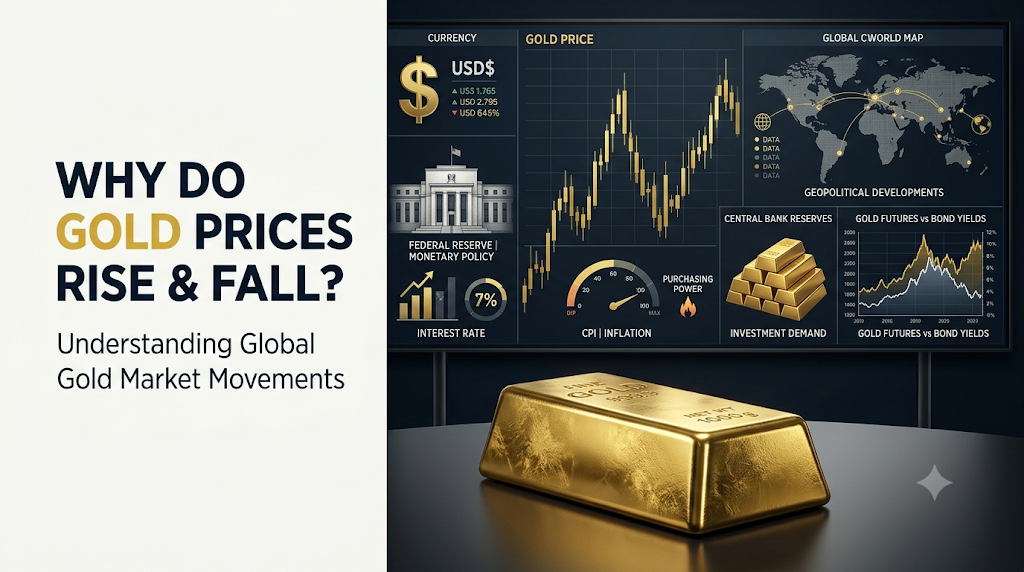
Why Do Gold Prices Rise and Fall in Global Markets ? 10 Key Factors Explained
Gold has held an important place in the global economy for thousands of years. People buy it as jewellery, investors use it to diversify their portfolios, and central banks keep it as part of their foreign exchange reserves. Yet, despite its long-standing reputation as a store of value, the price of gold does not remain constant.
One day, international gold prices may reach a new high. A few days later, the market may experience a sharp correction. These movements often leave investors and ordinary buyers asking the same questions: Why is gold becoming more expensive? What causes gold prices to fall? Does inflation always push gold higher? And why can gold prices increase even when the US dollar is strong?
The answer is that gold prices are influenced by several interconnected economic, financial and geopolitical factors. Unlike a product whose price depends mainly on manufacturing costs and consumer demand, gold has a dual role. It is both a physical commodity and a globally traded financial asset.
For example, a jewellery buyer may purchase gold for a wedding, while an institutional investor may buy gold to protect a portfolio during economic uncertainty. A central bank may increase its gold reserves to diversify its national assets. At the same time, traders in international markets may buy or sell gold futures based on expectations about interest rates and the US dollar.
All these participants influence the market.
The Gold Spot Price and International Gold Market Dynamics reflect the combined buying and selling activity of participants across major financial centres. Changes in the US dollar, real interest rates, inflation expectations, geopolitical uncertainty, central bank purchases, investment demand and physical gold supply can all influence the direction of prices.
Understanding these forces is useful whether you are purchasing jewellery, investing in gold coins, following international commodity markets or simply checking daily gold rates.
In this guide, we will examine the major reasons gold prices rise and fall, explain how these factors interact, and explore why no single indicator can predict every movement in the gold market.
1. Gold Spot Price, the US Dollar and Global Interest Rates
The first step towards understanding gold-price movements is to understand how international gold markets work. Gold is traded globally, and its price reflects activity across multiple financial markets rather than the buying and selling decisions of one country.
Gold Spot Price and International Gold Market Dynamics
The gold spot price is the market quotation for gold intended for immediate or near-immediate delivery under the relevant market conventions. It is commonly quoted in US dollars per troy ounce and represented by the trading symbol XAU/USD.
One troy ounce equals approximately 31.1035 grams. This is different from a regular ounce, which weighs approximately 28.3495 grams.
The international gold market operates through several connected trading channels, including:
-
Over-the-counter (OTC) bullion trading.
-
Gold futures contracts traded on exchanges.
-
Physical gold transactions between bullion dealers and financial institutions.
-
Gold-backed exchange-traded funds.
-
Jewellery and investment demand from consumers.
-
Central bank gold transactions.
These markets interact continuously. For example, changes in futures trading can influence market expectations, while physical demand from major gold-consuming countries can affect the balance between buyers and sellers.
The spot price is not necessarily the final amount a consumer pays for gold. A local retail price may include currency conversion, import duties, taxes, transportation, insurance, dealer margins and other costs.
This explains why the international gold price and the price displayed by a local jewellery retailer may differ.
Why does the spot price rise?
Gold prices generally rise when buying interest becomes stronger than available selling pressure. This can happen when investors seek safe-haven assets, central banks increase purchases, real interest rates decline or expectations of future inflation increase.
Why does the spot price fall?
Prices may decline when investors sell gold, the US dollar strengthens, real yields rise, investment demand weakens or market participants become more comfortable holding other financial assets.
The important point is that the spot price reflects the combined expectations and actions of global market participants.
US Dollar Strength (DXY) and Gold Price Correlation
The US dollar is one of the most closely watched influences on international gold prices.
Gold is commonly priced in US dollars. This creates an important relationship between the dollar’s value and the price of gold.
The US Dollar Index (DXY) measures the value of the US dollar against a basket of major international currencies. When the dollar strengthens, gold can become more expensive for buyers using other currencies. When the dollar weakens, gold may become relatively more affordable for those buyers.
Consider a simple example.
Suppose the international gold price remains unchanged at $3,000 per troy ounce. A buyer in India must convert this dollar price into Indian rupees. If the rupee weakens against the dollar, the rupee cost of purchasing the same amount of gold may increase.
This means the local gold price can rise even if the international dollar price has not changed.
The reverse can also happen. If the dollar weakens, international gold prices may receive support because gold becomes relatively cheaper for buyers using other currencies.
However, the relationship between the DXY and gold is not always perfectly negative.
For example, during a major geopolitical crisis, investors may purchase both US dollars and gold because they want to reduce exposure to riskier assets. In that situation, both can strengthen at the same time.
How dollar movements affect gold prices:
| US dollar movement | Possible effect on gold |
|---|---|
| Dollar strengthens | Can put downward pressure on dollar-priced gold |
| Dollar weakens | Can support higher gold prices |
| Dollar and gold both rise | May occur during periods of significant uncertainty |
| Dollar and gold both fall | May occur when investors move towards other assets |
The relationship should therefore be understood as an important market tendency rather than a guaranteed trading rule.
Real Interest Rates and Federal Reserve Monetary Policy
Interest rates are another major influence on gold prices, particularly when investors are deciding between gold and interest-bearing assets.
Gold does not pay interest or generate dividends. An investor holding physical gold does not receive regular income simply for owning it.
By comparison, a government bond or savings instrument may provide interest income.
This creates an opportunity cost. If investors can earn attractive returns from relatively safe interest-bearing assets, holding gold may become less appealing.
The most important measure in this relationship is often the real interest rate.
Real interest rates account for inflation. A simplified formula is:
Real Interest Rate ≈ Nominal Interest Rate − Inflation Rate
For example, suppose a government bond offers a nominal annual yield of 5%, while expected inflation is 3%. Its approximate real yield is 2%.
If the nominal yield remains at 5% but expected inflation increases to 4%, the approximate real yield falls to 1%.
In general:
-
Rising real interest rates can make interest-bearing investments more attractive relative to gold.
-
Falling real interest rates can reduce the opportunity cost of holding gold.
-
Negative real interest rates can make gold more attractive to investors concerned about the purchasing power of money.
This is one reason analysts monitor US Treasury inflation-protected securities, commonly known as TIPS, when studying gold-market conditions.
The Federal Reserve’s monetary policy also matters because its decisions influence borrowing costs, financial conditions and expectations about future interest rates.
When the Federal Reserve raises interest rates or signals that monetary policy will remain restrictive, bond yields may increase. This can create pressure on gold.
When the Federal Reserve cuts rates or signals a more accommodative approach, real yields may decline, potentially supporting gold prices.
However, markets do not wait for official decisions before responding. Gold traders often react to expectations about future policy.
For instance, if investors expect the Federal Reserve to reduce interest rates over the next several months, gold prices may respond before the first rate cut actually happens.
This is why central bank announcements, inflation reports, employment figures and Federal Reserve speeches can create sudden price movements in the gold market.
<em>Remember:</em> Higher interest rates do not automatically mean lower gold prices. If geopolitical uncertainty, central bank purchases or investment demand is particularly strong, these forces can offset the pressure from rising yields.
2. Inflation, Geopolitical Uncertainty and Gold’s Safe-Haven Appeal
Gold is widely recognised as a store of value, particularly during periods when investors are concerned about inflation, financial instability or political uncertainty.
However, gold does not respond to every economic or geopolitical event in the same way. The reason behind an event matters as much as the event itself.
Inflation Expectations and Gold as an Inflation Hedge
Inflation refers to a sustained increase in the general price level of goods and services. As inflation rises, the purchasing power of money declines.
For example, if the price of everyday products increases over several years, the same amount of money buys fewer goods and services than it did previously.
This is one reason investors consider gold an inflation hedge.
Gold has a limited natural supply, is traded internationally and has historically been viewed as a long-term store of value. Some investors therefore purchase it when they are worried that inflation may reduce the real value of cash and other financial assets.
But there is an important distinction between actual inflation and inflation expectations.
Actual inflation measures how much prices have already increased. Inflation expectations reflect how much investors, businesses and consumers believe prices may increase in the future.
Gold prices may respond to expected inflation before official inflation data confirms a change.
Consider this example.
Suppose energy prices rise sharply because of a disruption in global oil supply. Investors may begin to expect higher transportation, manufacturing and food costs. If they believe inflation will remain elevated, some may increase their allocation to gold.
This additional investment demand can support gold prices.
However, inflation does not always push gold higher.
If inflation increases and the Federal Reserve responds with aggressive interest-rate increases, real yields may rise. Higher real yields can make interest-bearing assets more attractive and reduce demand for gold.
This creates two competing effects:
-
Higher inflation expectations may increase demand for gold as a store of value.
-
Higher interest rates introduced to control inflation may increase the opportunity cost of holding gold.
The final direction depends on which force has the stronger influence.
Why gold is not a perfect inflation hedge
Gold can help investors diversify against some inflation-related risks, but its price can fluctuate significantly over short periods.
It may underperform during periods when interest rates rise sharply, the dollar strengthens or investors prefer other assets.
Therefore, gold should not be treated as a guaranteed protection against every increase in consumer prices.
Geopolitical Uncertainty and Safe-Haven Demand for Gold
Geopolitical events can have a major impact on investor confidence.
Wars, international conflicts, trade restrictions, sanctions, political instability and diplomatic tensions can create uncertainty about global economic conditions.
During such periods, investors may reduce their exposure to assets they consider risky and increase their demand for assets perceived as stores of value.
Gold often benefits from this behaviour because it is not the liability of a government or private company when held as physical bullion.
This characteristic contributes to its reputation as a safe-haven asset.
For example, imagine that an international conflict creates uncertainty about energy supplies and global trade. Investors may become concerned about the economic outlook, financial-market volatility and the possibility of further disruptions.
Some investors may respond by purchasing gold.
The resulting demand can push prices higher, particularly if buyers are willing to pay a premium for protection against uncertainty.
Geopolitical risk can also influence central banks. Countries may reconsider how they manage foreign exchange reserves when international financial relationships become less predictable.
Gold can become attractive because it is a reserve asset without the same issuer or counterparty structure as a government bond.
However, not every conflict causes gold prices to rise immediately.
Sometimes markets have already anticipated the event. In other cases, investors may initially purchase the US dollar, government bonds or other assets instead of gold.
Gold prices may also fall if the event reduces uncertainty more quickly than expected or if investors need to sell assets to raise cash.
Factors that can increase safe-haven demand include:
-
Military conflicts and international wars.
-
Financial-market instability.
-
Banking-sector concerns.
-
Trade disputes and economic sanctions.
-
Political uncertainty.
-
Concerns about sovereign debt and government finances.
-
Disruptions to global energy and commodity supplies.
The main lesson is that gold’s safe-haven demand depends on investor perceptions of risk, not simply on the number of negative headlines.
3. Global Gold Supply, Central Banks and Investment Demand
Gold prices are not determined only by financial markets. The physical gold market also plays an important role.
The amount of gold available, the willingness of investors to hold it and the purchasing decisions of central banks all influence the global balance between supply and demand.
Global Gold Supply and Demand Dynamics
Like other commodities, gold is influenced by supply and demand.
When demand increases faster than available supply, prices may receive upward pressure. When demand weakens or more gold becomes available for sale, prices may face downward pressure.
However, gold has some unique characteristics.
Unlike many industrial commodities, most of the gold ever mined still exists in some form. It may be held as jewellery, investment bars, coins, official reserves or recycled material.
This means the above-ground stock of gold is substantial compared with the amount of new gold produced each year.
The market is therefore influenced by both newly mined gold and the existing stock that owners are willing to sell.
The main sources of gold supply include:
-
Newly mined gold.
-
Recycled gold from jewellery and other products.
-
Gold released into the market by existing holders.
-
Official-sector sales, where central banks sell part of their reserves.
Gold demand comes from several different groups:
-
Jewellery manufacturers and consumers.
-
Investors purchasing physical bars and coins.
-
Financial institutions and investment funds.
-
Central banks and government institutions.
-
Technology and electronics manufacturers.
These demand categories do not always move in the same direction.
For example, jewellery demand may decline when gold becomes expensive, while investment demand increases because investors expect prices to rise further.
Similarly, central bank purchases may remain strong even when jewellery buyers reduce their purchases.
The World Gold Council describes this diversity as gold’s dual nature: it serves consumer, industrial and investment purposes, and the forces affecting each category can differ.
Central Bank Gold Reserves and Official-Sector Gold Purchases
Central banks are important participants in the international gold market.
A central bank manages a country’s monetary and financial reserves. These reserves may include foreign currencies, government securities, deposits and gold.
Gold is attractive to some central banks because it can diversify reserve holdings and provide an asset that is not directly dependent on the financial obligations of another government or institution.
When a central bank increases its gold holdings, the purchase can contribute to global demand.
If several central banks purchase significant amounts of gold over an extended period, their combined activity can become an important source of market support.
Why do central banks buy gold?
There are several possible reasons:
1. Reserve diversification
Central banks may hold gold to avoid relying too heavily on a single foreign currency or asset category.
2. Financial security
Physical gold held under appropriate arrangements does not carry the same issuer credit risk as a bond or deposit.
3. Geopolitical considerations
International tensions and changes in financial relationships can encourage countries to reconsider the composition and location of their reserves.
4. Long-term reserve management
Gold has been used as a monetary reserve asset for generations. Some central banks may view it as a long-term store of value.
5. Confidence in national reserves
Holding gold can help diversify a country’s reserve portfolio and support confidence in its long-term financial position.
It is important to understand that central bank purchases are not necessarily short-term trading decisions. Official-sector transactions may reflect long-term reserve-management strategies.
This is why analysts monitor central bank gold reserves and official-sector purchases when assessing the broader gold market.
However, central banks can also sell gold. Official-sector activity is not always one-directional, and the effect of any transaction depends on its size, timing and market conditions.
Gold Investment Demand and Gold-Backed Exchange-Traded Funds (Gold ETFs)
Investment demand is another major driver of gold prices.
Investors can gain exposure to gold through several methods:
-
Physical gold bars.
-
Gold coins.
-
Gold-backed exchange-traded funds.
-
Gold mutual funds or other financial products.
-
Gold futures and options.
-
Shares of gold mining companies.
Among these options, gold-backed exchange-traded funds (Gold ETFs) have made gold investment more accessible to many investors.
A gold-backed ETF is designed to provide exposure to gold prices through a fund structure. Depending on the product, the fund may hold physical gold or use another structure to track the metal’s price.
Investors can buy and sell ETF units through a stock exchange, subject to the product’s rules and trading hours.
This can be more convenient than purchasing, storing and insuring physical bullion.
How do Gold ETFs influence gold prices?
When investors increase their demand for a physically backed gold ETF, the fund may need to acquire additional gold or adjust its holdings according to its structure.
These transactions can contribute to demand in the underlying gold market.
When investors withdraw money and ETF holdings decline, gold may be released into the market or the fund may reduce its exposure, depending on its arrangements.
ETF flows therefore provide useful information about investor sentiment.
For example, during a period of economic uncertainty, investors may increase their exposure to gold ETFs because they want to diversify away from equities.
If this activity is widespread, it can provide additional support to gold prices.
On the other hand, when stock markets are performing strongly and investors become more comfortable taking risks, some may reduce their gold holdings.
Gold ETF flows are not a perfect prediction tool, but they help analysts understand how institutional and retail investment demand is changing.
Physical gold versus Gold ETFs
| Feature | Physical gold | Gold-backed ETF |
|---|---|---|
| Ownership | Direct ownership of the metal | Ownership of fund units |
| Storage | Requires secure storage | Managed through fund arrangements |
| Liquidity | Depends on dealer and market | Exchange-traded liquidity |
| Additional costs | May include premiums and storage | May include expense ratios and brokerage |
| Main exposure | Physical gold value | Fund’s gold-price exposure |
Investors should review the product structure, expenses, tracking differences and risks before choosing an investment method.
4. Gold Futures, Bond Yields and Financial Market Volatility
Gold prices are influenced not only by physical transactions but also by expectations about future market conditions.
This is where financial instruments such as futures contracts, government bonds and other investment assets become important.
Gold Futures, Bond Yields and Financial Market Volatility
A gold futures contract is an agreement to buy or sell a specified quantity of gold at a predetermined price for settlement or delivery at a future date, according to the contract’s terms.
Gold futures are traded on exchanges such as COMEX, which is part of CME Group.
These contracts allow market participants to manage price exposure, hedge transactions or speculate on future movements.
For example, a gold mining company may use futures contracts to reduce the risk of falling gold prices. An investor may use them to gain exposure to gold without purchasing physical bullion.
Futures markets can influence price expectations because they reflect the views and trading activity of a wide range of participants.
However, futures prices are not simply predictions of where spot prices will be in the future. They also reflect factors such as financing costs, storage, insurance, market conditions and the time remaining until contract expiry.
Why do gold futures prices change?
Gold futures may rise when traders expect stronger investment demand, lower real interest rates, a weaker dollar or greater geopolitical uncertainty.
They may fall when market participants expect higher interest rates, stronger dollar conditions or reduced demand for gold.
Futures prices can also move sharply when large traders adjust positions or when unexpected economic announcements change market expectations.
The Role of Bond Yields
Government bond yields are important because they provide an alternative investment return.
US Treasury yields are especially relevant to international gold markets because US government securities are widely used as reference assets in global finance.
When Treasury yields increase, some investors may prefer interest-bearing securities over gold.
When yields decline, the opportunity cost of holding gold may become lower.
Real yields are particularly important because they account for inflation.
For example, a nominal bond yield of 4% may look attractive when inflation expectations are 2%, but less attractive when expected inflation rises to 3.5%.
This difference changes the real return investors expect to earn.
Gold does not generate a contractual interest payment, so changes in real yields can influence how attractive it appears relative to bonds.
However, the relationship is not fixed. Gold may rise alongside bond yields when other forces, such as central bank purchases or geopolitical risk, are strong enough to offset the pressure from higher yields.
Financial Market Volatility and Investor Behaviour
Financial market volatility refers to the speed and size of price movements in financial assets.
When stock markets experience sudden declines, investors may become concerned about economic growth, corporate earnings and financial stability.
Some may respond by buying gold as a portfolio-diversification asset.
But the relationship between stock-market declines and gold prices is not always straightforward.
During a severe liquidity crisis, investors may sell gold along with other assets because they need cash to meet financial obligations or reduce leverage.
This means gold can temporarily fall even when market uncertainty is rising.
Consider two different situations:
Situation A: Investors seek protection
Stock markets decline because investors fear a recession. They move some money into gold, increasing demand and supporting its price.
Situation B: Investors need immediate cash
Financial markets experience extreme stress. Investors sell liquid assets, including gold, to cover losses or meet margin requirements. Gold prices may temporarily decline.
These examples show why financial market volatility can produce different outcomes depending on investor behaviour and the type of market stress.
Why Gold Prices Can Rise Despite Higher Interest Rates
A common assumption is that gold should fall whenever interest rates increase. In reality, several forces can influence the market at the same time.
Imagine that US real yields are rising, which would normally create pressure on gold.
At the same time:
-
Central banks are increasing their gold reserves.
-
Investors are concerned about geopolitical developments.
-
Gold ETFs are receiving strong inflows.
-
The US dollar is weakening.
-
Demand for physical gold remains strong.
These forces may offset the effect of higher real yields.
The gold market is therefore better understood as a system of competing influences rather than a simple relationship between two variables.
5. Jewellery Demand, Gold Mining Production and Recycled Gold Supply
Financial investors and central banks are not the only participants in the gold market. Jewellery buyers, mining companies, refiners and recycling businesses also influence the physical supply-and-demand balance.
Jewellery Demand and Consumer Buying Behaviour
Jewellery is one of the most recognisable uses of gold.
Countries such as India and China have large consumer markets where gold jewellery is connected with weddings, festivals, cultural traditions and personal savings.
In India, for example, gold purchases often increase around major wedding seasons and festivals such as Dhanteras and Akshaya Tritiya.
When household income increases and consumer confidence is strong, jewellery demand may improve.
However, jewellery demand can become more sensitive to price when gold becomes expensive.
Imagine that a family plans to purchase 30 grams of gold jewellery for a wedding. If the gold rate increases significantly before the purchase, the family may decide to:
-
Buy a smaller quantity.
-
Choose a lighter design.
-
Postpone the purchase.
-
Select a lower-cost jewellery option.
-
Spend more carefully on making charges and additional features.
This can reduce the volume of gold jewellery sold even if the value of sales in currency terms remains high.
Therefore, a rise in gold prices does not necessarily mean that consumers are buying more physical gold.
The relationship between price and jewellery demand is influenced by income levels, cultural preferences, seasonal buying patterns and the availability of alternative products.
Gold Mining Production and Its Effect on Prices
Gold mining is a major source of newly supplied gold.
Mining companies explore deposits, develop mines, extract ore and process it to recover gold. The process can require substantial investment, specialised equipment, energy, labour and infrastructure.
Gold mining production does not usually respond immediately to short-term price changes.
Even if gold prices rise sharply, a mining company cannot instantly produce significantly more gold. Discovering a deposit, securing permits, arranging financing and developing a mine can take years.
This makes newly mined gold supply relatively slow to adjust.
Factors affecting gold mining production include:
-
Availability of economically viable gold deposits.
-
Mining and processing costs.
-
Energy and fuel prices.
-
Labour and equipment expenses.
-
Government regulations and environmental requirements.
-
Political stability in mining regions.
-
Infrastructure and transportation facilities.
-
Investment in exploration and new projects.
When gold prices increase, mining companies may find some previously uneconomic deposits more attractive.
Over time, higher prices can encourage additional exploration and investment.
However, production growth may remain limited because of operational challenges, declining ore grades, regulatory delays and the time needed to develop new mines.
This is one reason mining supply does not always respond quickly to changes in market prices.
Recycled Gold Supply
Recycled gold is another important source of physical supply.
It generally comes from old jewellery, coins, bars, electronic components and other products that contain recoverable gold.
When prices rise, people may become more willing to sell unwanted jewellery or exchange old gold for cash or new products.
This can increase the amount of recycled gold entering the market.
For example, a household that purchased gold jewellery several years ago may decide to sell part of it when gold prices reach a level that makes selling attractive.
Similarly, jewellery retailers and refiners may collect old gold, process it and return the recovered metal to the supply chain.
Recycling can respond more quickly to price changes than mining production because existing gold can be brought back into the market without waiting for new mines to be developed.
However, recycled supply also has limitations.
Not every gold owner wants to sell, and the amount available depends on consumer behaviour, economic conditions, local recycling networks and the price offered by dealers.
How Mining and Recycling Work Together
The gold market receives physical supply from both newly mined gold and recycled material.
These sources behave differently:
| Factor | Gold mining | Recycled gold |
|---|---|---|
| Main source | Newly extracted gold | Existing gold products |
| Supply response | Generally slow | Can respond more quickly |
| Main influences | Deposits, costs, permits and investment | Gold prices and owners’ willingness to sell |
| Long-term role | Adds new gold to above-ground stocks | Returns existing gold to the market |
A rise in gold prices can encourage more recycling and mining investment, but the additional supply may not be enough to offset stronger demand immediately.
This is why the supply side should be considered alongside investment flows, central bank purchases and jewellery consumption when analysing global gold prices.
How Do All These Factors Work Together?
The most important lesson about gold prices is that no single factor controls the market at all times.
The gold price reflects several forces operating simultaneously. Sometimes these forces support each other. At other times, they move in opposite directions.
Consider three hypothetical market situations.
Scenario 1: Gold Prices Rise
Imagine the following conditions:
-
The US dollar weakens.
-
Inflation expectations increase.
-
Real interest rates decline.
-
Geopolitical uncertainty rises.
-
Gold ETFs experience investment inflows.
-
Central banks continue purchasing gold.
In this situation, several major factors are supporting demand at the same time.
Investors may see gold as an attractive store of value, while central banks and financial institutions add to their holdings.
The combined demand can push international gold prices higher.
Scenario 2: Gold Prices Fall
Now imagine a different market environment:
-
The US dollar strengthens.
-
Real interest rates increase.
-
Investors expect the Federal Reserve to maintain restrictive monetary policy.
-
Stock markets perform strongly.
-
Gold ETF investors reduce their holdings.
-
Geopolitical concerns become less intense.
These developments may reduce the attractiveness of gold relative to other investments.
If selling pressure becomes stronger than buying demand, gold prices may decline.
Scenario 3: Gold Prices Rise Despite a Strong Dollar
This situation is more complex.
Suppose the US dollar strengthens, which would normally create pressure on dollar-priced gold.
At the same time, major geopolitical developments increase uncertainty. Central banks continue accumulating gold, and investors increase their physical bullion purchases.
In this case, the safe-haven and official-sector demand may outweigh the negative effect of the stronger dollar.
Gold prices could rise even while the dollar remains strong.
These scenarios demonstrate why investors should examine multiple market indicators rather than relying on one headline or economic announcement.
Key Indicators to Monitor When Analysing Gold Prices
Anyone following the gold market can benefit from monitoring a small group of economic and market indicators.
| Indicator | What it tells you | Potential relevance to gold |
|---|---|---|
| XAU/USD spot price | Current international gold quotation | Shows global market direction |
| US Dollar Index (DXY) | Dollar strength against major currencies | A stronger dollar can pressure gold |
| US 10-year real yield | Inflation-adjusted bond return | Higher real yields can reduce gold’s appeal |
| Federal Reserve announcements | Monetary policy direction | Changes interest-rate expectations |
| Inflation data | Changes in consumer prices | Influences inflation expectations and policy |
| Gold ETF flows | Investor demand for fund-based gold exposure | Shows investment sentiment |
| Central bank purchases | Official-sector gold demand | Can support long-term demand |
| Gold futures positioning | Trading exposure and market expectations | Helps assess speculative activity |
| Mining production | Newly mined gold supply | Influences physical supply |
| Recycling activity | Existing gold returning to the market | Can increase available supply |
These indicators should be interpreted together. A single data point rarely provides a complete explanation of a gold-price movement.
Conclusion: What Really Makes Gold Prices Rise and Fall?
Gold prices rise and fall because the global market continuously reassesses the value of gold relative to currencies, bonds, other investments and physical commodities.
A weaker US dollar, lower real interest rates, rising inflation expectations and increased geopolitical uncertainty can support gold prices. Strong investment demand, Gold ETF inflows and central bank purchases may add further support.
On the other hand, a stronger dollar, rising real yields, reduced safe-haven demand and weaker investment interest can put downward pressure on prices.
The physical market matters too. Jewellery demand, gold mining production and recycled gold supply influence the amount of gold being bought and sold across the world.
The most important thing to remember is that these factors do not operate independently. Gold prices can rise even when one traditional indicator points towards a decline, because another force may be stronger.
For investors and buyers, understanding these relationships is more useful than trying to predict gold prices from a single news headline.
Before making a gold purchase or investment decision, monitor the international spot price, currency exchange rates, real interest rates, central bank activity and physical market demand. Compare prices using the same currency, weight and purity, and remember that local retail prices may include additional costs.
Gold can play a role in long-term wealth preservation and portfolio diversification, but its market price can be volatile. Research the risks, understand your investment objectives and avoid making decisions based only on short-term price movements.
Want to understand the gold market better? Explore our other guides on international gold spot prices, live gold rates worldwide, currency exchange rates and gold purity comparisons to build a clearer picture of how the global gold market works.
Frequently Asked Questions: Why Do Gold Prices Rise and Fall in Global Markets?
1. Why do gold prices rise and fall in global markets?
Gold prices fluctuate because of changes in the US dollar, real interest rates, inflation expectations, geopolitical uncertainty, central bank purchases, investment demand and physical gold supply and demand.
2. What are the main factors that influence international gold prices?
The major factors include the US Dollar Index (DXY), Federal Reserve monetary policy, real interest rates, inflation, geopolitical developments, central bank gold reserves, gold ETF flows, mining production and jewellery demand.
3. How does the US dollar affect gold prices?
Gold is generally quoted in US dollars. When the dollar strengthens, gold may become more expensive for international buyers using other currencies, potentially reducing demand. A weaker dollar can make gold relatively more affordable and support prices.
4. What is the relationship between the US Dollar Index and gold prices?
The US Dollar Index measures the dollar’s value against a basket of major currencies. Gold and the DXY often show an inverse relationship, although both can rise simultaneously during periods of significant market uncertainty.
5. Do interest rates affect gold prices?
Yes. Higher interest rates can make interest-bearing investments more attractive compared with gold, which does not pay interest. Lower rates may reduce the opportunity cost of holding gold and support demand.
6. Why do real interest rates matter for gold?
Real interest rates account for inflation and represent the inflation-adjusted return on an investment. Rising real yields can put pressure on gold, while declining real yields may make gold more attractive.
7. How does Federal Reserve monetary policy influence gold prices?
Federal Reserve decisions influence borrowing costs, bond yields, dollar movements and investor expectations. Interest-rate increases can pressure gold, while expectations of rate cuts may support it, depending on wider market conditions.
8. Does inflation always cause gold prices to increase?
No. Higher inflation expectations can increase gold’s appeal as a store of value. However, if central banks raise interest rates aggressively to control inflation, higher real yields may create downward pressure on gold.
9. Why is gold considered an inflation hedge?
Gold has historically been viewed as a store of value. Some investors hold it to diversify their portfolios and protect against concerns about declining purchasing power. However, gold does not guarantee protection against inflation over every period.
10. How does geopolitical uncertainty affect gold prices?
Wars, political instability, trade disputes and international tensions can increase demand for gold as a safe-haven asset. However, the actual price movement depends on investor expectations and wider financial-market conditions.
11. Why does gold rise during economic uncertainty?
During uncertain economic conditions, some investors move money into assets they consider stores of value. Gold may benefit from this additional demand, especially when concerns involve inflation, financial instability or geopolitical risk.
12. What is the gold spot price?
The gold spot price is the market quotation for gold intended for immediate or near-immediate delivery under relevant market conventions. It is commonly quoted in US dollars per troy ounce as XAU/USD.
13. What does XAU/USD mean in gold trading?
XAU/USD represents the price of one troy ounce of gold in US dollars. XAU is the international currency code used to represent one troy ounce of gold in financial markets.
14. Why do gold prices increase when the dollar weakens?
A weaker dollar can make dollar-priced gold more affordable for buyers using other currencies. This may increase international demand and support gold prices, although other market factors also influence the outcome.
15. Do central banks influence global gold prices?
Yes. Central banks hold gold as part of their official reserves. Large-scale purchases can contribute to global gold demand, while official-sector sales may increase available supply.
16. Why are central banks buying gold?
Central banks may buy gold to diversify foreign exchange reserves, reduce reliance on particular currencies, manage financial risks and hold an internationally recognised reserve asset.
17. What is central bank gold demand?
Central bank gold demand refers to gold purchases made by monetary authorities and government reserve managers. It is an important component of official-sector demand in the global gold market.
18. How do Gold ETFs affect gold prices?
Gold-backed exchange-traded funds provide investors with exposure to gold prices. Strong inflows into physically backed funds can increase demand for gold, while significant outflows may reduce fund holdings and create selling pressure.
19. What causes investment demand for gold to increase?
Investment demand may increase because of inflation concerns, falling real yields, geopolitical uncertainty, a weaker dollar, financial-market volatility or expectations of higher future gold prices.
20. What are gold futures, and how do they affect prices?
Gold futures are exchange-traded contracts that allow participants to buy or sell gold at a specified future date and price under the contract terms. Futures trading influences market liquidity, hedging activity and price expectations.
21. How do bond yields influence gold prices?
Rising bond yields can make interest-bearing investments more attractive compared with gold. Declining yields may reduce the opportunity cost of holding gold. Real yields are particularly important when analysing this relationship.
22. Can gold prices rise when interest rates increase?
Yes. Gold can rise despite higher interest rates if other forces, such as strong central bank purchases, geopolitical uncertainty, a weaker dollar or increased investment demand, outweigh the pressure from higher yields.
23. Does stock market volatility affect gold prices?
Stock market volatility can increase demand for gold as investors seek portfolio diversification. However, during severe liquidity crises, investors may sell gold to raise cash, causing temporary price declines.
24. How does global gold mining production affect prices?
Mining production contributes newly extracted gold to the market. Higher production can increase available supply, while disruptions, rising production costs or declining output may limit supply growth.
25. What is recycled gold supply?
Recycled gold is gold recovered from existing jewellery, coins, bullion and electronic products. It returns previously mined gold to the market and can respond more quickly to price changes than new mining production.
26. How does jewellery demand influence gold prices?
Jewellery demand contributes to physical gold consumption. Strong buying during weddings, festivals and other seasonal periods can support demand, while high prices may encourage consumers to purchase lighter jewellery or postpone purchases.
27. Why do gold prices rise during geopolitical crises?
Geopolitical crises can increase concerns about economic stability, international trade and financial markets. Investors may purchase gold to diversify their holdings and reduce exposure to perceived risks.
28. Why can gold prices fall even during a war?
Markets may have already anticipated the conflict, or investors may prefer other safe-haven assets. During severe liquidity pressure, investors may also sell gold to raise cash. Therefore, conflict does not guarantee rising gold prices.
29. How can investors analyse whether gold prices may rise or fall?
Investors can monitor the international spot price, DXY, US real yields, Federal Reserve announcements, inflation data, central bank purchases, Gold ETF flows, futures positioning and physical gold demand. No single indicator guarantees a particular outcome.
30. Is gold a good long-term investment during economic uncertainty?
Gold can provide portfolio diversification and exposure to a globally recognised store of value. However, it can experience substantial price fluctuations and does not generate regular interest or dividends. Investors should consider their objectives, time horizon and risk tolerance.
Also Read: How Is the International Gold Spot Price Calculated
